
Istanbul on Foot: Following Orhan Pamuk's Memories of the City

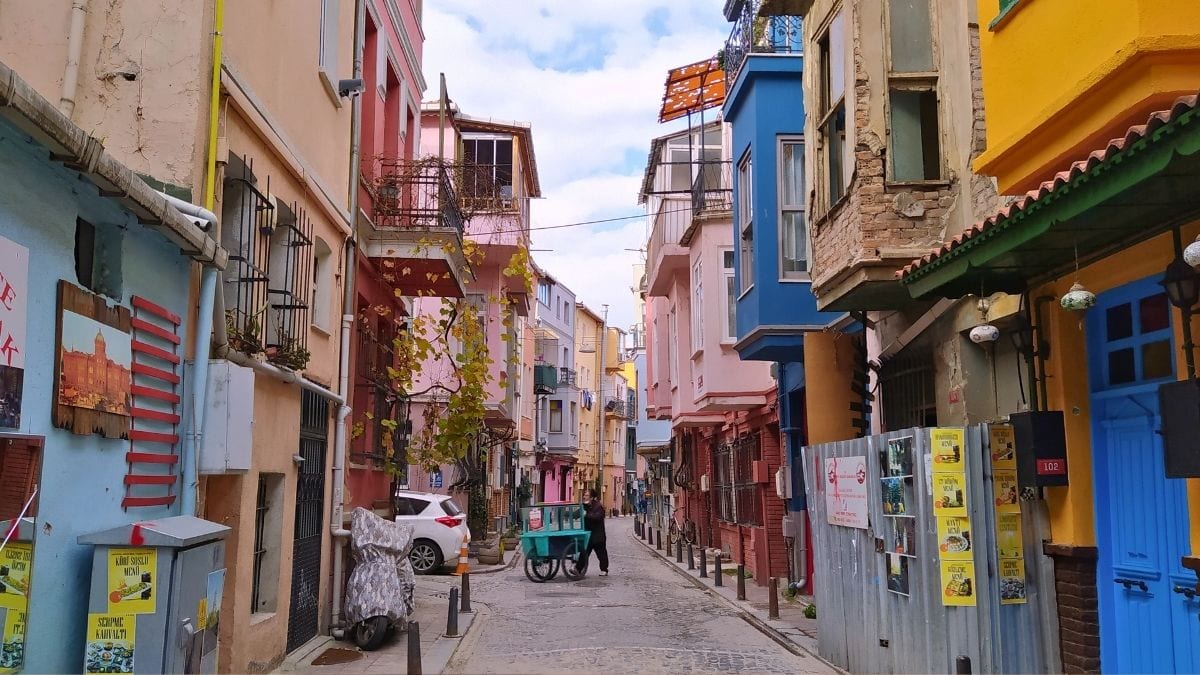
I’ve only read works of fiction and non-fiction about Istanbul. When it was safe enough to travel again during the pandemic, I finally got the chance to experience this city that had different names throughout its history: Byzantium, Constantinople, and Istanbul. My fascination with this ancient city in Turkey grew as I read books by Orhan Pamuk and other writers.
ALSO READ:
Into the Gobi Desert: An Expedition through a Land of Contrasts
A Journey Through Ancient Kingdoms, Vast Safaris, and Scenic Hikes in Sri Lanka
Vestiges of the Past, the Hagia Sophia
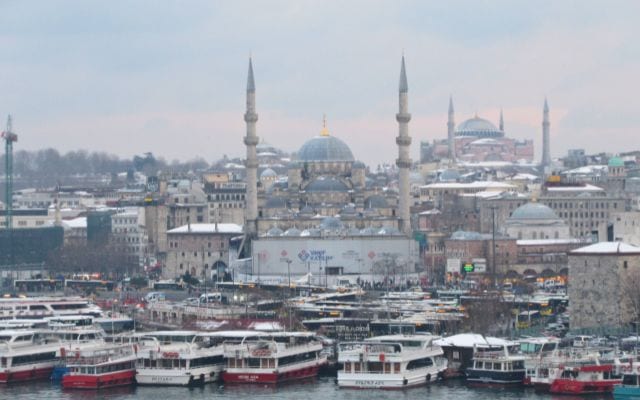
One of Istanbul’s most famous landmarks is the Hagia Sophia. Justinian I built as a Christian church. Then, the Ottomans came and turned it into a mosque. It was turned into a museum in the 20th century, and then a mosque once again in the 21st. I saw vestiges of this mix as I explored the Hagia Sophia. I could still see the faded Christian frescoes while Muslims came in to pray. This ancient building might be the perfect symbol of the city as it displayed the intersection of cultures and histories despite its Islamic façade. Aren’t we all an intersection of the cultures and histories that we’ve experienced? From our parents to friends to our lovers, during each stage of our life to the strangers we meet, to the places we’ve been to.
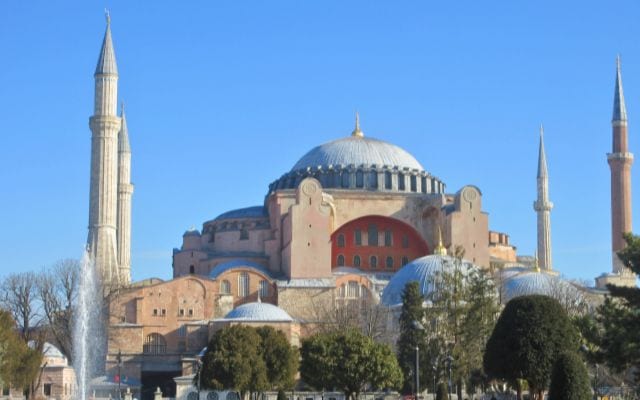
Inside the Hagia Sophia
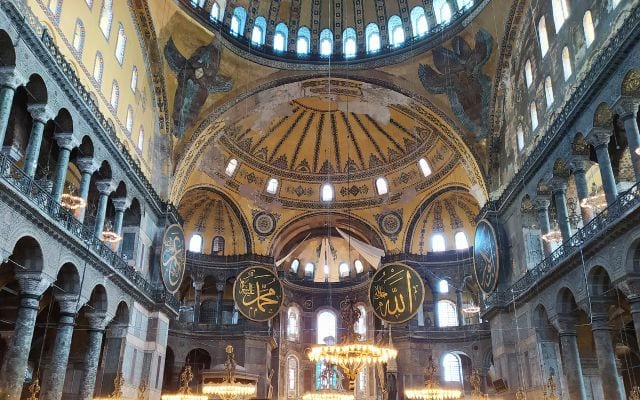
The Hagia Sophia isn’t the only prominent mosque dotting Istanbul’s skyline. Within walking distance is the Blue Mosque, which was constructed in the 17th century upon the orders of Sultan Ahmed I. Its blue Iznik tiles used in its interior and six minarets are its most distinguishable features. Sultan Süleyman the Magnificent commissioned Sinan, a renowned Ottoman architect, to design the Süleymaniye Mosque in the 16th century. His vision combined simplicity and elegance.
The Convergence of East and West
“Still, the melancholy of this dying culture was all around us. Great as the desire to westernize and modernize may have been, the more desperate wish was probably to be rid of all the bitter memories of the fallen empire, rather as a spurned lover throws away his lost beloved’s clothes, possessions, and photographs. But as nothing, western or local, came to fill the void, the great drive to westernize amounted mostly to the erasure of the past.” (from Orhan Pamuk’s Istanbul: Memories and the City)
Istanbul is in a unique location because it straddles the Asian and European continents. The Bosphorus Strait bisects the city—and Turkey—between Asia and Europe. The city’s most famous landmarks, such as the Blue Mosque, Hagia Sophia, the Topkapi Palace, and the Grand Bazaar, just to name a few, are on the European side.
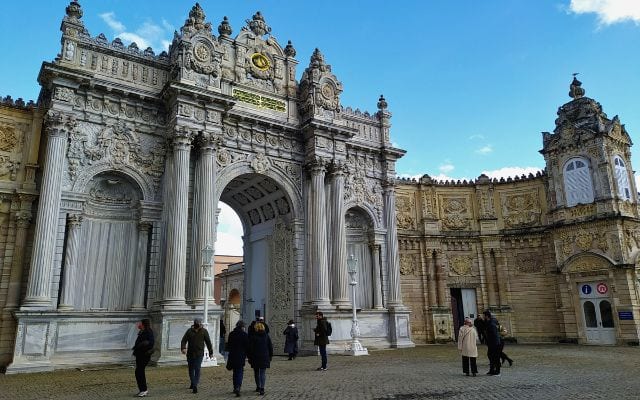
The Dolmabahçe Palace is a symbol of the city’s push for modernization. It is the first European-inspired palace that Sultan Abdülmecid I had built in the mid-19th century. Presidents and sultans called the massive and elaborate palace home. It has been a museum that displayed the opulence of the sultans’ families since 1984.
Gates of Dolmabahce Palace
Istanbul is a lively city with bustling markets selling all kinds of things: trinkets, lamps, carpets, jewelry, teacups, spices, shoes, and clothes. Despite its chaos, it is an ideal place for long walks. I would mimic some of the characters in Pamuk’s books and walk from Taksim to Beyoglu to Galata or from Sultanahmet to Fatih to Balat and the places between these famous districts. There would be roads too narrow for cars, but somehow, some vehicles would be able to pass through. Some roads would lead to dead ends. Some of the buildings and establishments would encroach the space for sidewalks, leaving pedestrians to walk on the street and be constantly mindful of vehicles passing by.
Balat Neighborhood
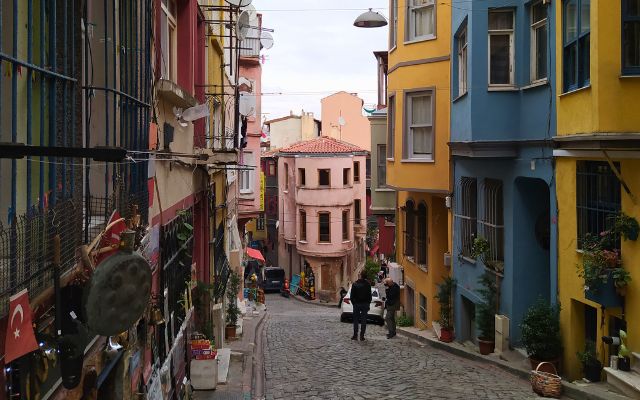
I would see furniture outside buildings: worn-out sofas, old chairs, lamps that were no longer working, tables, and black garbage bags filled with random things. There would be clotheslines connecting two houses or apartment buildings with shirts and pants hanging out to dry. I ended up in an area lined with decrepit houses—ironically, one of the best viewpoints of the city. I saw the minarets of Istanbul’s mosques, the houses and buildings clumped together, and the Bosphorus in the foreground. I once ate at a restaurant with no wall on the second floor. I initially thought there was at least glass covering it because I decided to sit with my back facing it. However, I heard the faint conversations of people and cars driving by, and I felt the cold winter breeze coming through the empty space. I switched places immediately to face the street. I would sometimes sit in the outdoor area of a café, eating a snack and having a drink, just to peoplewatch.
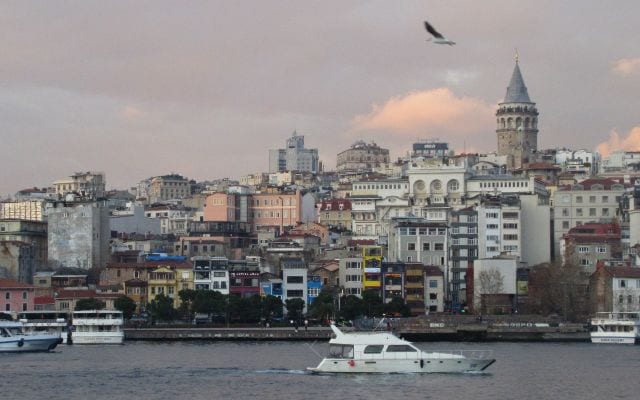
Galata Tower
Lost Selves
“If I am to convey the intensity of the hüzün that Istanbul caused me to feel as a child, I must describe the history of the city following the destruction of Ottoman Empire, and – even more important – the way this history is reflected in the city’s ‘beautiful’ landscape and its people. The hüzün of Istanbul is not just the mood evoked by its music and its poetry, it is a way of looking at life that implicates us all, not only in a spiritual state, but a state of mind that is ultimately as life affirming as it is negating." (From Orhan Pamuk’s Istanbul: Memories and the City)
In Pamuk’s works, the characters all experience this shared (or communal) melancholy. They are constantly reminded of their city’s (and country’s) glory days. I would see and feel this sense of loss. There would be random ruins from ancient times in different parts of the city. Locals would just go around it or build around it. The Hagia Sophia itself is a vestige of the city’s heyday.
For someone who isn’t Muslim or Turk, I would indulge myself and overextend the metaphor of the city. Istanbul’s chaos and clutter might lead one to think these are all distractions. But for me, it managed to focus my thoughts on years that will never return or might tease one that there are better days ahead because of how memorable the past was.
The vestiges of an empire that stretched to Europe loom over the city. I often wonder if the locals feel this way and apply it to their personal lives. They might not be kings and queens in a past life, managers in their current jobs, or entrepreneurs, but they rule over their own lives and memories. They might have a fond memory with a loved one while on a cruise on the Bosphorus, or they might remember the last conversation they had with a friend just outside the Galata Tower. I was simply passing through. What are a few days, weeks, or years in a country? If I knew I was going to leave.
