
The Philippines Has the Lowest ROI on Tourism in Southeast Asia, Says Report

Editor's note: The original report by Eric Jurado was disputed by the Department of Tourism on September 8 via a Facebook post.
A policy report titled "Which Southeast Asian Countries Truly Profit from Tourism" has a sobering message for the Philippines: our tourism industry is failing to turn a profit.
The report by investment and hedge fund manager Eric Jurado, published in The International Investor in June, introduces a metric called Return on Tourism Impact (RoTI). Unlike traditional metrics that just look at tourist numbers or revenue, RoTI measures a country's total tourism value—including revenue, GDP contribution, and employment—against the government and private investments made in the sector. A country with high RoTI doesn't always mean that it has high tourist arrivals, but rather one that converts tourism investment into sustainable, inclusive, and profitable returns.
However, the Department of Tourism, on September 8, said that this policy report by Jurado "relies on flawed methodology, questionable data, and misleading presentation that distort tourism’s true contribution to our economy and communities."
ALSO READ:
Surprise? Boracay is No Longer the Top Local Travel Destination for Foreign Tourists
Why Did the Philippines Miss Its 2024 Tourism Arrivals Target?
Estimated Return on Tourism Impact (RoTI) of Six Southeast Asian Countries
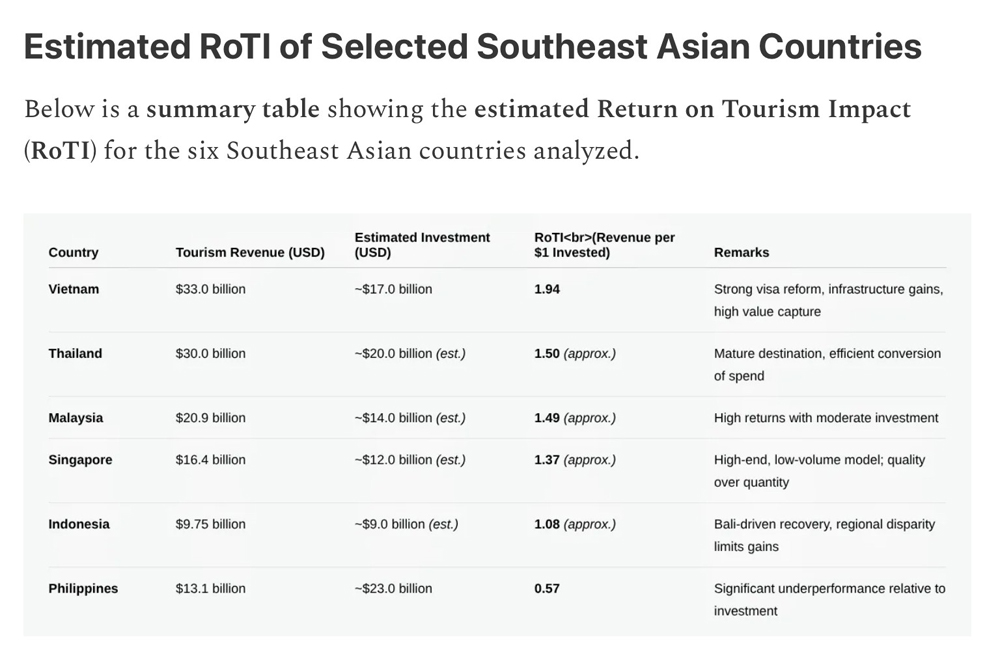
According to Jurado’s research, the Philippines has a RoTI of just 0.57, the lowest among six Southeast Asian countries studied. This means for every dollar invested in tourism, the country only earns back 57 cents. This is a stark contrast to the region's top performers:
- Vietnam leads the pack with a RoTI of 1.94, generating nearly $2 for every dollar invested.
- Thailand follows with a RoTI of 1.5, a testament to its long-standing brand equity.
- Malaysia and Singapore also show strong returns with RoTIs of 1.49 and 1.37, respectively.
- Even Indonesia, with its geographical challenges, manages a RoTI of 1.08.
Where Philippine Tourism Went Wrong
Jurado points to four key reasons the Philippines' tourism industry is underperforming:
- Weak Branding: Despite the recent change from "It’s More Fun in the Philippines" to "Love the Philippines," the country’s brand equity remains the lowest in the region. Jurado’s Digital Brand Score places the Philippines at 120.8, well below Singapore and Thailand, which both score above 147.
- Inadequate Infrastructure: While the government has poured money into tourism—an estimated $23 billion over the past two administrations—major gateways like NAIA, Cebu, and Davao remain in need of serious upgrades.
- Restrictive Visa Policies: The report recommends expanding visa-free access to key markets like China and the EU and launching a modern e-visa platform.
- Limited Data-Driven Planning: The government often focuses on job creation as a measure of success, but Jurado argues that a low RoTI limits the quality and pay of those jobs. He suggests the Philippines should institutionalize RoTI monitoring to create a “national scorecard” that tracks returns on tourism investments at the regional and national levels.
The Significance of Return on Tourism Impact (RoTI) Framework
Jurado believes that by adopting a RoTI-driven approach, the Philippines can make its tourism sector a true powerhouse. This isn't just about attracting more tourists; it's about making tourism a source of inclusive development, regional equality, and global relevance.
The Philippines’ potential as a tourism destination is immense. The challenge now is to convert that potential into tangible, profitable, and sustainable returns. It means prioritizing smart investments, strengthening our brand, and modernizing our approach to tourism.
