The Surprising Role of Bamban, Tarlac in Philippine History

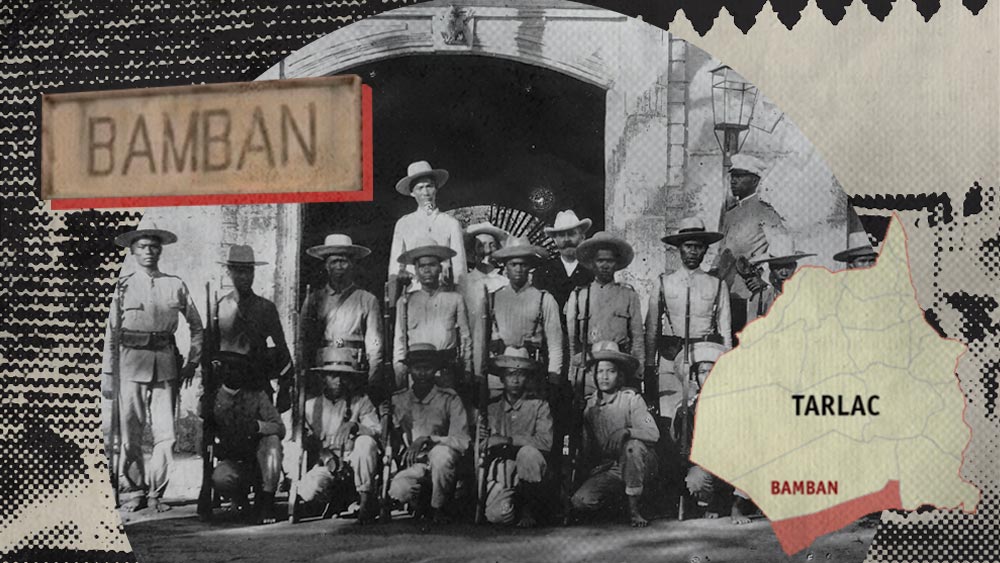
Bamban, a municipality in the province of Tarlac, is making the headlines these days amid issues with its mayor, who allegedly grew up on a farm. But more than a hundred years ago, this town bounded by a river on one side and mountainous regions on the other was known for something else. It was once a bastion of resistance under General Emilio Aguinaldo during the Philippine-American War.
ALSO READ
I Went to Bamban, Tarlac and Asked the People There About Their Mayor
From Mayor to Meme Queen: Filipinos Have the Funniest Takes on Who Alice Guo Is
Bamban, Tarlac in the Philippine Revolution
According to comprehensive lectures and research by Dr. Lino L. Dizon of the Center for Tarlaqueño Studies, Tarlac State University, Bamban was the capital of Aguinaldo's short-lived revolutionary government.
To refresh our stock knowledge of Philippine history, let's back up a bit.
Spain's colonization of the Philippines officially began in 1565, after the surrender of Rajah Tupas, the last Rajah of Cebu, to Spanish conquistador Miguel López de Legazpi. The colonial period lasted until December 10, 1898, through the Treaty of Paris, in which Spain essentially relinquished all claim of sovereignty of the Philippines to the United States. This also signaled the end of the Spanish-American War.
Remember that before the Treaty of Paris, General Emilio Aguinaldo proclaimed the sovereignty and independence of the Philippines on June 12, 1898, in Cavite el Viejo (present-day Kawit). The Philippine Declaration of Independence saw the unfurling of the Philippine flag as well as the first-ever presentation of the national anthem, "Marcha Filipina Magdala" (now, "Lupang Hinirang").
On June 18, 1898, Aguinaldo's Dictatorial Government was formally proclaimed after its initial announcement on May 24, 1898, on the general's return from exile. This was followed by the start of the Revolutionary Government of the Philippines, with Aguinaldo as president on June 23, 1898. The First Philippine Republic (Malolos Republic) was proclaimed on January 23, 1899, with a constitution written and approved by the Malolos Congress.
Assertions of the Philippines' independence and government were not recognized by either Spain or the United States. Likewise, the Philippine Revolutionary Government did not recognize the Treaty of Paris, bringing us to the Philippine–American War, which commenced on February 4, 1899, in the Battle of Manila. This was followed by significant campaigns in Iloilo, Malolos, Laguna de Bay, San Isidro, Zapote River, and other parts of the Luzon and Visayas.
Where is Tarlac in all these?
Gen. Antonio Luna was promoted by Aguinaldo to Lieutenant General and Commander-in-Chief of all forces in Central Luzon in March 1899. Luna planned a series of delaying battles from Caloocan to Angeles, with Mountain Province as the last foothold. But he was assassinated on June 5, 1899, after he was ordered to go on a journey to Cabanatuan, Nueva Ecija, to meet with Aguinaldo.
The day after, Aguinaldo was already in Bamban, Tarlac, where he established his headquarters and assumed command of all operations.
It was a contention of whether it was actually in Bamban and not anywhere else in Tarlac and if the headquarters were really just temporary or a proclaimed capital of the revolution.
Manila Railway trains were used by both the Philippine Revolutionary Army and the United States Army forces during the Philippine–American War. Bamban Train Station, as shown in this movie still, played a significant role in history.
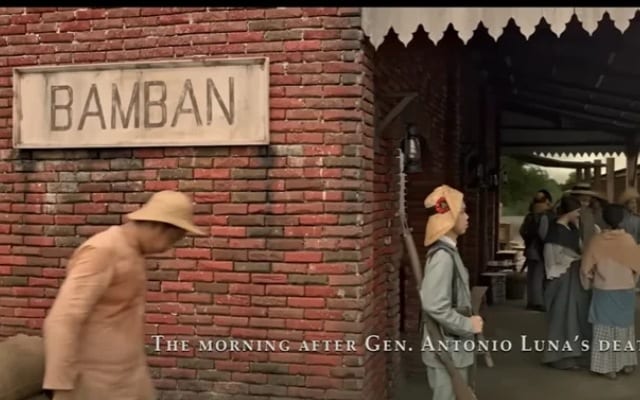
Dizon, in his paper Bamban, Tarlac in 1899: A Crux of the Philippine Revolution, asserted that the headquarters was specifically in Bamban:
“It must be clarified, however, that what was proclaimed on June 6 as the Headquarters of the Captain-General of the Philippines was not the town of Tarlac, but that of Bamban, approximately 26 kilometers away. In this proclamation, President Aguinaldo also assumed the command of all military operations, a function vacated by General Luna and which he himself was interested with earlier but held it in abeyance instead, so as to avoid a direct confrontation with his former rival.
This phenomenon might have been merely sideswiped by our historians but Bamban, the nonchalant capital, was the crux of the Filipino republic during the whirling days of 1899. From every angle, from within and without, Bamban was the key to those critical events at that period in our history.”
Dizon also refers to the documents by Capt. John R.M. Taylor (compiled and translated in (Philippine Insurrection Against the United States. Pasay: E. Lopez Foundation, 1970[Vol. IV, Exh. 659, p.107]):
“Before the death of Luna he had gone through Benguet Province to find a new site for the capital which would be fit for a continued defense; but Aguinaldo preferred Tarlac, and proclaimed it the capital of the republic on June 6." [ibid., vol. II, p.231. See also Alfredo B. Saulo. Emilio Aguinaldo Generalissimo and President of the First Philippine Republic in Asia. Quezon City: Phoenix Publishing House, 1983. p.353. Also Cesar C. Baroman. Nueva Ecija, Part I. Muñoz, Nueva Ecija: Central Luzon State University, n.d. p.17.]
June 6 is officially declared as Bamban Day in recognition of Bamban's role in the Philippine revolution.
The National Historical Commission of the Philippines also unveiled on July 4, 2024, a historical marker at the former municipal hall in Bamban, bearing the words:
"Bamban: Landas ng Pagkabansang Pilipino, 1899
Saksi ang pook na ito sa pagkabansa ng Pilipinas, ang kauna-unahang republika sa buong Asya."
Bamban During the Japanese Occupation
Like the rest of Tarlac, Bamban was transformed into a rice and sugarcane plantation during the American period. Nearby barangays were used as farmland, while the produce was transported to the Bamban Sugar Mill. However, during the Japanese occupation, the sugar central was used as a garrison and detention camp.
The Japanese also built an extensive network of tunnels in the hills of Bamban. These were used as defense lines and headquarters of the Imperial Army but were also later utilized by guerrilla units and the U.S. Army. Bamban was officially liberated on January 23, 1945.
In October 2023, the Sangguniang Bayan of Bamban, Tarlac, officially declared the World War II tunnels as a municipal historical site and heritage zone.
References:
- Bamban WWII Museum - Bamban Historical Society
- Website of the Municipality of Bamban, Tarlac
- Bamban, Tarlac in 1899: A Crux of the Philippine Revolution - Dr. Lino L. Dizon