

The Life of Panday Pira, the Philippines' First Cannon Maker

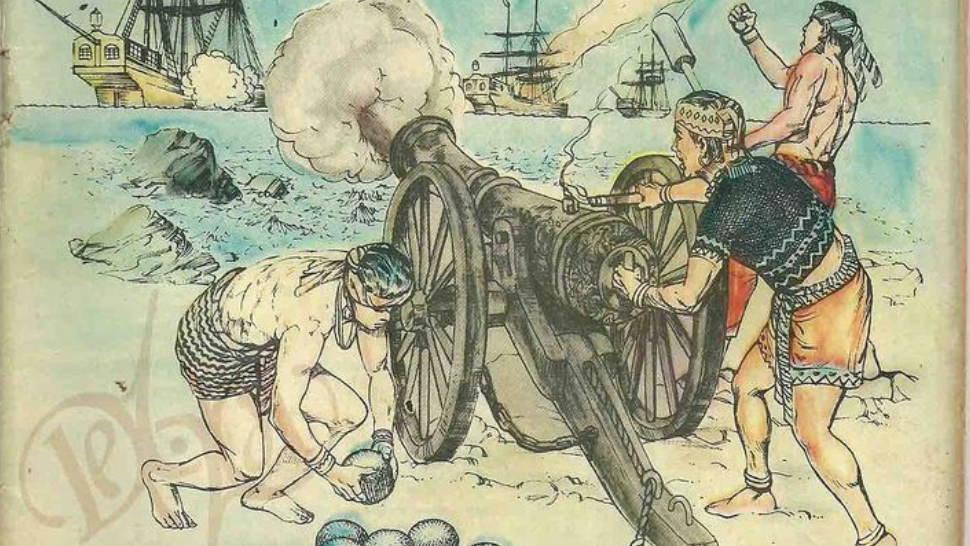
Filipinos have long been acquainted with artillery even before the rule of colonial powers. If we were to go through the Taosug tarsilas, we can surmise that firearms had already been available in Sulu as early as the late 14th century. Spanish Governor-General of the Philippines Miguel Lopez de Legaspi, too, was said to have told Philip II in a report back in 1570 that those from Luzon had cast and finished some impressive pieces of artillery themselves. Not bad for what was then considered "primitive" weaponry.
Enter Panday Pira, who was said to have been the man behind some of those pieces. Considered the Philippines' first cannon maker, the Muslim Kapampangan was born in 1488 in the southern part of the country. He would soon become one of our finest blacksmiths, whose skills were recognized by the likes of Rajah Sulayman, as well as the Spaniards and even the King of Spain.
ALSO READ:
A Powerful Datu Could Have Owned This 2,000-Year-Old Dagger
Ferdinand Magellan's Rock in Homhonhon Has Been Vandalized
From Making Cannons for Rajah Sulayman to Becoming the Spanish Army's Official Cannon Maker
It was in 1508 that Panday Pira and his family move to Maynilad, where they would set up a cannon-forging shop by the banks of the District of San Nicolas (present-day Pasig River). One of his clients happened to be Rajah Sulayman, then one of the rulers of the Kingdom of Manila in Luzon. Panday Pira would go on to make cannons for him, which were mounted in and around the kingdom. According to accounts, these cannons were as big as the Malaga cannons used by the Spanish.
These would all come in handy in 1570. Legazpi had ordered Martin de Goiti to create an outpost in the north, and Manila soon became a primary target. Spaniards would extend messages of friendship to the Rajahs of Manila. This was the same tactic used to capture Visayan territories. Protection and friendship were offered if the rulers pledged allegiance to the Crown.
When Rajah Sulayman declared war on the Spaniards, his enemies, the Castillan forces under the command of de Gotti, would advance and burn the city down. The Rajahs and their people would retreat. Natives would briefly return and resettle in Manila after Goiti sailed back to Cebu, fearing retribution from remaining enemy forces.
With it, the artillery was taken away from the Kingdom, as it was presented to Legazpi as war booty. Legazpi and his men would closely examine and test these captured cannons. They found the artillery pieces not only durable but also powerful. The design for Panday Pira's cannons would eventually be adopted by the army.
Legazpi arrived in Manila with a larger fleet in 1571 and forces would, ultimately, go on to ultimately seize Manila. The Governor General would go on to establish a permanent Castilian settlement in Manila on May 19, 1571.
The Spaniards knew him as Pandapira. Even the contrarian chronicler Fray Gaspar de San Agustin said that Panday Pira's cannons were as good as the ones in Malaga.
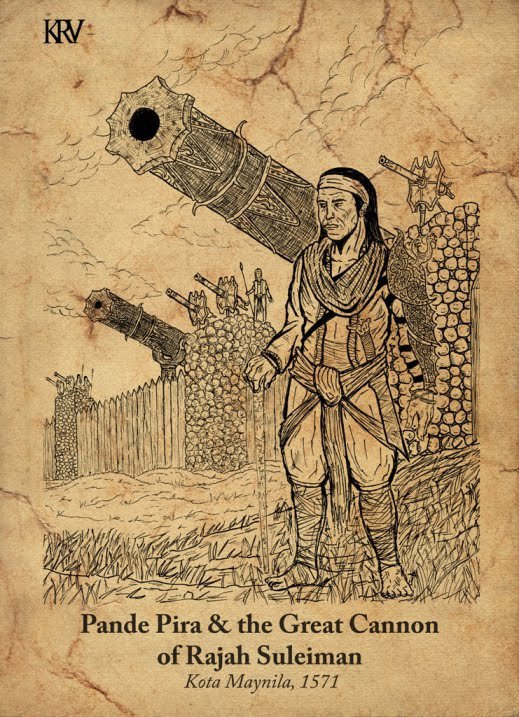
So what became of Panday Pira amidst all this? Well, he would flee to Bulacan first and then onto Pampanga to attempt to start a new life in the town of Apalit in 1570. There, he worked as a blacksmith who focused on farm implements. Legazpi would, however, summon him back to Manila through emissaries to work on cannons for the Spaniards.
Panday Pira was called upon for his technical expertise as the Spaniards created a new city. The blacksmith would go on to open up his own foundry in 1572 with his sons in Lamayan (now Santa Ana). Governor-General Santiago de Vera would commission Panday Pira to cast cannons for him in defense of the fortress of Nuestra Señora de Guía (present-day Intramuros). Other pieces made by Pira were used for expeditions to Borneo and the Moluccas.
The metallurgist would be exempted from obligations to the Spanish government in exchange for his services. This meant Panday Pira was afforded some liberties his contemporaries didn't have. He could do as he pleased without having to offer tributes and be subjected to forced labor.
His legend followed him for the rest of his life and beyond. The Filipino journalist, historian, and politician Jaime de Veyra once said of the acclaimed metallurgist:
"Panday Pira's cannons are as good as those produced in Spain and became the official cannon maker for the Spanish army in the Philippines. His efforts contributed much to the defense of the islands against sea pirates."
Panday Pira continued making cannons for Spain until his death in 1576 at the age of 88. Upon learning of his death, the Spanish authorities appealed to the King of Spain to send an equally impressive cannon maker, writing: "Pandapira our cannon maker is dead. We can not find a single man among us to take his place."
Sources:
- Filipinos in History, Volume II, National Historical Institute (1990)
