

Today I Learned: 'Natutulog sa Pansitan' Has Nothing to Do With Noodles


There's a Filipino idiomatic expression that goes: "Natutulog sa pansitan." It is often said in an accusatory manner, as in "Natutulog kasi sa pansitan" or "Patulog-tulog ka kasi sa pansitan," and directed to someone who misses out on opportunities due to negligence or laziness. But what is this pancit? And why is someone sleeping over a bowl of pancit canton, pancit bihon, or pancit palabok?
However, "natutulog sa pansitan" has nothing to do with noodles.
ALSO READ
50 Filipino Words Worth Reintroducing Into the Common Lingo
10 Names of Places That Are Actually Filipino Words
Origins of Natutulog sa Pansitan
The origins of "natutulog sa pansitan" can be traced back to the humble herb locally known as pansit-pansitan. Its scientific name is Peperomia pellucida, and commonly called in North America as pepper elder, silverbush, rat-ear, man-to-man, or clearweed. In the Philippines, pansit-pansitan is also called ulasimang-bato (Tagalog), olasiman ihalas (Bisaya), sinaw-sinaw or tangon-tangon (Bikol), lin-linnaaw (Ilocano), and clavo-clavo (Chavacano).
Peperomia pellucida, a.k.a. pansit-pansitan
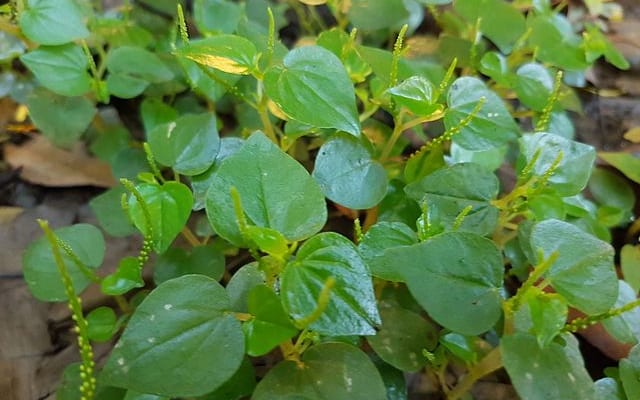
Pansit-pansitan is a common plant that thrives in cool, damp places and is often found carpeting nooks and yards all over Asia and the Americas. It thrives in loose, humid soils and a tropical to subtropical climate. It's a shallow-rooted herb that grows from six to 18 inches and is characterized by its succulent stems and shiny, heart-shaped leaves. Its tiny seeds are attached to fruiting spikes. When crushed, the pansit-pansitan emits a mustard-like smell.
In the past, workers in the fields would take breaks from the harsh sun by napping on patches of pansit-pansitan. Over time, the phrase evolved to signify not just taking a break but doing so to the extent that one neglects their responsibilities, leading to lost opportunities.
Use of Pansit-Pansitan in Medicine
Ironically, the pansit-pansitan is nothing less than hardworking, if one can say. The plant is not only visually appealing but also packed with a myriad of medicinal properties.
In different regions around the world, its uses vary: from lowering cholesterol in Brazil to treating proteinuria in Guyana and acting as a cough suppressant in the Amazon. The plant has also been applied topically for wounds and used to address conditions such as abdominal pain, acne, gout, headaches, and rheumatic pain. Modern scientific investigations have validated some of these traditional uses.
Pansit-pansitan has been a staple in Philippine traditional medicine for its analgesic, anti-inflammatory, and anti-hyperuricemic properties. Proponents (Dr. Nelia C. Maramba et al.) of a study at the National Integrated Research Program on Medicinal Plants of the University of the Philippines - Manila have developed a drug formulation from the plant's extracts that is targeted to cure hyperuricemia and gout. Results show that this has significantly reduced serum uric acid levels and that the percent reduction is comparable with the effects induced by allopurinol. Recurrence of hyperuricemia has not been recorded among patients receiving ulasimang-bato doses. The drug formulation has an existing patent for its tablet form, but is still undergoing clinical trials.
