

Today I Learned: The History of the Multi-Billion Peso ‘Payanig sa Pasig’ Lot

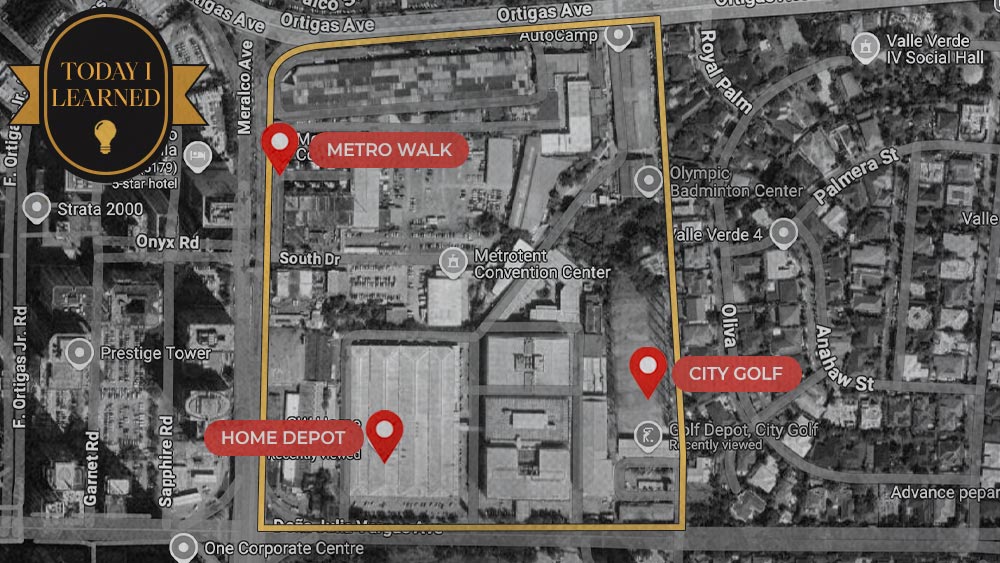
After the group of businessman and former Ilocos Sur governor Luis “Chavit” Singson announced plans to redevelop the Metrowalk Commercial Complex recently, considerable attention has been directed toward that piece of prime property located in the middle of Pasig City’s business district.
While Singson’s company, the LCS Group, controls Metrowalk, it’s actually part of a larger piece of land bordered by Ortigas Avenue in the north, Meralco Avenue in the west, Julia Vargas Avenue in the south, and the Valle Verde subdivision in the east. This piece of land, which measures about 18.5 hectares, has since come to be known as the Payanig sa Pasig lot.
Like many other highly commercialized districts in the city, the Payanig sa Pasig lot has gone through some major changes, not to mention several ownership claims, over the years. And if the Singson group’s plans materialize, it will undergo further development and become, as Singson himself calls it, a “city within a city.”
Before that happens, it helps to understand how that piece of lot came to be, and its complex and sometimes controversial history involving the government and various private entities. Here’s a short history of the so-called Payanig sa Pasig lot.
ALSO READ
This Is the Story of That Big Hole in EDSA-Ortigas
Cubao Hole: This Is the Story of That Once-Idle Lot on the Corner of EDSA and Aurora Boulevard
History of the ‘Payanig sa Pasig’ lot
The so-called Payanig sa Pasig lot and much of the surrounding areas were originally owned by the Ortigas family, who had (and still has) large swaths of property in Pasig and San Juan.
According to court records, on May 31, 1968, during the time of President Ferdinand Marcos Sr., the Ortigases sold a 16-hectare piece of land in the area to Anchor Estate Corporation for P6.4 million. The title was later transferred to Mid-Pasig Land Development Corp. (MPLDC) instead of to Anchor. On December 9, 1974, an additional 2.4 hectares was sold to MPLDC by the Ortigas family. Jose Campos was then the president and majority stockholder of both Anchor Estate and MPLDC.
Whether the Ortigases sold the land willingly or under duress is up for debate. According to a report in the Philippine Daily Inquirer, the Ortigas family said it was forced to sell the property at disadvantageous terms “due to intimidation and undue influence” then-President Marcos Sr. allegedly exerted on Francisco Ortigas, the family’s patriarch. Campos was a known close associate of former President Ferdinand Marcos Sr.
After the 1986 People Power Revolution, which ousted Marcos from power, Campos turned over various properties, including the Payanig sa Pasig lot, to the Presidential Commission on Good Government (PCGG), which considered these assets part of the ill-gotten wealth of the Marcoses and their cronies. Specifically, Campos surrendered to the PCGG two land titles of the mixed-use property owned by Mid-Pasig Land Development Corp. (MPLDC) bordered by Ortigas, Meralco and Doña Julia Vargas Avenues. (This is under dispute though, as the group of Singson claims to have paperwork asserting their ownership of the entire lot).
The actual Payanig sa Pasig
After the government took control of the property, it has seen various occupants, ranging from entertainment venues to commercial establishments. It has also been embroiled in numerous legal disputes, particularly over ownership claims.
Perhaps most famously, portions of the lot were used for a temporary amusement park called “Payanig sa Pasig,” from which the property got its name. The carnival became a popular attraction during the 1990s, along with similarly named theme parks like Big Bang sa Alabang in Muntinlupa, and Boom na Boom and Star City in Manila. Payanig sa Pasig featured carnival rides, games, and food stalls and was a favorite destination for families, particularly during the holiday season.
At the turn of the century, Payanig sa Pasig ceased to operate and the government started leasing the property to various small businesses and commercial establishments. These include restaurants, retail stores, and service-oriented businesses. However, the fragmented nature of the property, due to the ongoing legal disputes, has prevented large-scale development. The property is leased to several groups that developed the following over the years.
Occupants of the Payanig sa Pasig lot
1| Goldpark
This was one of the earlies developments on the property after Payanig sa Pasig closed down. The commercial strip included a mix of retail outlets, restaurants, and other commercial establishments that attracted both local residents and workers from nearby offices. It also included a place that sold pre-owned cars.
Among the popular places there was a Korean restaurant called Ye Dang and a Korean grocery store that was established in the early 2010s. Animal House (a pet care clinic) and Rapide Car Repair Services was established there but Goldpark had to cease operations to give way to the subway construction work in 2022.
2| Auto Camp
Auto Camp was a notable part of the property’s history, particularly in the early 2000s. The concept of Auto Camp was centered around creating a venue dedicated to automotive enthusiasts, offering various services and activities related to selling pre-owned cars. It included a Goodyear Servitek and other car accessories stores.
In 2023, Auto Camp was raided by the Bureau of Customs and close to 100 cars were seized by the BOC.
3| MC Home Depot
MC Home Depot opened in the late 1990s and was the first home improvement big box stores to open in the property. It occupied about one hectare of the Payanig sa Pasig property along the Ortigas Avenue side facing the Meralco Building.
4| City Golf
City Golf was another development that was established in the early 2000s and is situated along the Julia Vargas Avenue side. It was developed as a recreational facility aimed at both amateur and professional golfers. The primary feature of the complex is its driving range, which offers golf enthusiasts a convenient location to practice their swings without having to leave the city. The concept was to provide a recreational space within the urban environment, catering to the growing number of people working and living in the Ortigas and Pasig areas.
Over time, CityGolf expanded beyond just a driving range. The complex began to attract a variety of dining establishments, bars, and cafes. These include Barcino, Bugsy’s, Razon’s, The Reserve, and the very first branch of successful chicken wing chain Frankie’s.
4| CW Home Depot (formerly Ortigas Home Depot)
A much bigger home improvement chain occupying about 2.5 hectares on the opposite side of MC Home Depot, along Julia Vargas Avenue, opened in 2004. CW Home Depot was originally called Ortigas Home Depot and was the second big box home improvement chain to open in the Payanig sa Pasig lot.
CW Home Depot also houses various specialty stores which cater to more specific requirements of customers. All its outlets are strategically laid out into four divisions: the Home Builders’ Superstore or its D-I-Y Section, the Home Interior Superstore, the Home Appliance Superstore, and a roster of Specialty Stores that cater to more specialized builder and home improvement products.
Both home improvement depots continue to operate and have been doing so continuously for around two decades. Aside from CW Specialty Stores, popular dimsum place North Park opened there in 2005, while a branch of actor Joel Torre’s chicken inasal chain, JT’s Manukan, opened in the compound in 2010.
The group behind CW Home Depot also developed within its area a commercial strip called Ortigas Food Street that was like an alley of all sorts of restaurants and bars. This included the very popular Seaside Paluto Market, where there was a wet market where customers could buy seafood and have the restaurants cook and serve them immediately.
Beside the market there was also a popular place where people could buy cellphone accessories and pirated DVDs, back when the format was still popular and streaming was not yet a thing.
Other popular establishments in the area were Pier One, which erected a three-storey building using used old container vans stacked together; Jay-J’s Inasal; Café 80’s Bar; Buffalo Wings and Things; Masil Korean Restaurant, O Bar, and many more.
According to sources, this area of the Payanig sa Pasig property was originally planned as Ortigas Auto Depot to replicate the popularity of Banawe car accessories, but it evolved into a mixed-use commercial strip. Today, Big Bert’s Auto Detailing, a popular car wash and detailing shop originally located in Araneta Avenue, is the only automotive retail establishment surviving in the area as the place was redeveloped into a complex of mid-rise BPO office buildings with ground floor retail spaces renamed as Ortigas Technopoint. Currently, popular retail food establishments in the compound include Starbucks, Uncle John’s, Tom and Tom’s Coffee, Andy’s Kitchen, Hai Chix and Steaks, and ‘80s themed bar New Order Lounge.
5| Metrowalk
About half a year after Ortigas Home Depot opened, Metrowalk complex also opened. This part of the Payanig sa Pasig lot is the one owned and controlled by Singson through his BLEMP Commercial Philippines Inc., although the company is claiming ownership of all 18.5 hectares of the Payanig sa Pasig lot.
According to BLEMP, its land titles under the name MPLDC are covered by duly notarized deeds of sale dated 1971 for two parcels of land—16 hectares and 2.5 hectares—which effectively make up the entire Payanig sa Pasig property.
In a Philippine Star report, lawyers of BLEMP claim that Campos’ MPLDC sold the property to BLEMP owners Benedicto Parchamento and Estrelita Marinas. Singson said he has formed a joint venture with both Parchamento and Marinas, and it is this joint venture that is now collecting lease payments from some (but not all) of the current tenants occupying sections of the property. The PCGG has since rejected these claims, asserting that the government is the true owner of the Payanig sa Pasig lot.
In any case, Metrowalk has become a popular leisure destination with its selection of restaurants, bars, and events places. Some of the anchor establishments that have come and gone in the area over the years include Starbucks, Behrouz Persian Restaurant, Yoo-hoo BBQ, Aruba, the Metrotent Events Place, the Elbow Room, and Metro Cars, a used car park with some car accessories stores. Metrowalk also used to be a popular poker and billiards establishment in the early 2000s. Today, part of the complex also has the GAC and Dongfeng car showroom, the latter of which is also owned by Singson’s group.
Future of the Payanig sa Pasig lot
Singson’s LCS Group has made pubic its plans to redevelop Metrowalk into a mixed-use complex, with office and residential high-rise buildings. The company said it has partnered with Korean investors for the project. It seems the group has also made peace with the PCGG as its plans include space for the new headquarters of the government agency. The LCS Group has said the PCGG will move into the new development once it is completed.
Over the years, various other claimants have voiced their intent to claim a piece of the Payanig sa Pasig lot, including the Ortigas family, the Marcos family, victims of human rights during the Martial Law years, and other private individuals.
According to current market prices, the former Payanig sa Pasig lot is worth an estimated P300,000 to P500,000 per square meter, and possibly more, which would make the entire property worth anywhere from P55.5 billion to around P92.5 billion today.
