

Home of Beauties, Long Abandoned: Here's the Story of the Philippine Village Hotel

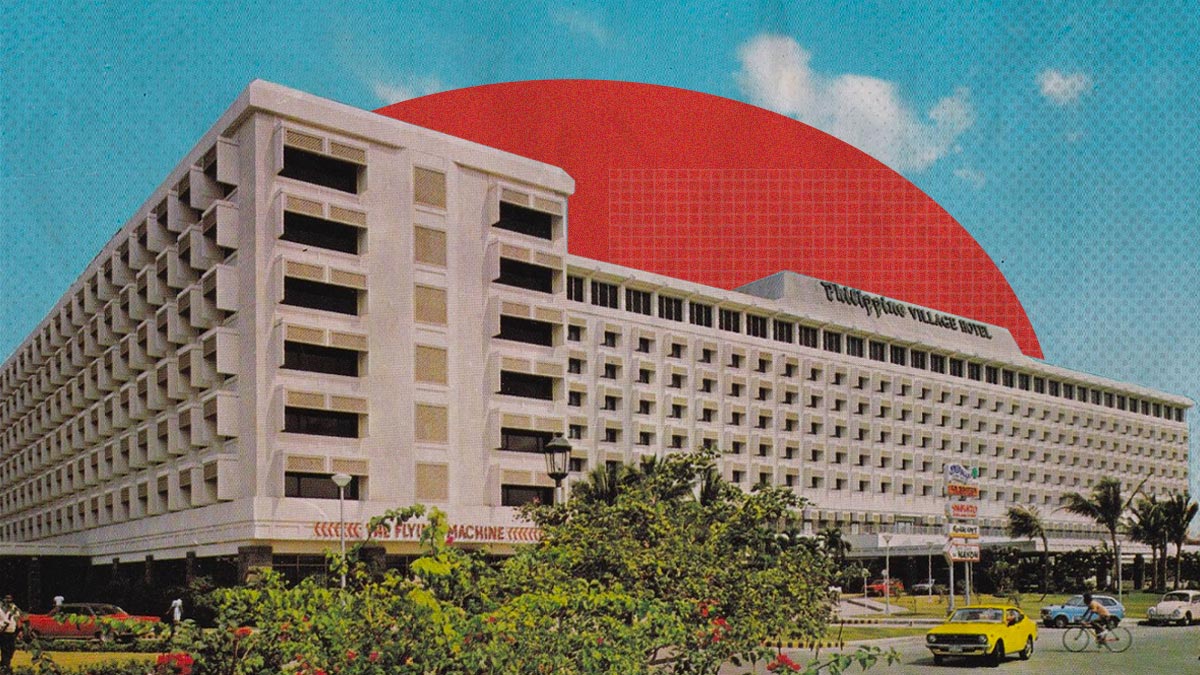
If you’ve ever traveled through the Ninoy Aquino International Airport over the past few decades, you’ve likely seen an abandoned structure surrounded by overgrown vegetation in the area. This is—or was—the Philippine Village Hotel, a once vibrant and luxurious property that hosted glamorous parties and events but has now become a blight on the landscape near the airport and even a safety and security risk for travelers.
In early December, the Philippine government, through the Manila International Airport Authority (MIAA), regained control of the hotel after sheriffs enforced a warrant issued by a Pasay court. Although the land where the crumbling hotel is located is owned by MIAA, the building itself had been under private ownership for decades.
This seems to put a period in the story of the hotel. Here’s the long and fascinating history of the Philippine Village Hotel.
ALSO READ
Here’s The Story of Silahis/Grand Boulevard Hotel And Why It Hasn’t Been Torn Down
Asia's First Living Cultural Park: The Story of Nayong Pilipino
History of the Philippine Village Hotel
The Philippine Village Hotel (PVH) was built on a piece of land measuring 36,289 square meters inside the Nayong Pilipino, a sprawling complex that featured some of the best regions and landscapes of the Philippine archipelago all in one place. There were scale models of the Banaue Rice Terraces in the Cordilleras and Chocolate Hills in Bohol, recreations of the old houses in Vigan and Mindanao, and Magellan’s Cross in Cebu, and, of course, a lifelike, albeit much smaller, Mayon Volcano.
While Nayong Pilipino opened in 1970, the PVH came later, in 1974. Like many of Manila’s grand old hotels, the hotel was built in the early 1970s to accommodate delegates and participants of the annual meeting of the International Monetary Fund and the World Bank, which the Philippines was hosting for the first time. It was a centerpiece event for the administration of then-President Ferdinand Marcos Sr., and so they needed to make sure there were enough hotels that were up to international standards.
Besides the PVH, which was designed by National Artist for Architecture Juan Nakpil, other hotels built during this time were the Century Park Sheraton, the Manila Mandarin (later called the Mandarin Oriental), the Manila Midtown Ramada, the Peninsula Manila, the Philippine Plaza (now Sofitel), and the Silahis (later Grand Boulevard) Hotel.
The PVH itself was built by a company called the Philippine Village Hotel Inc (PVHI), which was previously called Sulo ng Nayon Inc., through a loan from the Government Service Insurance System (GSIS) in the amount of P22 million. According to records, while the PVH already opened in 1974, the lease from the Nayong Pilipino Foundation, which owned the entire Nayong Pilipino complex, to the PVHI wasn’t signed until June 1, 1975.
In order to guarantee payment of the loan, PVHI hypothecated or pledged the hotel and its contents to the GSIS, which in turn, lent PVHI additional loans amounting to P8 million and P6.5 million in April 1974 and June 1975.
The lease, meanwhile, between Nayong Pilipino and PVHI was for an initial period of 21 years, or until May 1996 and was renewable for a period of 25 years.
Thus, the PVH operated throughout the 1970s and 1980s as an upscale hotel that was a stone’s throw away from the country’s main gateway, the former Manila International Airport. The PVH was noteworthy for several things, including the fact that it was the site of the Philippines’ first-ever land-based casino. There had been a casino before called the Manila Bay Casino, which operated out of the luxury liner MS Philippine Tourist docked just off Manila Bay, which opened in 1977. But after the ship burned down in 1979, PAGCOR transferred casino operations to the Philippine Village Hotel.
Miss Universe connection
Another fascinating fact about the PVH is that it was where delegates of the 1974 Miss Universe beauty pageant lived while they were in Manila. In fact, according to Miss Universe historian Butch Francisco, one of the suites of the hotel was called the Miss Universe suite and this was where that year’s winner, Spain’s Amparo Muñoz, stayed after she won the crown.
By March 1995, the owners of the PVH negotiated with the Nayong Pilipino Foundation to renew their lease contract for another 25 years. On July 4 of that year, the extension of the lease agreement was signed by Jose Marcel E. Panlilio, who was Senior Executive Vice President of the PVHI and by Chairman Alberto A. Lim of the Nayong Pilipino Foundation. Both parties agreed to the contract renewal for another 25 years, or until 2021.
Under this new agreement, PVHI’s monthly rental of the land was P20 per square meter and was subject to an increase of 20 percent at the end of every three-year period. According to records, at the time of the renewal of the lease contract, the monthly rental amounted to P725,780.
Between December 1972 to June 1986, PVHI paid GSIS a total of P98.92 million. However, based on records, this was not enough to cover the total liabilities PVHI owed GSIS. When faced with demands for payment, the company requested for an extension on numerous occasions, until finally, the GSIS involved the local government of Pasay to institute foreclosure proceedings on the property.
Sequestered by the PCGG
While all this was going on, the Presidential Commission on Good Government (PCGG), which was formed soon after the EDSA People Power Revolution of 1986 that toppled the administration of President Marcos, seized or sequestered many of the Marcos family’s companies, properties, and other assets, as well of those owned and controlled by their so-called cronies or supporters. That included the Enriquez-Panlilio clan, which owned PVH and many other companies and properties, such as Ternate Development Corporation, Fantasia Filipina Resorts, Inc., Monte Sol Development Corporation, Olas del Mar Development Corporation, Puerto Azul Ocean Villas Condominium, Philroad Construction Corporation, Sulo Dobbs, Inc., Hotel Properties, Inc., and Silahis International Hotel, Inc.
Of course, the Enriquez-Panlilio families, through their companies, challenged the sequestration orders by the PCGG and filed temporary restraining orders and injunctions to prevent their implementation.
At one point, there were eight cases pending involving PVHI, GSIS, and the PCGG.
While the PVHI was tied up in litigation for all of those years, the 1990s and the 2000s rolled around and, by then, newer hotels had sprouted all over the city. The PVH was no longer the bright, shiny new hotel it once was, and that clearly didn’t help it with its financial woes. The hotel closed and permanently ceased operations in 2001.
But that wasn’t the end of the hotel’s legal woes. By the end of the 2000s, while the PVHI grappled with its commitments with the GSIS, it still owed the Nayong Pilipino Foundation around P100 million in unpaid lease obligations. By that time, the Supreme Court had already ordered the owners of PVHI to vacate the Nayong Pilipino complex.
News stories at the time pointed to the Enriquez and Panlilio clans as the owners of PVHI. However, in January 2009, Jose Marcel Panlilio released a statement insisting that he was no longer the owner of PVHI. In fact, he and his family had sold nearly 100 percent of their interest in PVHI to a company called Burgundy Asset Development Corp. (BADC), whose chairman is named Rogelio Serafica. According to a Rappler investigation, it is BADC that has employed armed guards to secure the abandoned hotel.
NAIA expansion
Meanwhile, in the year 2000, officials of the MIAA had been petitioning the courts that it needed a portion of the land that Nayong Pilipino occupied to expand the airport and comply with safety standards required by the International Civil Aeronautics Organization. The MIAA said the land was required to build an additional parallel taxiway and surface road connection between the Terminal 2 to Terminal 3 of the airport, which by then had been renamed Ninoy Aquino International Airport (NAIA).
Then-President Gloria Macapagal-Arroyo issued Executive Order No. 111, which ordered the transfer initially of 8.6 hectares of land occupied by the Nayong Pilipino to the MIAA. However, in 2012, during the administration of President Benigno “Noynoy” Aquino, Executive Order No. 58 directed the Nayong Pilipino Foundation to transfer the remaining 22.3 hectares of land it owned to the MIAA. That includes the site of the abandoned PVH.
But, due to the pending legal issues involving the PVHI, which still technically owned the building, the order couldn’t be served. Guards still patrolled the area, preventing even government officials from entering the compound.
On November 21 this year, by virtue of an order from Pasay City Metropolitan Court Branch 45, officials and security personnel of the MIAA, accompanied by guards led by Pasay City Sheriff Randy Leviste, were finally able to access the property and serve a notice for the occupants to vacate the building. MIAA officer-in-charge Bryan Co said agency staff immediately conducted security checks on the property, something he said the MIAA has been unable to do for over 20 years.
With the PVH finally under MIAA, the plan now is to utilize the property in the modernization program of the NAIA meant to improve and expand the capabilities of the country’s main aviation gateway.
And what of the hotel? According to MIAA officials, the once grand hotel is too run-down to benefit from any sort of refurbishment and will be demolished to make way for the expansion of the adjacent NAIA Terminal 2. That will mark the true end of the Philippine Village Hotel.
