Today I Learned: The Story of One of the Last Pockets of Green in Pasig City

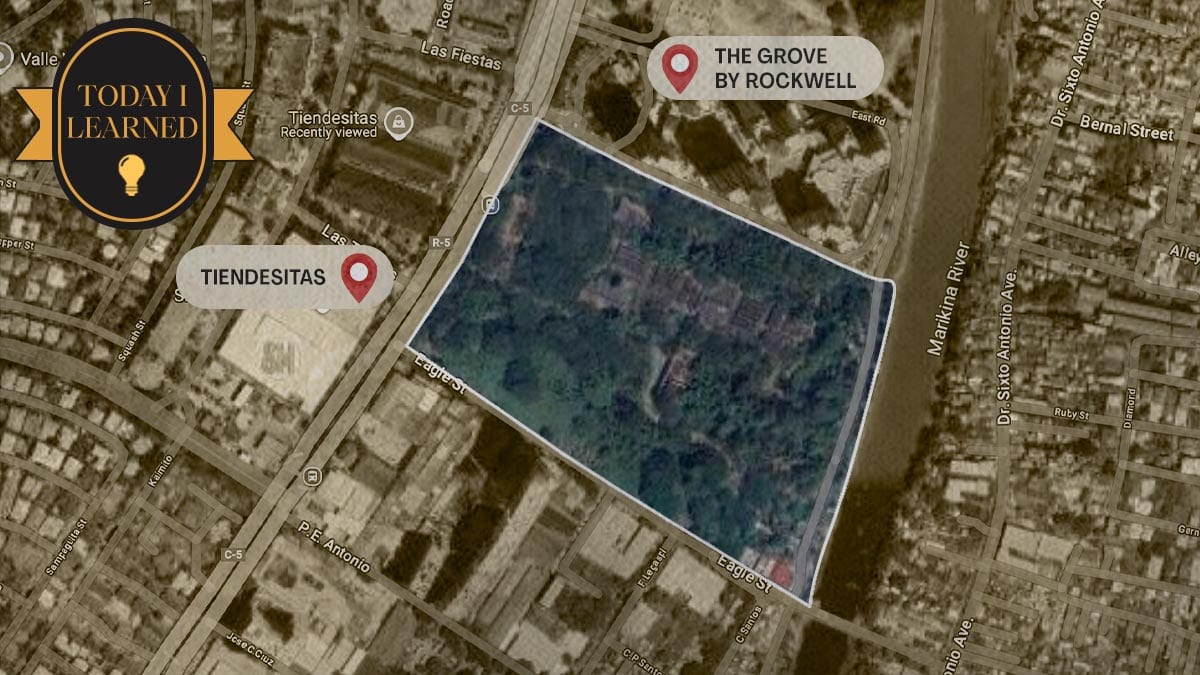
ILLUSTRATION: Igi Talao
Anyone who ever passes through the northbound side of C5-E Rodriquez in Pasig City on a regular basis would have probably noticed and wondered about the fenced-off lot just after Eagle Street and right before The Grove by Rockwell. Located right across Tiendesitas, the lot stands out from the other plots of land in this area of the city for being undeveloped and still covered in thick bushes and trees.
What is the story of this lot and why has nothing been built on it, especially since it’s located in an area undergoing rapid development from some of the country’s top real estate companies?
ALSO READ
Today I Learned: The History of the Multi-Billion Peso ‘Payanig sa Pasig’ Lot
This Is the Story of That Big Hole in EDSA-Ortigas
The PIMECO Compound
To begin with, this lot, which measure about 12 hectares, is often referred to as the old PIMECO lot, after the Philippine Integrated Meat Corporation. Founded in 1975, PIMECO was the country’s first integrated and fully automated meat processing plant that produced both processed meat and canned meat products. The premises included facilities for slaughtering, fresh meat preparation, curing and smoking of pork cuts and sausage, inedible rendering, canning and labeling. It also had provisions for blood drying, inedible rendering and hide curing, and storage, as well as can-making and limited machinist facilities.
Although PIMECO occupied and did its business in the property, it did not own the said property. The company leased the land from the Meat Packing Corporation of the Philippines (MPCP), a government-owned and controlled corporation (GOCC) that was wholly owned by the Government Service Insurance System (GSIS). According to court records, in November 1975, the MPCP leased to PIMECO the Barrio Ugong, Pasig property under a lease-purchase agreement at an annual rental rate of P1,375,563.92, payable over a period of 28 years. That means the total rental price that PIMECO had to pay MPCP was P38,515,789.87.
There was a supplementary and loan agreement that was signed between the two parties that basically increased the rental rate that PIMECO had to pay to a total of P93,695.552.59 because of additional expenditures incurred by MPCP for rehabilitating and refurbishing the meat processing and packing plant. That new contract commenced on January 1, 1981, which meant that the contract would have officially been binding until 2009.
For a number of years, MPCP, through PIMECO, operated normally as a business. According to court records, “MPCP came to enjoy unwarranted preferential rights in livestock and meat importation through PIMECO and its marketing arm, the PIMECO Marketing Corporation; it thus gained a monopoly in the supply of meat products to the Greater Manila Area.”
However, in February 1986, the EDSA People Power Revolution happened, which toppled the government of then-President Ferdinand Marcos Sr. and installed Corazon Aquino to power. One of the consequences of this turn of events was the formation of the Presidential Commission on Good Government (PCGG), whose primary task was to recover and investigate the so-called ill-gotten wealth accumulated by former President Ferdinand Marcos, his family, and their close associates.
One of the companies the PCGG sequestered during the course of fulfilling its mandate was PIMECO. That included all the company’s records and assets, as well as the meat-processing and packing plant and the lease-purchase agreement with the MPCP.
In November 1986, MPCP wrote to PIMECO informing the latter that the lease purchase agreement between the two companies had been rescinded for non-payment of rentals amounting to P2 million, among other reasons. Later the GSIS wrote to the PCGG asking it to exclude the meat processing plant from the sequestered assets of PIMECO. While the PCGG denied the request, it did eventually grant a request from MPCP to turn over to it the meat processing plant because it believed at the time that the contract with PIMECO had already been rescinded.
However, while all this was going on, a man named Peter Sabido, who was then the majority shareholder of PIMECO, filed a motion with the Sandiganbayan asking it to review the alleged turnover of PIMECO to MPCP and GSIS. Sabido argued that, because PIMECO had been sequestered by the PCGG, its turnover must have been approved by the Sandiganbayan, or the special court that handles graft and corruption cases involving public officials and government employees. Later on, upon reading from newspaper reports that PIMECO had, indeed, already been turned over to MPCP and the GSIS, Sabido filed another motion asking the court to declare the turnover null and void because it was done without the approval of the Sandiganbayan.
We should note that, before all this happened, the PCGG had filed a civil case against Sabido and others (including Roberto Benedicto and Luis Yulo) for allegedly benefiting from huge loans from GSIS in favor of PIMECO “under favored and very liberal terms.”
While the property was sequestered and under court litigation, company operations slowed and eventually stopped. According to a 1989 study undertaken by students of the University of the Philippines, since the sequestration, “there has not been any inflow of capital in any form.
“For almost three years now, the company has been operating merely with its available resources and through suppliers’ credit,” the study said. “Lack of funds coupled with having very old machines would indeed greatly affect the company’s operational level. They can no longer operate at full capacity.”
Amicable Settlement
As the operations of PIMECO as a meat processing and packing company declined, the battle for control of the 12-hectare lot continued in the courts, with GSIS-MPCP and PIMECO trading lawsuits for years. In 2001, the Supreme Court dismissed a petition by the MPCP to set aside a decision by the Sandiganbayan directing MPCP to accept the tender of payments by the PCGG for the PIMECO property amounting to P5 million. According to the court, this meant that MPCP’s statement that the lease-purchase agreement with PIMECO could not have been canceled automatically as, in order to warrant the rescission of the contract, it must be shown that PIMECO failed to pay the aggregate amount of at least P10,038,809.10.
“Assuming in the extreme that, as alleged by MPCP, the arrears at the time of tender on January 30, 1991 amounted to P12,578,171.00,the tender and consignation of the sum of P5,000,000.00, which had the effect of payment, reduced the back rentals to only P7,578,171.00, an amount less than the equivalent of three annual installments,” the Supreme Court said in its decision. “Thus, with the Sandiganbayan’s approval of the consignation and directive for MPCP to accept the tendered payment, the lease-purchase agreement could not be said to have been rescinded.”
In any case, it seems PIMECO and GSIS-MPCP were able to amicably settle the dispute in 2009. This came to light when, according to reports, on December 11 of that year, a compromise agreement was reached between Peter Sabido, the PCGG, and Consolidated Prime Development Corporation (CPDC), which is a part of the SM Group of the Sy family.
According to the terms of the compromise agreement, the PCGG in 2009 under former chairman Camilo Sabio had signed off on the sale of the PIMECO lot to CPDC for about P1 billion. The Sandiganbayan approved the sale on March 24, 2010. Days later, on March 29, the GSIS-MPCP, the PCGG, and Peter Sabido issued a manifestation declaring that they had reached a settlement concerning the petition to review the Sanidganbayan ruling that upheld the lease-purchase agreement between MPCP and PIMECO.
In other words, with all parties finally coming to an agreement concerning the ownership of the PIMECO lot, SM’s subsidiary CPDC should have been free to purchase the property.
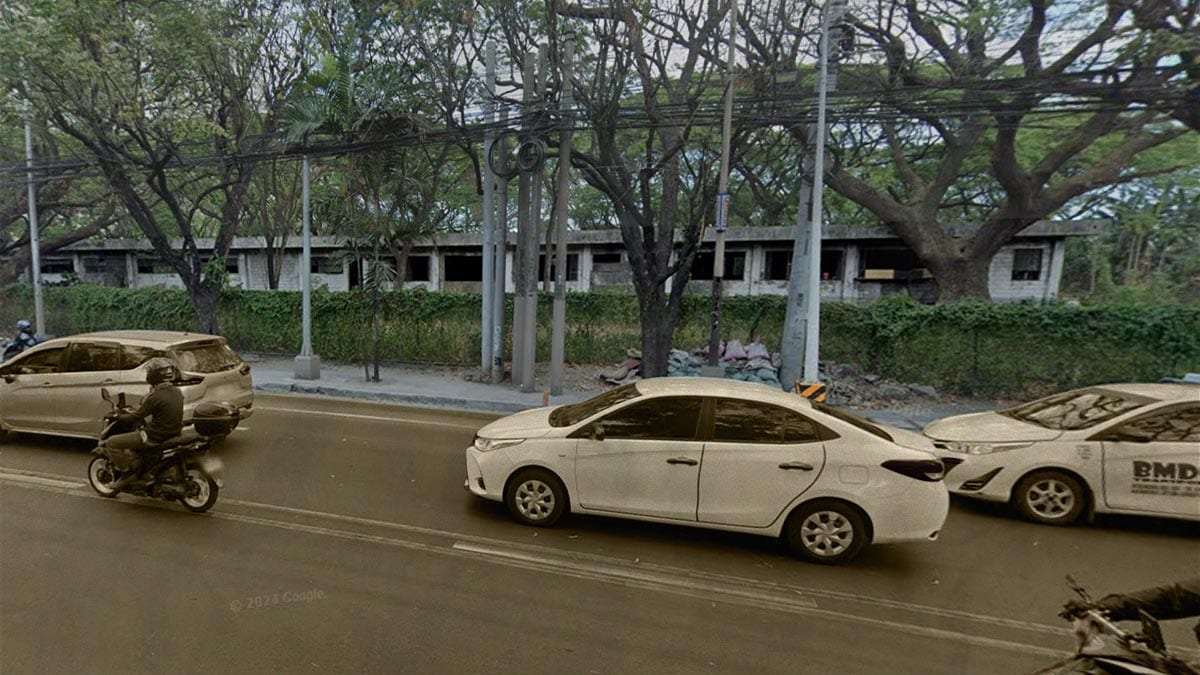
A street view of the PIMECO lot
However, after President Benigno “Noynoy” Aquino Jr. was sworn in, a new administration took over the PCGG. In March 2011, this new PCGG administration questioned the compromise agreement, calling it a “midnight deal” closed in the waning days of the administration of former President Gloria Macapagal-Arroyo and that it was “grossly disadvantageous” to the government.
Specifically, the new PCGG administration in 2011 insisted that the PIMECO property had a zonal value estimate of no less than P4.2 billion and an estimated fair market value of more than P6 billion but was sold for only P1 billion. According to reports, the PCGG received P100 million from the proceeds of the sale. This was the reason why the new PCGG, led by Atty Gerard Mosquera, who was then commissioner for litigation, asked the Sandiganbayan to nullify the deal.
By that time, according to the records of the PCGG, PIMECO was already 100 percent owned by the state after two of its biggest shareholders—Roberto Benedicto and Jose Yao Campos, surrendered their stakes to the government.
The terms of the compromise deal, according to the Rappler report, also showed that the PIMECO shares of another sequestered firm, Independent Realty Corp (IRC), were acquired by the SM Group’s CPDC for P10.909 million, while Sabido had already sold his shares for P20 million.
Legitimate deal
For its part, the SM Group maintained that its purchase of the PIMECO property was legitimate. The conglomerate insisted that it only went ahead with the deal after the Sandiganbayan approved the compromise agreement in March 2010. The SM Group also cited the Supreme Court’s termination of MPCP’s petition to review the Sandiganbayan’s own ruling upholding the validity of the lease-purchase agreement between MPCP and PIMECO.
In April 2015, the Sandiganbayan denied the PCGG’s plea to declare the compromise agreement void. This led the PCGG to take the case to the Supreme Court.
However, in September 2018, PIMECO initiated settlement discussions with the PCGG, hoping to come to a resolution that would see all parties benefiting. According to a report, in exchange for withdrawing its objections and abandoning its case, the PCGG, led by acting Chairman Reynold Munsayac, would receive an “additional consideration” of P100 million from PIMECO. The compromise agreement was signed in February 2019.
A few months later, in November 2019, the Supreme Court approved this compromise agreement, saying it is “not contrary to law, morals, good customs and public policy, and appears to be freely executed by the parties, with the assistance of their respective counsels.”
This was the last information we can find online about the PIMECO lot. Although it seems it is now indisputably owned by the SM Group, as of early 2025, the lot remains idle. There has been no news yet on what SM is planning to do with the property. With several big-ticket developments in that area—Megaworld’s Arcovia, Robinsons Land’s Bridgetowne, Ayala Land and Eton Properties’ Parklinks), and of course, the neighboring The Grove by Rockwell—we reckon it’s only a matter of time before that pocket of green will be turned into something else.