
A Famous Irish Political Scientist Has Another Legacy in the Philippines

About four years ago, I was in a near-empty classroom listening to my politics and governance professor raving about this Irish political scientist named Benedict Anderson. I was 17 then and my eagerness to explore the world of politics inspired me to give my professor my undivided attention. My professor was lecturing animatedly when he was interrupted by one of my classmates, who blurted out a question which, at that moment, seemed to the rest of us rather vague.
“Si Benedict Anderson ba…’yung malaking white guy na madaming libro?” she asked. “...’yung namatay sa Indonesia nung 2015?” to which our professor said yes. At that point, most of us in the class were confused. How did she know these details? This is a man we have only heard of just now.
“Lolo ko ‘yan,” she said.
That was my classmate, Amber Navoa, obviously Filipino. There was a silence that followed. There was a connection here, but no one in the room knew it yet.
Anderson took in her family before she had even been born, as it turns out. Anderson, the scholar most celebrated for his work on nationalism, had this whole alternate life—another legacy far different from the academic pursuits in the Philippines he’d been long associated with.
The Man Who Named Them
It all began in the ‘80s when Amber’s parents ended up working for Anderson: her dad, Henry, as a driver while her mom, Charity, mostly took care of domestic work. The author spent most of his time traveling in and around, studying the country, on and off, for two decades or so.
Anderson would eventually develop a fondness for the couple. This, to such an extent that when they started a family, it was decided that their firstborn was to be named Benedict, taking after the scholar.
“Siya yung nagpangalan sa’min,” Amber tells me. Anderson ended up naming three more of Henry and Charity’s children, including her. One of them, Aclan, was delivered while Anderson was traveling in the province of Aklan. You might guess where Aclan got his name. Meanwhile, Amber’s other first name, Coeli, came from Anderson’s fellow scholar in Thailand.
Lolo Ben and Kuya Badik; Benedict Anderson pictured with Amber’s oldest brother, Benedict

Lolo Ben, the Political Scientist
“Nationalism has to be understood, by aligning it not with self-consciously held political ideologies, but with large cultural systems that preceded it, out of which—as well as against which—it came into being.”
ADVERTISEMENT - CONTINUE READING BELOW- An excerpt from Anderson's Imagined Communities: Reflections on the Origin and Spread of Nationalism
Anderson established an esteemed reputation in the academe after publishing his book Imagined Communities: Reflections on the Origin and Spread of Nationalism back in 1983, which pioneered the idea of the nation as “an imagined political community.” He theorized that social groups (specifically, nations) are “imagined” because they are socially constructed; most often, people do not know and will not know every member of their community, yet they feel a sense of comradeship in sharing the same set of culture, beliefs, and interests.
Conversely, Amber says she’s always had a faint understanding of what her Lolo Ben did for work, but it was only before starting high school that she realized just how “famous” he was, for a lack of better terminology.
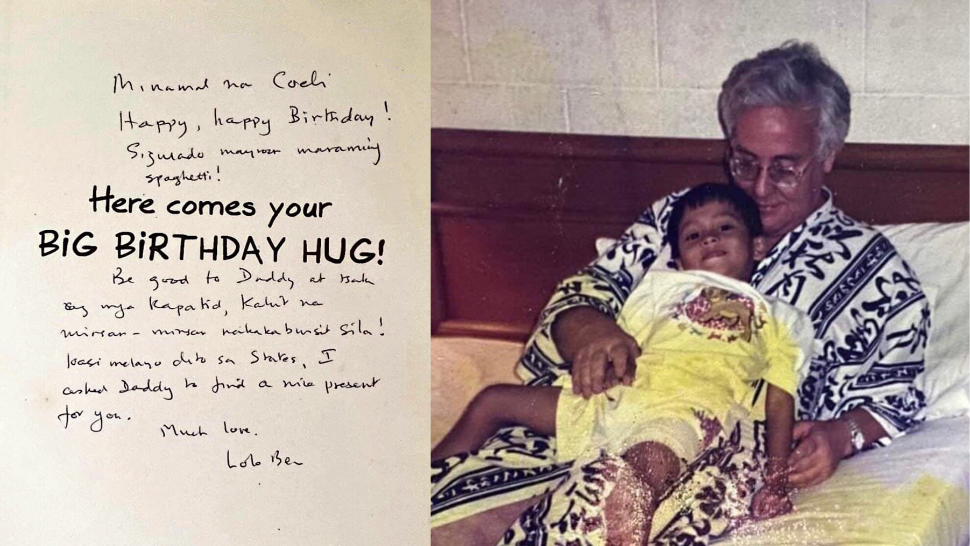
Birthday cards sent by Benedict Anderson to Amber.


To her family, however, Anderson was merely the wise grandfather figure who lit up the room with jokes and warmed hearts with hugs and kisses. He was someone who took them on out-of-country trips, never forgetting to send birthday cards or postcards from overseas. “Siyempre bata pa ako no’n, hindi ako aware. Parang ang tingin ko lang sa kanya, kalaro ko siya.”
She recalls being amazed by the books he’d written, many of which are considered groundbreaking in the field of social sciences. “Kaya pala ang daming libro sa bahay na may pangalan ni lolo, siya pala yung author no’n. Sabi ko, ‘ay, kilalang tao pala si Lolo Ben’.”
Anderson’s Why Counting Counts, a book published in 2008, examines the evolution of the social and political language used in Noli Me Tangere and El Filibusterismo. The book had even been dedicated to Benjo—Henry and Charity’s third child. One of her most cherished memories with her lolo, Amber remembers, is going to the book launches at Ateneo De Manila University and the National Museum, where she watched her brothers perform a special dance number for the event.
ALSO READ:
'Don't Shut Up!' Urges Journalist Maria Ressa in A Thousand Cuts
Life’s a Game of Connections
It was fascinating to hear such accounts of Anderson’s life. Usually, when we tackle thought systems in class, we focus on the concepts and conjectures that make up the theories. The authors, more or less, are oftentimes reduced to nothing but names on a paper, to be memorized during exams. Almost abstract in a sense. We facetiously cuss them out for making our studies difficult at times, too.
In a game of six degrees of separation, connections like these are thrilling. Learning that the exceptional man behind the papers is a kindhearted fellow makes him all the more amazing.
Amber mentions how much her Lolo Ben has impacted their family, from providing financial and educational support to the tender care that made them feel as though they were related by blood and not circumstance. “It never felt like we’re not related at all. He is the lolo I grew up with. Siya ‘yung pinaka-close sa’min, compared sa dalawang biological grandparents namin.”
“You are like an explorer, and try to notice and think about everything in a way you would never do at home, where so much is taken for granted. You can no longer take your class position, your education, even your gender, for granted. What you will start to notice, if your ears and eyes are open, are the things you can’t see or hear. That is, you will begin to notice what is not there as well as what is there, just as you will become aware of what is unwritten as well as what is written.”
- An excerpt from Anderson's A Life Beyond Boundaries
Amber’s third brother, Benjo, as seen on the dedication page of Benedict Anderson’s Why Counting Counts, published in 2008.

Beyond his scientific contributions to the study of humanities and Southeast-Asian politics, what sticks out to me most are his views on the importance of doing fieldwork and the value of quantitative analysis. As befits this humanistic nature, Benedict Anderson went outside the confines of traditional research methods.
He lived and died by the tenets of fostering community. Whether in Indonesia, Thailand, or the Philippines, Anderson made sure to immerse himself in the mundane, day-to-day lives of people, their way of life—soaking in the culture, learning about colloquial ways, and forging profound connections.
Simply put, as he reflected in his autobiography A Life Beyond Boundaries, published posthumously in 2016: to learn how to empathize with people is to learn the history and culture that shape them.
