
Did the Scripps National Spelling Bee Mix Up 'Baguio' and 'Bagyo'?

The Scripps National Spelling Bee, an annual spelling bee held in the United States, has been around since 1925. That's more or less 100 years—there were breaks between 1942 and 1946 as well as 2019 and 2021—of oral spelling onstage by students below 14 years of age. It's not only popular in the U.S., but also in other countries (like Guam, Puerto Rico, Nigeria, Jamaica, etc.) that send their regional spelling bee winners to the Scripps.
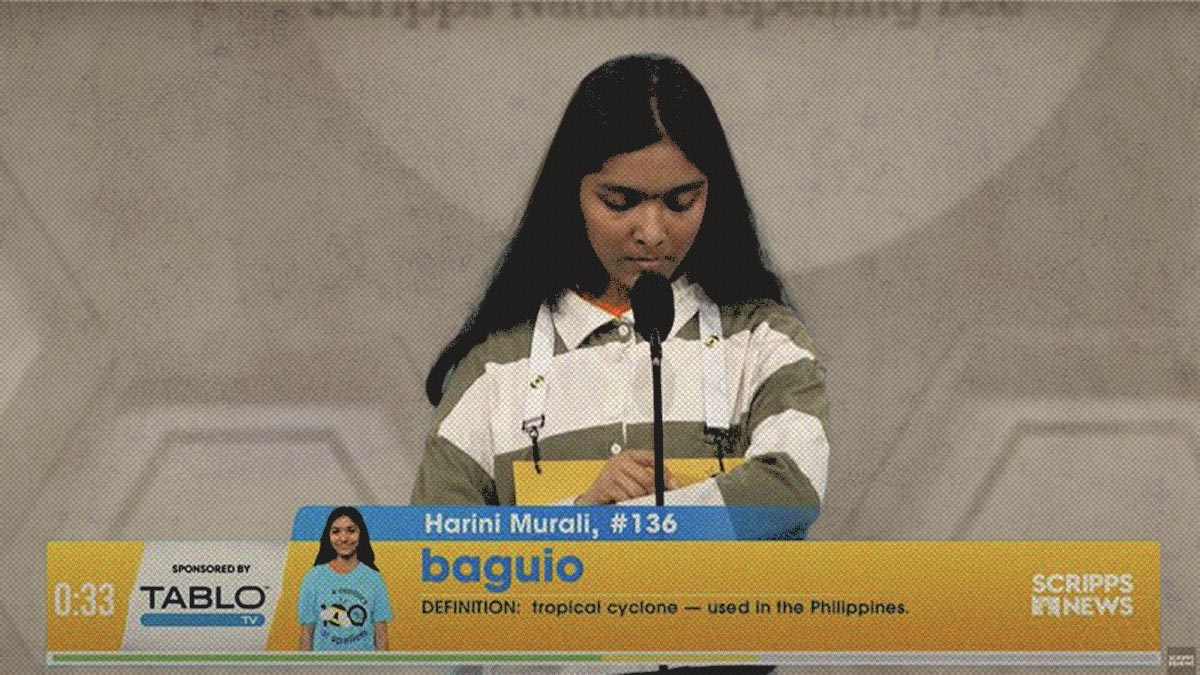
But most recently, it gained Philippine attention when, at the finals of the 97th Scripps National Spelling Bee on May 30, the word "baguio" came up on Round 13 with only six spellers remaining.
ALSO READ:
15 Fashion Brands You're Probably Spelling Wrong
Words Matter: A Review of The 25th Annual Putnam County Spelling Bee
"Baguio" or "Bagyo" at the Scripps National Spelling Bee
During Round 13, Dr. Jacques Bailly, official pronouncer of the Bee and winner in 1980, called up contest 136, Harini Murali, to the mic. The Grade 8 student hails from Edison, New Jersey, and has so far successfully spelled words like "bosc," "blepharism," "onegite," "bibliognost," in the prior rounds.
"Hi, Harini. Báguio or baguió," Bailly started, stresses indicated based on how he pronounced it (and, ultimately, how this writer heard it). His first was "BA-gi-yow", while the second was "bag-YOW." Letters in caps signify accented syllables.
The word sounds and looks similar to our own "Báguio", which is a city in Benguet; and "bagyó," which is the local Tagalog word for typhoon. Again, that's "Báguio" (capital B, stress on first syllable) and "bagyó" (small b, stress on second syllable), but the pronunciations slightly differ from Bailly's.
The rest of the segment went on:
Harini: Báguio. Can I have the language of origin, please?
Bailly: It's from Spanish, which took it from Ta- Tagalog.
Harini: Báguio. Can I have all the information, please?
Bailly: Baguío or báguio is a noun from Spanish, which took it from Tagalog. It's a tropical cyclone used in the Philippines. Virgil took shelter in the community center just before the baguió made landfall. Baguío or baguió.
Harini, after this information, changed her previous pronunciation a bit. Switching from "báguio," to something nearer Bailly's earlier "baguió."
Harini: Baguió. Am I pronouncing it right? I mean, yeah.
Bailly: Can we hear it again?
Harini: Baguió.
Bailly: Baguío or baguió
Harini: Baguió
Bailly: Baguío
Harini spelled the word, B-A-G-U-I-O, with one letter after the other being highlighted on the screen. "That is correct," the judges decided.
But the eighth grader lost in the 17th round after misspelling the word "tekke" as "tekki." She finished in fourth place.
So, did Scripps National Spelling Bee misspell "bagyo"?
Bailly did say that the word they were looking for came from Spanish.
In the Collins Spanish-English Dictionary by HarperCollins Publishers, "baguío" is defined as a masculine noun meaning hurricane or typhoon. The online dictionary also has a playable button for pronunciation, which sounds a lot like "ba-GI-yo," similar to Bailly's.
From that origin of the word, no, the Scripps National Spelling Bee did not misspell "bagyo." The word that needed to be spelled out was really "baguío," a Spanish word for typhoon.
Now, let's go to the next part in Bailly's reading of the etymology, where he said "a noun from Spanish, which took it from Tagalog. It's a tropical cyclone used in the Philippines." Based on the information, this meant that either "baguio" with the same spelling also means tropical cycle in the Philippines, or "baguio" came from the "bagyo" we know (or vice versa).
Did "bagyo" (the typhoon) come from "Baguio" (the city)?
Several sources, including the book The Philippine Archipelago by Yves Boquet and news outlets like the Chicago Tribune, claim that the word "bagyo" (typhoon) was coined from Baguio, when a record-high rainfall of 1170 mm within 24 hours happened in the city on July 15, 1911.
"The Tagalog term 'bagyo' is used to designate Philippine typhoons since a storm dumped a record rainfall of 1170 mm in 24 h in the northern city of Baguio on July 15, 1911," said Boquet.
"Baguio: A severe tropical cyclone (hurricane) in the Philippine Islands. The name derives from the Philippine city of Baguio, which holds the world record for 24-hour rainfall (46″) during the passage of a tropical cyclone in July 1911," said the Chicago Tribune.
This, however, assumes that the word "bagyo" (which supposedly came after "Baguio") hadn't existed until 1911.
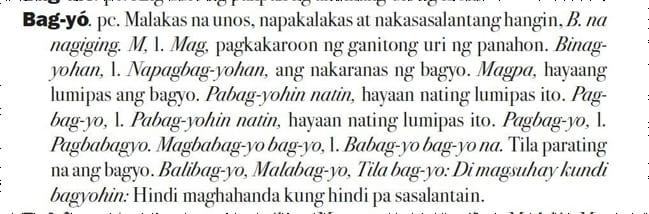
But Vocabulario de la lengua tagala already cited the word "bagyo" when the dictionary was written in 1613 and published in 1754. Its accent is on the second syllable, bag-yó; and is defined as "malakas na unos, napakalakas at nakasasalantang hangin," in a reprinting by the Komisyon sa Wikang Filipino in 2013. This means that our forefathers have been using the word "bagyo" since the 18th century (way before 1911, when the strong typhoon in Baguio was recorded); and maybe even before that, it just wasn't documented.
From Vocabulario de la lengua tagala (1754), reprinted in 2013 by Komisyon sa Wikang Filipino
A 2020 published research, Reimagining Panahon: Exploring the Nexus of Time and Weather in Philippine Languages by Ruchie Mark D. Pototanon (from UP Visayas), also observed that the word for typhoon or storm in 12 Philippine languages shows high cognacy, or high chances of a common ancestry in historical linguistics. "Bagyu" for Ilokano, Pangasinan, Kapampangan, Tagalog, Waray, Capiznon, and Bato-Rinconada Bikol; "badzu" for Ibanag; and "balyu" for Agutaynenn suggest Proto-Austronesian origins.
"We can say, therefore, that the word 'bagyu' in Ilo, Pag, and Pam are loans from other languages, the source of which could probably be again GCP languages like Tgl, Bisayan, or Bikol languages, or a /g/ language like Ibanag. Ibanag 'badzu,' on the other hand, may be a result of fricativization of Ibanag consonants, where the stop+affricate cluster /gy/ was reanalyzed as /dz/," the research said.
Therefore, "bagyo" did not come from "Baguio."
Then, there's the shifting of accent. The Names of Philippine Languages (by Carlos Everett Conant), published in 1909 in the journal Anthropos, made a case for "erroneous shifting of accent by Spanish writers of native words." Tagbánwa, for example, is the native pronunciation, but colonizers (and/or Spanish writers) called it Tagbanúa. In the same way that the Philippines' "bágyo" or "bágyu" is interchanged with the Spanish "baguio."
Did "Baguio" (the city) come from "bagyo" (the typhoon)?
Baguio was originally called Kafagway by its people (the Kankaney and the Ibaloi), the original inhabitants of the land. According to the Partners for Indigenous Knowledge Philippines, "Kafagway was the Ibaloy place name of a cool, hilly, pine-covered valley in what is now the center of Baguio City in the Cordillera." "Kafagway" refers to the wide open space or grassy area that characterizes that part of the Cordilleras.
In the 1900s, American colonizers took over Kafagway and transformed it into their place of rest and recreation, a city of vacation houses for when it became too hot in the capital in the lowlands. It was established as a hill station, the U.S.' only hill station in Asia.
The name "Baguio" came from the word "bagiw," which refers to a kind of moss that's common in the area, according to Ibaloy newspaper columnist and researcher Dr. Morr Pungayan.
As most legends go, where colonizers have difficulty spelling or speaking local words, and thus bastardizing them, the same supposedly applies to "bagiw" and "Baguio."
"Legend (or History) has it: when the Americans could not get the rather ‘difficult’ Ibaloi rendition of Ba-giw, they just let-be the spelling of the Ilokano (the first or nearest Lowland group to stay, work, or settle in then Ibaloi Bagiw) secretaries or clerks, escribientes, and that being: B-a-g-u-i-o," Pungayan said in an article on the Baguio Midland Courier.
Therefore, "Baguio" did not come from "bagyo".
Now, we have: Baguio (the city), bagyo (the typhoon), baguio (also the typhoon, but in Spanish). Confused? Well, "tifón" is also another Spanish noun for typhoon.
