

Siklesa Is the Kalesa's Natural Successor

Where is the kalesa's place in modern Philippines?
Since its introduction to the country in the 18th century, the humble kalesa has become one of our most enduring cultural icons. The image of a horse-drawn carriage traversing the narrow cobblestone roads in Manila will forever be ingrained in the Filipino psyche.
Today, with the advent of jeepneys and tricycles and buses and trains, the kalesa has descended into the backdrop of the country's transportation system. What was once considered luxury transport for the mestizos of yesterday has now been reduced to, at times, a caricature of our colonial past. It nevertheless will always be a symbol for Filipino transport innovation—one that should also survive and evolve in present times.
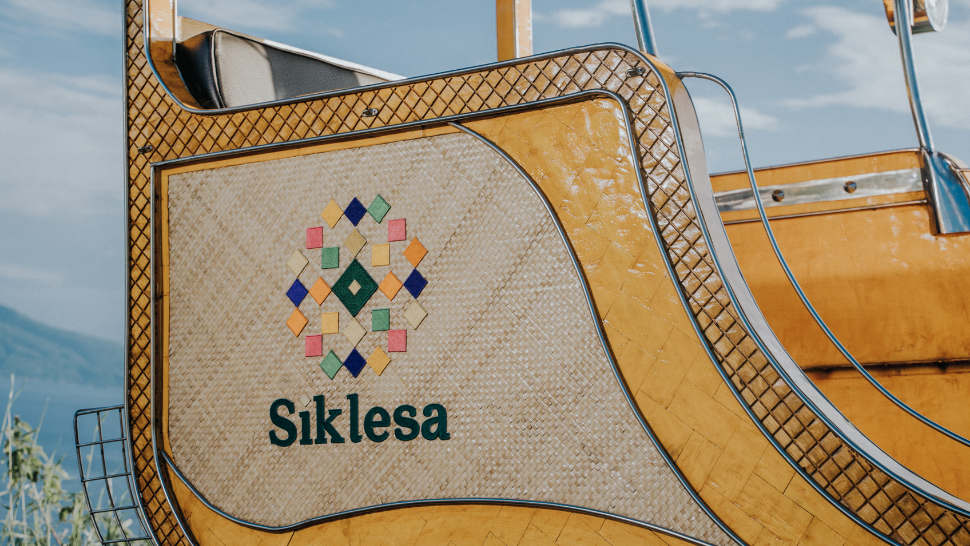
Siklesa shows us the possibilities of what a modern kalesa would look like. Entrepreneur Lorenzo Vega and Architect Jaime Recto first introduced us to the kalesa's natural successor in 2018 at Manila FAME. The "revolutionary Filipino vehicle" gave the old-time carriage some much-needed contemporary updates in design and functionality. It also captured the old kalesas' character and luster.
Fashion Designer Rajo Laurel once called it a product that "encompasses what being a Filipino is."
.png)
The Siklesa subsequently won the KATHA Award for best design at the show. It took Vega and Recto close to two years before unveiling the prototype to the public. "I still remember my grandmother light up when she saw it for the first time at the show all those years ago," Vega says.
Siklesa was actually a concept laid out by Vega's grandmother, former Marinduque Governor Carmencita Ongsiako Reyes. During their weekly health checkups to Chinatown, his grandmother showed him a picture of a crude design for a “kalesa without a horse." She told him that these were supposed to be used for a local festival but it never came to be. It was there that he saw the idea's potential.
"The way we’ve always envisioned it is that it is the next step in Philippine transportation," Vega tells Esquire Philippines. "We designed it with great respect to our heritage, but using contemporary technology, to hopefully create a vehicle that will be the future of transportation here."
Since jeepneys took over our roads in post-World War II Philippines, it's been a while since we've seen our last true transport innovation update. "When we talk about Siklesa, we really see it as the successor to the jeepney, the next step in Philippine transportation," he claims. "It's a Philippine cultural icon in-the-making."
The Siklesa is powered by 175cc gasoline motorcycle engines, operating within a custom frame and chassis. It speeds up to about 80 kilometers per hour and offers riders a nice, comfortable trip. Since it was launched, Siklesa has been used by hotels like the Manila Hotel and institutions like the Department of Tourism and Ayala Corporation, to name a few.
They even accept customization requests. Vega recalls one particularly peculiar one, too. "I can’t say too much about it, but some years ago we were approached...to create a design to serve as a gift from our country to a certain Chinese political figure."
The electric Siklesa should be making its debut around September, according to Vega.
.png)
Vega's group works with a factory in Las Piñas where they source all of the materials, most of which are indigenous to the country, like the banig. The vehicle also makes use of more modern materials, such as the tried-and-tested stainless steel. The next step for the Siklesa is actually in the works: An electric, zero-emissions Siklesa, to be exact.
The project began roughly three years ago when Vega's group consulted with various experts who had experience in electrical vehicle manufacturing. It was incredibly challenging for the team, to say the least. One of their main concerns was balancing the weight of the vehicle, making sure it wouldn't be too heavy for the build.
Powerful batteries and motors generally increase the weight the car carries. It also dramatically increases the cost. Vega and his team still want to maintain a market-appropriate price tag, of course. The price of the current version of the Siklesa starts from P300,000.
In terms of the design, heritage and modernity are still at its core. The new Siklesa looks relatively similar, only differing in how it works. "Aside from the obvious benefits of zero-emission, it is an overall quieter ride, and it is as easy to drive as a golf cart," Vega explains. "In addition, the price is a fraction of what it would cost in terms of mileage compared to using a vehicle (that runs) on fossil fuels, since the price per charge is quite minimal, relatively speaking."
It should be easy enough even for a child to drive (under the supervision of an adult, obviously). But the team also ran into other legal hurdles. When it comes to legal terms on electric vehicles, the Land Transportation Office has been vague on electric vehicle registration and restrictions.
"Consumers and cultural advocates can expect continued designs that pay respect to Philippine heritage but with a forward-thinking spin," Vega promises.
.png)
Vega and his cohorts are working on different variations of Siklesa simultaneously. Two of them involve designs that would be readily available on major roads like EDSA and a Siklesa "pedicab." The obvious challenge with these new prototypes, Vega says, is still about retaining the Siklesa signature.
"We feel strongly in continuing to innovate," he says. "Quite often, on the bucket list for a lot of tourists who visit our country here is to ride a jeepney. We hope to add the Siklesa to that list."
In the long run, Vega and his team hope to spread Siklesas all over the country. They want to make the units more affordable, where even local tricycle drivers would choose to drive a Siklesa instead.
"We’d like to reach a point that the design is no longer seen as a novelty but something that is synonymous with our country. In essence, we see it being adopted all over the Philippines, and even outside, as an export that we can be proud of," the entrepreneur remarks. "We’d love to open showrooms internationally. We’ve gotten a number of inquiries and offers, but we did not proceed as we are not ready for that yet at this point in time. It will happen though—we’re nothing if not ambitious."
To reconcile the spirit of the kalesa and the grips of modern transportation problems is a tall task indeed. But Siklesa looks to address them straight on. Siklesa, after all, makes sense as a natural progression of centuries' worth of transport vehicle development.
"I suppose if I could sum it up in a single sentence: The Siklesa is the past, present, and future of Philippine transportation," Vega says.
