
Today I Learned: The Spanish Origin of the Filipino Word 'Undas'

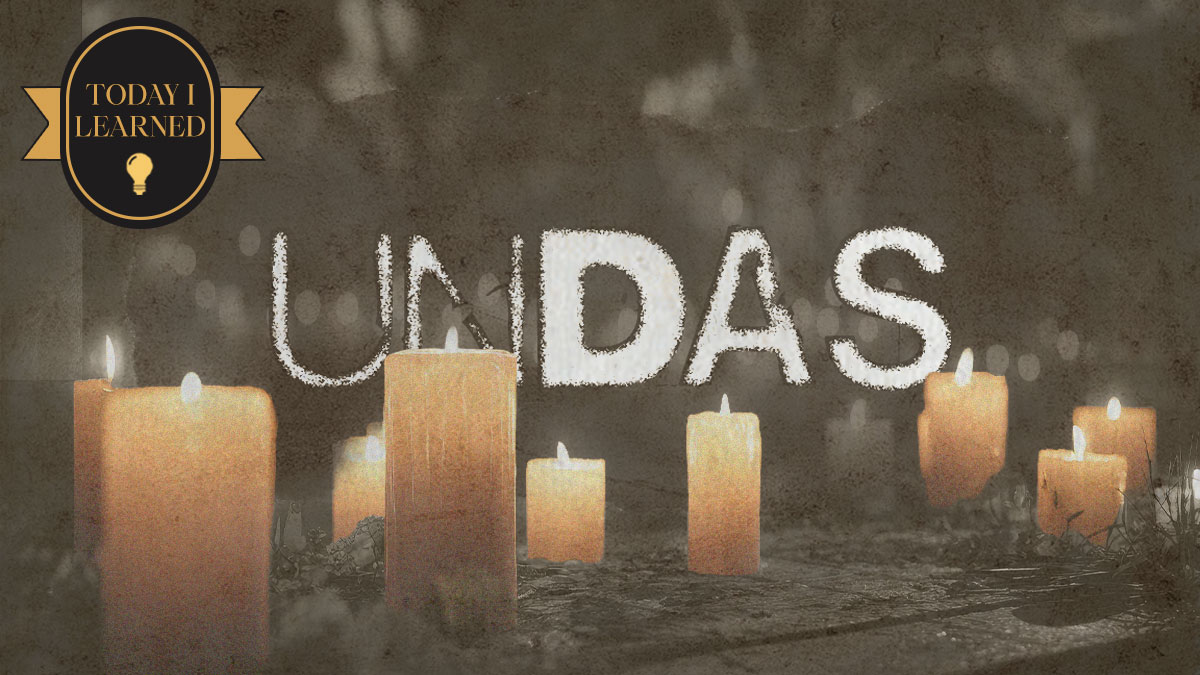
Every start of November, Filipinos observe a solemn commemoration of the departed. Preparations begin as early as October 31, when people return to their hometowns, ensuring they visit the tombs of deceased loved ones by November 1 (Todos Los Santos or All Saints' Day) or by November 2 (All Souls' Day). Collectively, these days are referred to as undas, the Filipinos' unique tradition of honoring the dead.
As a predominantly Catholic nation, some of us believe that praying for the souls of the dead ensures that they're at peace or helps hasten their transition from Purgatory to Heaven. This also aligns with the Filipino value of family closeness, as the dead are never forgotten.
ALSO READ:
Alcohol and Undas: Filipinos Turn to Liquor in Times of Grief and Celebration
In Bacolod, There's a Pre-War Cemetery in the Middle of the Road
The undas is our version of Halloween, but instead of decorating our homes with fake spiderwebs, we light candles on our doorstep. Instead of giving away candies for trick-or-treat, we offer food to the dead (a.k.a. atang in Ilocano tradition) by putting kakanin in front of their photos in an altar or by their tomb.
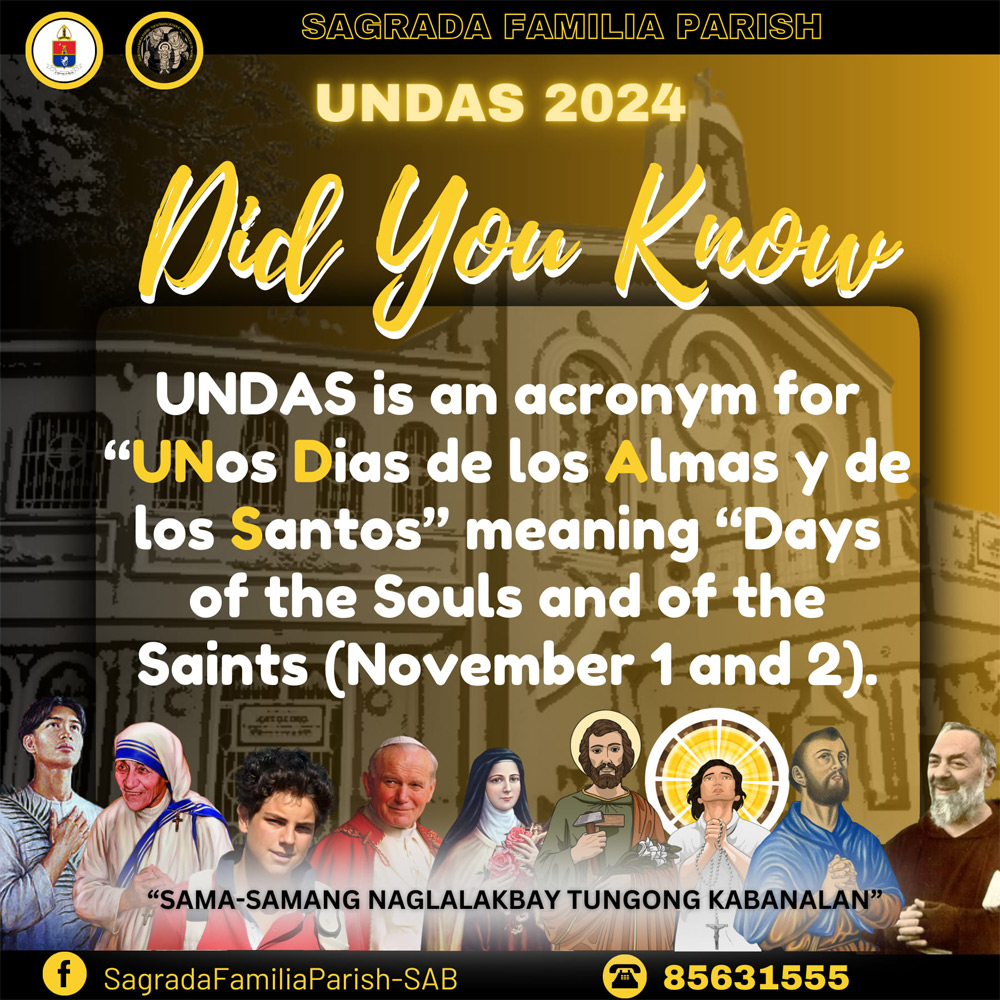
But where did the word undas actually come from? A compelling—but incorrect—claim seems to circulate on social media every year, insisting that the word is an acronym for the long Spanish phrase, "UNos Días de las Almas y de los Santos." It actually makes sense, since the literal translation of that is "Days of the Souls and of the Saints"—technically, our November 2 and 1 celebrations, in that order.
But Fr. Francis B. Lucas, CEO and President of the Catholic Media Network, tells Esquire Philippines that "This acronym has not been found in any historical literature."
A widely shared claim on social media insists that undas is actually an acronym for "UNos Días de las Almas y de los Santos." Is this the real origin?
And while that explanation is catchy and clever, the etymology of the Filipino word undas is not a convenient modern acronym, but rather traces its roots to the old Spanish word honras, which means honors, specifically honras funebres or funeral honors (as in, honoring the dead).
The UP Diksiyonaryong Filipino (2nd Edition, 2010), which was edited by National Artist for Literature and former Komisyon sa Wikang Filipino chairman Virgilio Almario, lists the word undas as having a Spanish origin. Its definition is Araw ng mga Patay, with the variation undras.
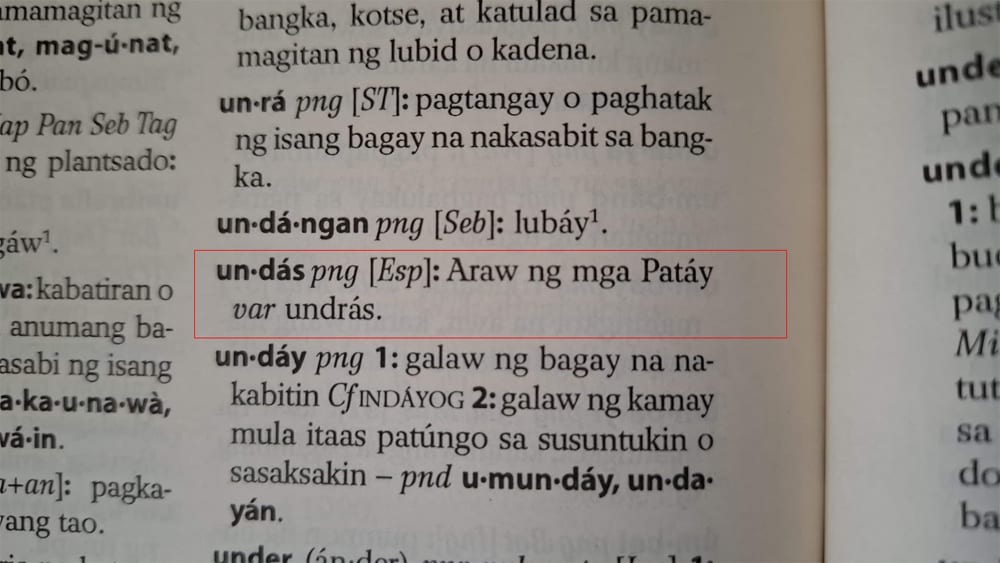
The KWF Diksiyonaryo ng Wikang Filipino, which is accessible online, likewise lists undas (un•dás) as a noun with Spanish origins (ondra+s), defined as Araw ng mga Patay, with the variation undras (un•drás).
Undras (instead of undas) is being used by speakers of Chavacano de Cavite, a Spanish-based creole language variety in the province of Cavite. Chavacano, the only Spanish-based creole in Asia, is also spoken in Zamboanga City.
Diksyunaryo-Tesauro Pilipino-Ingles by Jose Villa Panganiban (1972) and Tagalog-English Dictionary by Leo James English (1986) also indicate that undas is a noun of Spanish origin and not an acronym.
So how did honras become undas? Sound change is common when Tagalog speakers adapt foreign Spanish sounds. "H" in Spanish is often silent, so "honras" may sound like "onras." The shift of r to d, on the other hand, is common among the Tagalogs (especially in Southern Luzon), where the r phoneme is an allophone of d. We're familiar with the rito-dito and raw-daw swaps, the transformation of lunod to lunurin (for example), ma + dunong to marunong, etc.
The history of undas reveals that its origin is not a fabricated acronym, but rather a linguistic evolution. It reflects that we're not just mentioning a holiday, we're also participating in a centuries-old tradition of honoring our dearly departed.
