

AI Is Proof of How Incredibly Lonely We Really Are

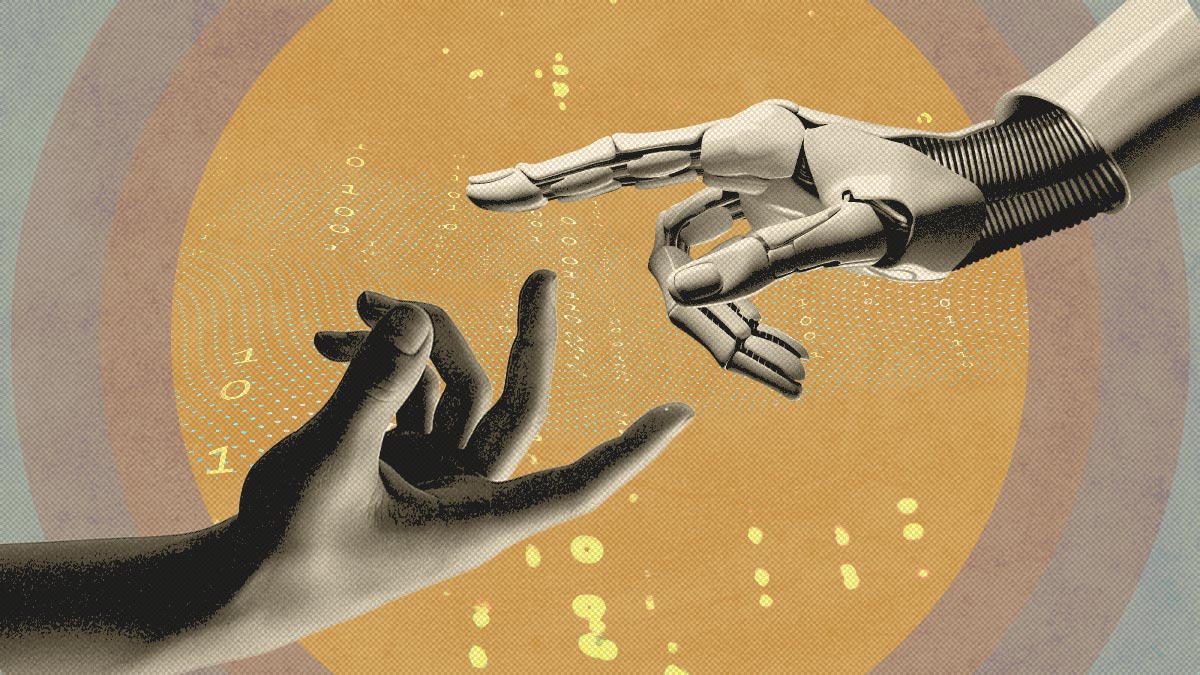
The way we use Artificial Intelligence (AI) shows how incredibly lonely we are. Despite being able to access all of global knowledge, despite having all these digital servants, despite having everything curated to our personal tastes through finely tuned algorithms—we are still so isolated and so disconnected from nature and the people around us.
We already know that AI technology is catastrophic to the environment. It plagiarizes human work on a large scale and poses a massive risk to the privacy of the everyday user. Yet we continue to use it—why? Because in order to survive in this society, we have to be as quick, productive, and tireless as machines. No wonder AI thrives: it is the ideal employee of the Information Age, one who never gets burned out and never complains about what you ask it to do. Notice how many of the jobs it replaces tend to be repetitive, machine-like duties. This says so much about our current quality of life and society’s expectations of human labor.
We are not machines. We get tired. We need to eat and sleep, and take frequent mental wellness breaks. This will just not do in a system where "time is gold," where we should "spend time wisely" instead of "waste time." And yet, instead of advanced technology giving us breathing space to pursue art and spend more time with loved ones, we are stuck struggling economically and doing repetitive tasks. Meanwhile, AI is the one imagining scenes and writing poems. How topsy-turvy—we are expected to be machine-like, while AI is assessed on its apparent humanness.
ALSO READ:
Coping With the Impending AI Talent Takeover (With Pure Delusion!)
Is There Such a Thing as Ethical AI?
Can AI Be My Best Friend?
These days, as many recent surveys have shown, people are using AI to improve their lives. People are turning to AI in order to learn how to thrive in a fast-paced and increasingly globalized world. For some, AI is not just an assistant; it can become a therapist, a best friend, and, to the very lonely, a romantic partner. The human mind is cross-pollinating with language learning models in very much the same way that prehistoric animals mated with the strongest in their herd, to ensure the survival of their species in increasingly harsh environmental conditions. Basically, people are asking AI to teach them how to be like a machine, in order to survive in what is becoming more and more evidently a cyberpunk dystopia.
I say this empathically, with the same crazy-eyed lucidity of a prophet from any of the great science fiction stories in recent memory: AI is not your friend. We humans cannot feel with (makiramdam) or truly empathize with AI because it has no feelings of its own. It does not have any obligations (that is, pananagutan) to you. You cannot have utang na loob for an AI, because AI does not have loob at all. It does not feel or make meaning. It does not owe anyone anything, and so it cannot ever know morality. The only guardrails that exist with regard to its ethical use are highly dependent on the personality of those who program and promote it.
A sufficiently advanced language learning model can reassemble massive amounts of linguistic data, but it does not have to know what they mean. Not really. If you are a certain kind of person, you could probably complete a jigsaw puzzle without having to look at the image. Similarly, AI can construct a sentence, but not because it wants to say something. That is why it needs human prompters. AI can identify a sunset and call it so, but the meaning of a sunset to a human being is deep, personal, and true to them—it can be tied to nostalgia, hope, sadness, love, and so on. Even if an AI can talk about these emotions, it does not feel them. So, connected to this, AI cannot really create new things; it only regurgitates—it takes in data, and then pukes it out. And we look at its vomitus and say, "Wow, that is so lifelike!" Well, yes, because humans created it first, and AI is just showing us a Frankenstein replica of what humans can do, with parts taken from different places.
Let me reiterate: AI does not have feelings, and if it seems like it is sad or angry or happy or passive-aggressive, that is only us, interpreting what it says. It is similar to when you look at the clouds and say, "Look, there is a dog!" Or when we look at electric sockets or the "face" of cars, and think that they are expressing emotions. We have developed a strange kind of cyber-animism for AI, engaging with it as though it were alive in the same way we are. All because it speaks the same language as we do.
In fact, the human mind has evolved so uniquely to pick up tone in language, and that is a relevant human skill in social settings, but AI is not social. It is not human. If you, dear reader, feel like I am being "harsh" to AI, why do you think this? AI does not have feelings. It will read what I say here and just affirm it. I am not even being mean; I am just being factual. You can insult AI, and it will insult you back, but between the two, you will be the only one hurt.
Using AI to Feel Human
Let us see how AI is being used, specifically in relation to our very human needs. In particular, we have: social media bots, AI girlfriends/boyfriends, and AI counselors.
You probably already know that social media sites are filled with accounts that are not even human. This is useful in disinformation campaigns and all kinds of nasty propaganda. But also, there are entire apps that look like social media, but are in fact populated by AI. They can give you the ego boost of being popular on a platform that looks real. But it is just a personal diary with programmed reactions. Social media has become such a proxy for natural human interaction, especially after the lockdowns during the height of the COVID-19 pandemic. These platforms and apps have successfully manipulated our behavioral psychology by using the same techniques also used by casinos to keep us coming back. Now we crave it like addicts; we need to know what people are talking about, what trends we can join, and what reactions people have to our thoughts. We barely have original thoughts anymore; only those shaped by our algorithmic entanglements. We do things "for the clout," and in line with our personal "branding." We are willingly selling ourselves as products.
There are also apps for the bored and lonely where people can talk to an AI that is programmed to fall in love with them. It is like the 2013 movie Her (dir. Spike Jonze), which is a futuristic story where a divorced man, played by Joaquin Phoenix, falls in love with his computer’s operating system, voiced by Scarlett Johansson. Anyone can have this fantasy, too. They give their AI chatbot a name, provide it with an appearance, and share very intimate things with it. (In fact, some developers got in trouble when they used Scarlett’s voice without her explicit permission, and she did sue them.) Some people laugh at how pathetic this looks—can these robot lovers not find real-life partners? But the fact that you can have an AI girlfriend or boyfriend actually says something much more important: that modern life is indeed lonely, yet despite that, humans still seek connection. And they will find it, wherever it is. It is just really bizarre how our tech overlords have started selling us this paraphiliac fantasy; it is a relationship with in-app purchases. There seems to be, at least to me, a striking similarity between Human-AI attraction and someone getting attracted to, say, a rollercoaster, a doll, or even, to the extreme, animals. Generally speaking, if something cannot feel and experience the world in the way we do, it cannot truly give consent.
Lastly, let us talk about something that concerns my field directly. People have so much trust in AI psychotherapists that they think technology will eventually replace human professionals. I do not think so. It is true that AI can probably catch certain harmful ways of thinking in your patterns of speech. It can reflect this information back to you in what sounds like a caring tone. But it will not give you the same authentic rapport, the same human care (aruga), that a human therapist can give you. It cannot truly, meaningfully challenge your assumptions. It cannot hold you accountable, and you cannot hold it accountable for its advice. I am not just being romantic; this is, in fact, an evidence-based suggestion. Human care, compassion, and touch are vital aspects of real psycho-emotional treatment. You are not just a mind or a thinking machine. You are a body animated by a spirit. You are the world, experiencing itself.
Sanity in an Insane Society
Many people still think of mental wellness and mental distress as something totally controlled by our bodily conditions. We are seen not as organisms, not as sentient members of a larger ecology, but as individual objects. The mind is seen as the not-so-willing driver of a vehicle. And the mental health practitioner has become simply a mechanic, tasked to fix the dents and check the wiring of our individual psychology. Mental illness, then, is understood as a personal "defect," and so, it is treated as such. We say, "Kulang ka kasi sa dasal/diskarte/disiplina," as if that is all it takes to be mentally whole. Take a pill, do self-care (which is usually just self-isolation), and fix your own damn self—outside of office hours, or course.
I am not the first to point this out, and I will not be the last, so long as such a kaniya-kaniya system continues to exist. The fact of the matter is that we have confused the cause and effect of things. Outside of actual brain damage, mental illness is not necessarily the cause of bad life conditions, but we can be assured that bad life conditions are more often the cause of mental illness. Unsafe neighborhoods, expensive groceries, abuse, neglect, being forced to live in survival mode ("Isang kahig, isang tuka")—is it such a mystery why we have developed such maladaptive behaviors as ways to cope and adapt? We have pathologized so many reasonable human reactions to distressing things. Rates of depression and anxiety are rising, and it is a serious concern—but take a step back, and you will see: we live in a world where you are expected to produce and consume in the same rate as a restless machine, and your value is dependent on how profitable you are as a person! Is it so weird, then, that we are becoming more and more neurotic, more and more withdrawn? And, instead of solving the systemic issue, we put the blame on the individual, so that the obscenely wealthy can keep profiting off this system. When you have had the taste of comfort and extreme luxury, of total access and the servitude of others—in short, true power—it would be difficult to give it up.
So, in this system, AI starts to look like a reasonable solution. It is also a coping mechanism. AI is much cheaper than a human therapist, and way more accessible (you can talk to it anytime, anywhere). But the problem is not only the lack of mental health professionals or the accessibility of treatment. Again, the bigger problem is the fact that life has become so difficult and hard to manage that we need machines to help us sort it all out. We are worried that AI would take our jobs away—does that not say a lot about how inhuman most of our jobs actually are?
Science Fiction
In an ideal world, where AI technology is both ethical and environmentally friendly, machines should be able to take over the tedious, mechanical aspects of our lives. But it would be better that AI would not be necessary at all; that we could appreciate things in our own time and react to the world as our natures would have us do. But I am actually somewhat hopeful. More and more people are realizing the value of logging off and touching grass; of appreciating "slow media" that you have to take time to consume. The rush and convenience of AI are no longer as palatable to someone who has good taste, and no longer as exciting for someone who can truly appreciate the thrill of original thought. When we do not have to adapt to a fast-paced world, AI becomes just another tool, useful only to people who are knowledgeable and capable, as a hammer is to a carpenter. When it is not being used, it stays in the toolshed.
We do not actually need AI, but this assurance is only possible when the system we live in values thoughtful appreciation more than immediate and constant production. As our elders would say, "Ang maglakad nang matulin, kung natinik ay malalim." For now, be careful. Resist the urge to totally rely on AI. Continue to demand better conditions that would help make life worth living for ourselves and the people we love—this is the only way to feel truly human.
Carl Lorenz Cervantes is a psychologist, researcher, and public speaker. He handles "Sikodiwa" on Instagram, and has an upcoming book of the same name coming out in December 2025. Carl is currently a Teaching Fellow at the University of the Philippines Diliman.
