
Financial Adviser: 5 Best Performing Blue-Chip Stocks in the First Nine Months of 2024 and How to Profit from Them

As the first nine months of 2024 come to a close, the Philippine stock market has staged an impressive comeback, with the Philippine Stock Exchange (PSE) Index reaching the 7,400 mark. This remarkable recovery follows a turbulent start to the year, driven by global uncertainties and domestic challenges.
Now, with improving economic conditions and a shift in monetary policy, the market has gained solid momentum, sparking renewed optimism among investors. The primary catalyst for this surge has been the central bank’s decision to cut interest rates.
After a period of high inflation and tight monetary policies, the easing of inflationary pressures has allowed the central bank to lower rates, which provided much-needed support to the economy. This rate cut has made borrowing cheaper for businesses and consumers, encouraging spending and investment. For investors, lower interest rates have made equities more attractive than fixed-income assets.
This resurgence has been broad-based, with gains seen across key sectors such as consumer goods, property, and infrastructure. About 70 percent, or 21 out of the 30 companies in the PSE Index, have posted positive year-to-date gains.
These sectors have benefitted from stronger consumer confidence and government infrastructure programs, which have supported economic growth. The optimism in the market has been fueled by expectations of continued decline in inflation and interest rates, with many investors believing the worst of the economic challenges may now be behind us.
However, despite the positive outlook, there are reasons for investors to remain cautious. While interest rate cuts have provided a much-needed boost, external risks still pose a threat to the sustainability of the market’s uptrend. Geopolitical tensions, particularly in the Middle East, remain unresolved and could potentially disrupt global markets if they escalate further. Additionally, the risk of a global economic slowdown, especially in major economies like the United States and China, could negatively impact the Philippine economy and its stock market.
Domestically, while many sectors are showing signs of recovery, others continue to face challenges. Inflation, although easing, still impacts consumer spending power, and certain industries may struggle to keep pace with the broader market recovery.
Investors need to remain vigilant and selective in their stock choices, focusing on companies with strong fundamentals, such as healthy balance sheets, consistent earnings growth, and competent management teams.
Diversification is also crucial in exploring the current market environment. While the overall market is trending upward, not all sectors or companies will perform equally well.
By spreading investments across various industries and asset classes, investors can reduce their exposure to sector-specific risks and enhance their chances of capturing growth in different areas of the economy.
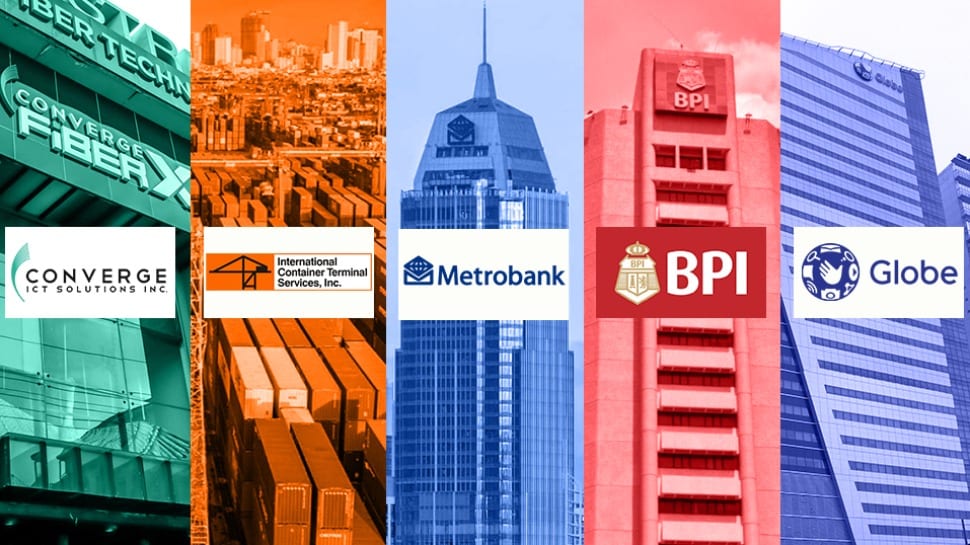
For the first three quarters of 2024, let’s take a look at the performance of the five biggest blue-chip winners to date and how to profit from them:
ALSO READ
Financial Adviser: 5 Dividend-Paying Preferred Stocks Every Saver Can Buy to Earn Up to 10.3% p.a.
1| Converge ICT Solutions, Inc
Price: P16.78
Year-to-date gain: +100.2 percent
Converge ICT Solutions (PSE: CNVRG) holds the title of the largest high-speed fixed broadband operator in the Philippines, boasting a 55-percent market share for download speeds of 25 Mbps and higher.
Over the past three years, CNVRG has maintained dominance, securing approximately 60 percent of new fixed broadband subscriptions. Its residential business contributes to about 77 percent of total revenues, while the remaining 23 percent is derived from providing high-speed fixed broadband solutions to companies.
CNVRG’s total revenues have been growing rapidly by an average of 196 percent per year from P1.9 billion in 2016 to P33.7 billion in 2022. This growth in revenues has enabled the company’s net income to increase by an average of 53 percent per year from P574 million in 2016 to P7.4 billion in 2022.
From 2021 to 2023, CNVRG experienced consistent revenue growth, though the rate slowed over time. In 2021, revenue surged by 69 percent to P26.5 billion, boosting net income by 111 percent to P7.1 billion. In 2022, revenue increased by 27 percent to P33.7 billion, while net income grew by only four percent due to higher financing costs and customer churn. By 2023, revenue growth slowed to four percent, reaching P35.4 billion, but net income rose by 22 percent to P9.09 billion, driven by improved gross margins and lower operating costs.
This year, CNVRG's first six-month total revenues grew by 12 percent to reach P19.5 billion, compared to P17.4 billion in the same period last year. Consequently, its net income saw a strong growth of 24 percent, reaching P5.3 billion from P4.3 billion in the previous year.
CNVRG had been the biggest loser in the PSE Index for two consecutive years, shedding up to 61 percent of its value from its 2023 peak of P19.98 per share due to negative sentiment surrounding the stock. However, this year, with an improving earnings outlook, CNVRG has staged a remarkable recovery, surging by more than 100 percent from its low of P8.38 per share at the start of the year to as high as P17.40 per share recently. This turnaround makes CNVRG the biggest winner in the PSE Index so far this year.
The rise in the stock price of CNVRG has increased its 12-month trailing PE ratio to 12.25 times, making it relatively cheaper compared to other telecom stocks such as Globe Telecoms (PSE: GLO), which has a PE ratio of 14.0 times and PLDT (PSE: TEL), which is trading at 12.34 times PE ratio.
When comparing the Enterprise Value-to-EBITDA (EV/EBITDA) ratios, CNVRG is on par with PLDT (PSE: TEL) at 5.9 times, but significantly cheaper than Globe Telecom (PSE: GLO), which has an EV/EBITDA ratio of 7.72 times.
Given the relative pricing of CNVRG, the stock offers a good opportunity for trading. If we value CNVRG at similar price-to-earnings ratio of GLO at 14 times, given its strong earnings momentum this year, we can anticipate a further advance in the stock price towards P20 per share. This would result in a gain of 19 percent from its current share price.
2| International Container Terminal Services
Price: P140
Year-to-date gain: +66.1 percent
International Container Terminal Services, Inc or ICTSI (PSE: ICT) is one of the world’s leading global operators of international common user container terminals serving the container shipping industry ranging from 50,000 20-foot long containers (TEU) to 3.5 million TEUs.
ICT has 35 terminal operations, including concessions and port development projects, in 20 countries worldwide, which include its flagship, the Manila International Container Terminal.
ICT’s net earnings have grown at an average annual rate of 13.2 percent from $130 million in 2011 to $581 million in 2023, driven by consistent revenue growth of 11.1 percent per year. This strong earnings performance has translated into a 13.7 percent annual increase in its share price, rising from P53 per share in 2011 to P246 per share in 2023.
This annual appreciation is also consistent with the share price’s compounded annual return of 17 percent for the past 27 years where the stock grew from P5.78 per share in 1997 to P403.4 per share today.
Last year, ICT reported that its total revenues grew by 7.0 percent from $2.3 billion the previous year to $2.48 billion, but its net income declined by 14.2 percent to $581 million due to booking of one-time impairment losses of $165 million. Without it, ICT’s income would have grown by 9.8 percent from pre-tax income of $830 million to $912 million.
This year, ICT’s first-half revenues saw a robust 14.5 percent increase, rising from $1.2 billion to $1.4 billion. Meanwhile, net income surged by 32.7 percent, reaching $461.9 million compared to $348 million in the same period last year.
At the beginning of this year, ICT was trading at a PE ratio of 24 times, representing a 50 percent premium over its three-year average of 16 times.
However, thanks to the company’s strong earnings performance, its 12-month trailing PE ratio has decreased to 20 times, even as its share price has surged by 66 percent this year. If the stock returns to its historical PE ratio of 24 times, ICT’s share price could increase by an additional 20 percent, reaching P483.6 per share before the year ends.
3| Metropolitan Bank and Trust Company
Price: P81.05
Year-to-date Gain: +57.9 percent
Metropolitan Bank and Trust Company or Metrobank (PSE: MBT) is the second largest private bank in the country with total assets of P2.8 trillion. MBT is a member of the GT Capital group, one of the country’s largest and most successful conglomerates with businesses spanning retail, property development, and financial services.
MBT’s total interest income derives primarily from loans and receivables, which contributes about 68 percent of the total with the balance from trading of securities and investments in bonds and other debt instruments.
MBT's total interest income has experienced consistent growth, averaging a 7.0 percent increase annually, surging from P68 billion in 2016 to P102 billion in 2022. Concurrently, its net income also rose steadily, averaging 10.4 percent growth from P18 billion in 2016 to P32.8 billion in 2022.
Last year, MBT saw a substantial 28.9 percent surge in net income, reaching P42.2 billion compared to P32.8 billion in the same period last year. This remarkable financial achievement was underpinned by robust year-on-year revenue growth, which grew by 18.5 percent to P134.4 billion.
This year, MBT’s net income for the first six months increased by 13.3 percent, rising to P24 billion from P21.2 billion in the same period last year. This continued growth reflects the bank's strong financial performance and consistent revenue generation, building on the momentum from the previous year’s impressive results
At current share price of P81.05, MBT’s PE stands at 7.79 times, which is lower than its average PE ratios for the past three years at 8.1 times. It is also significant lower than its peers such as BDO Unibank (PSE: BDO) at 11.2 times PE and Bank of Philippine Islands (PSE: BPI) at 11.72 times PE.
If we price MBT at only 80 percent of the average PE ratios of BPI and BDO at 11.46 times, which is 9.2 times, we should expect its stock price to reach at least P95 per share this year.
The other way to price MBT is based on its Price-to-Book (PBV) ratio. At its share price, MBT’s PBV ratio stands at 1.03 times, which is three percent premium to its book value per share of P78.6.
A higher PBV ratio for MBT is justified by its improved Return on Equity (ROE). In 2023, MBT’s strong earnings growth pushed its ROE to 12.5 percent, up from 10.3 percent in 2022. This year, MBT’s 12-month trailing ROE has further increased to 13.12 percent. This reflects the bank’s enhanced profitability and efficient use of equity.
If we value MBT at a 20 percent premium over its book value per share, or a PBV of 1.2 times—equivalent to 50 percent of the average premium enjoyed by BDO and BPI—the stock should reach at least P95 per share.
4| Bank of Philippine Islands
Price: P137
Year-to-date Gain: +31.98 percent
The Bank of the Philippine Islands (BPI) is one of the oldest and most established financial institutions in the Philippines, with a rich history dating back to its founding in 1851.
As one of the largest banks in the country, BPI operates over 800 branches nationwide. It is majority owned and controlled by Ayala Corporation (PSE: AC), one of the Philippines' leading conglomerates, further strengthening BPI's position as a trusted and stable player in the banking industry.
BPI’s total interest income derives primarily from loans and receivables, which contributes about 83 percent of the total with the balance from trading of securities and investments in bonds and other debt instruments.
BPI's total interest income has shown consistent growth, averaging an annual increase of 8.5 percent, rising from P58 billion in 2016 to P145.6 billion in 2023. At the same time, its net income has steadily increased, with an average annual growth of 12.9 percent, climbing from P22 billion in 2016 to P51.7 billion in 2023.
During the first six months, BPI's total interest income increased by 33.9 percent, rising to P91.1 billion from P68 billion in the same period the previous year. Meanwhile, its net income grew by 21 percent, reaching P30.7 billion compared to P25.2 billion last year.
BPI is currently trading near its all-time high, with a share price of P137. At this level, its PE ratio is 11.72 times, which reflects a roughly 10 percent discount compared to its three-year historical average of 13 times. If BPI were valued at its historical average PE of 13 times, the stock could potentially reach a new record high of P152 per share.
5| Globe Telecoms
Price: P2,258
Year-to-date Gain: +31.3 percent
Globe Telecoms (PSE: GLO) is the leading telecommunications and technology provider in the country with 87.4 million mobile subscribers, 3.1 million home broadband customers, and over 1.1 million landline subscribers.
About 62.1 percent of GLO’s revenues comes from mobile service, 17.2 percent from home broadband, and 20.6 percent from corporate data, fixed line voice, and non-service revenues.
Over the past 10 years, GLO’s total revenues have grown at an average annual rate of 7.3 percent, increasing from P86 billion in 2012 to P175 billion in 2022. Meanwhile, its net income has seen even stronger growth, averaging 17.5 percent per year, rising from P6.8 billion in 2012 to P34.5 billion in 2022.
Last year, GLO's total revenues grew by 2.9 percent, slower than its historical average growth of 7.3 percent, reaching P180 billion. Meanwhile, its net income declined by 29 percent to P24.5 billion, primarily due to the absence of a one-time gain of P10.5 billion from the previous year. Excluding this one-off, net income would have increased by approximately 1.9 percent.
This year, GLO’s total revenue growth for the first six months was almost flat at P89.6 billion, while its total net income hardly grew with 1.0 percent increase to P14.5 billion from P14.4 billion in the same period last year.
The disappointing earnings results of GLO last year have made it one of the worst-performing blue-chip stocks in the PSE, but this year, the share price of GLO has recovered strongly with 31 percent gain despite its continued lackluster earnings performance.
GLO is currently trading at a PE ratio of 14 times, higher than TEL's PE ratio of 12.3 times. Additionally, GLO's EV/EBITDA ratio stands at 7.72 times, compared to TEL's 5.9 times, indicating a relatively higher valuation. Unless the company delivers encouraging earnings results by the third quarter, GLO’s stock price may face a potential correction.
GLO has been a consistent dividend payer. The company has paid a total of P75 per share and it is expected to pay another P25 per share by November this year. At a total of P100 per share, the stock currently has dividend yield of 4.4 percent.
Last year, the average dividend yield of GLO was 5.8 percent. If we value the stock at 5.8 percent yield, the stock price should correct to P1,724. At this price, the stock should offer an excellent buying opportunity.
