
Financial Adviser: 5 Business Lessons Everyone Can Learn from Sam Karazi, Co-Founder and CEO of Bebang Halo-Halo

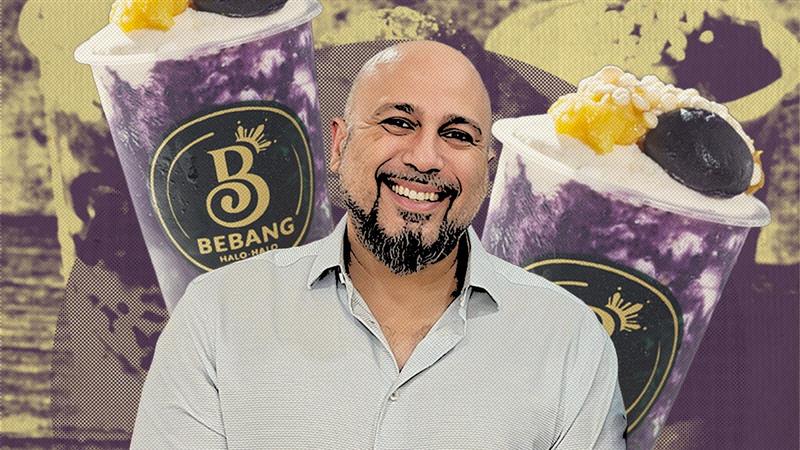
ILLUSTRATION: Igi Talao
Sam Karazi’s story is not conventional. He left school at 14 and grew up in a financially struggling household in Lebanon. But what he lacked in formal education, he made up for in street smarts, hustle, and an instinctive grasp of how people and business work.
After working various jobs—from delivery boy to factory worker—Karazi moved to Dubai in search of better opportunities. He worked his way up in retail for over a decade, teaching himself business by spending hours reading in bookstores and attending short courses, eventually becoming a leader in his field.
But the turning point of his life would come not in Dubai—but in the Philippines, during one of the most uncertain periods in recent memory.
After relocating to the Philippines in 2015, Karazi ventured into e-commerce and launched a personalized wedding gift business. But when the pandemic struck in 2020, the wedding industry was among the hardest hit. With events canceled and sales plummeting, Karazi was forced to close down his business.
It was in the middle of the pandemic when Karazi was approached by his friend May, who had the idea to offer an improved version of the Filipino classic dessert halo-halo—using frozen milk instead of shaved ice.
At first, Karazi was not interested in the business, but when he saw customers’ reactions to the product, he became involved and stepped in to scale the idea into a real business. With people stuck at home, the rise of food delivery helped turn Bebang into a huge success.
Today, after less than five years of operation, Bebang has grown to 12 outlets and is opening one store almost every week and aims to end the year with 40 stores. The brand has redefined the local dessert scene by elevating halo-halo to a premium experience through strong branding and a commitment to quality—setting a new standard in the market.
How did Karazi’s early experiences in retail and entrepreneurship prepare him to launch Bebang during the pandemic? What strategies did he implement in the brand’s early days that contributed to its rapid success? And how did he overcome market skepticism about pricing to convince customers to embrace a premium version of halo-halo?
Here are the five business lessons everyone can learn from Sam Karazi, co-founder and CEO of Bebang Halo-Halo:
ALSO READ
Financial Adviser: 5 Business Lessons Everyone Can Learn from the Founders of Manila Creamery
1| Know how to validate a business idea by listening to the market
One of the biggest mistakes entrepreneurs make is assuming they know what customers want. Market feedback tells you if there’s real interest in your product or service. Instead of relying on assumptions, you get actual reactions from potential customers, which helps you avoid wasting time and money on ideas that won’t work.
More importantly, feedback gives you the opportunity to refine your product early. By listening to what users like, dislike, or suggest, you can make targeted improvements while your business is still small and flexible. This makes your product stronger and more aligned with what customers truly want—before scaling up or launching to a broader audience.
Faced with the disruption of his wedding-related e-commerce business during the pandemic, Karazi found himself at a crossroads. Rather than retreating, he chose to stay engaged and open to new opportunities. When a friend began selling halo-halo from home, Karazi didn’t dismiss it outright—even if he initially had reservations about the idea. He was willing to test the waters using his core competencies: digital marketing and customer engagement.
Instead of making assumptions, Karazi focused on listening to the market. He didn’t jump straight into scaling; rather, he committed to a three-month testing phase to assess demand based on actual customer data. The feedback was immediate and overwhelming; orders came in quickly, and the number of repeat purchases confirmed that the product had real staying power.
By investing time and money into digital campaigns and monitoring the response, Karazi followed a lean startup approach—testing, learning, and adjusting before going all in. Through market feedback data, Karazi validated not only the product but also the business model behind Bebang.
"I actually started from scratch,” he says. “A lot of people know this. I left school when I was 14. I never continued my education. I started in retail from scratch—like from the front line, like the people who sell in our stores now. I was like them for a very big part of my life. Then I worked in Dubai for almost 12 years. I scaled up until I reached the sales manager position in the company I was working for.
“Dubai was basically my school. I learned a lot of things—from customer service to interacting with people. In 2015, I came here and started my first e-commerce company. From a young age, I was really fascinated by tech. I'm not a developer—I still don't know how to code—but I love technology. Whenever there's something new, I'm always one of the first to adopt it. From early chat solutions to being among the first to use email, I was there.
“When I started my company, one of my key skills was knowing how to run ads on social media. Back then, most companies weren’t really using it yet. I was very successful applying it in my first business. That first business was more like a BPO setup. I had designers here in the Philippines, but the product was being sold in the United States—even though I’ve never been to the U.S. to this day. I was running everything remotely. The company was registered in Hong Kong, the product was sold in the U.S., and the designs were made in the Philippines.
“It was a personalized wedding gift, and it was doing very, very well, until the pandemic happened. The pandemic was more like a shake-up for me—a wake-up call. I had become very comfortable in that business and didn’t really think about diversifying. I was almost retired. I had people running the company while I was living in Subic, like doing nothing most of my time.
“We took a very big hit because our business was related to weddings, and most weddings were cancelled for almost two years. I was really spending money on the team without making any income. Like many business owners, we felt sorry for our people, so we didn’t want to let anyone go. I kept 50 people for two years without making any single peso. I was paying all the salaries without making any money at all, which bled me technically for a long period of time.
“Then a friend of mine started this business like many people did during the pandemic—selling products from their house or even from their garage. She was selling halo-halo and asked for my help. I really wanted to step up and help because I’m very good at social media marketing and creating campaigns.
“So I said I could help with those and let’s see what will happen, because when you run a business from home, you mostly just sell to your neighbors. That’s the extent of your reach—your friends, your connections—but that’s it.
“So when I started helping—designed the logo, created the page, ran the ads—I saw a lot of good feedback from people. That’s when I saw the product’s potential. My reaction was: I want to test this properly for three months. Testing it properly meant going heavy on ads, investing more money, and seeing where it would go. And when everything started going the way I expected, I decided I would invest to build the business.
“My friend wasn’t really thinking about growing the business. It started as a side project—something to do out of boredom, to be honest. There were no big plans for the business in the beginning. But when I began testing it, I think we didn’t even run a full month of testing. I immediately saw the demand.
“The most important indication that a product will work is when people buy it twice. When someone makes a repeat purchase, you already know that you have a good product. If people order only once, it could just be because of the hype, and they might never come back.
“But when someone orders from you and then returns after two days, orders again for their friends, and even brings them along, then it’s clear that something is really working.
I even saw people arguing with the team on social media, saying things like, 'Why can’t I order?' or 'Why do I have to wait two to three hours?' At that time, we were operating out of a very small stall in Teachers Village, Quezon City. That’s when I told her, 'It seems like you’re sitting on a gold mine. We really need to build this properly.”
2| Know how to pivot and create a unique selling proposition that wins customers
Pivoting is important in business because initial assumptions often don’t align with reality. When the actual market response turns out different from what was expected, being able to adapt quickly can mean the difference between failure and success.
Instead of sticking rigidly to a plan that’s not working, pivoting allows an entrepreneur to shift strategies based on real-world data and customer behavior. At the same time, creating a unique selling proposition (USP) that sticks is what gives the pivot lasting power. A USP is what sets your product apart—it’s the reason customers choose you over others.
Karazi’s ability to pivot and sharpen Bebang’s USP became a cornerstone of the brand’s success. Initially, he believed that moving operations to Shaw Boulevard would give Bebang better access to high-income markets like Bonifacio Global City (BGC) and Makati.
He assumed that customers from these areas, with greater purchasing power, would form the bulk of their sales. However, after the relocation, he quickly discovered that his expectations were off: the majority of their customers came from Pasig, Quezon City, and Mandaluyong—areas he hadn’t initially prioritized.
Instead of forcing a strategy that no longer aligned with reality, Karazi responded with agility. He accepted that his target market was different from what he had anticipated and pivoted accordingly. Rather than viewing the shift as a setback, he used it as a springboard to sharpen the brand’s identity and focus on what truly set Bebang apart.
What truly elevated Bebang’s position in the market was how Karazi doubled down on delivering a clear USP. Amid the pandemic, when food delivery became the norm, most dessert shops struggled with maintaining product quality—especially for something as delicate as halo-halo. Traditional versions melted during delivery, arriving at customers’ homes as watery milkshakes rather than the layered frozen dessert they expected.
Karazi and his team saw this challenge as an opportunity. They invested in R&D to perfect the packaging, set delivery radiuses based on melt times, and boldly guaranteed a “delivered frozen or your money back” promise. This became more than a marketing line—it was a serious differentiator that competitors couldn’t easily replicate.
“So when I discovered that it really had a lot of potential, I told her, 'Let’s move somewhere,'” Karazi says. “We started checking the map to see where we could go. So we searched on the map, and I liked Shaw. When we moved to Shaw, I initially thought most of our customers would come from BGC and Makati because of the higher purchasing power. That’s actually why I wanted to be in Shaw—so we could deliver to those areas, which we couldn’t do from Quezon City.
“The strange thing is that what you think you know is often wrong. Back then, most of our customers were from Pasig, Quezon City, and Mandaluyong, while very few—less than five percet—were from Makati and BGC. So the market we actually sold to wasn’t the market we initially expected.
“One of the key factors behind Bebang’s success was that we were the first during the pandemic to deliver a frozen product—no one else was doing it.
“Even until now, if you try to order halo-halo from any of our competitors, you’ll get a milkshake. You never receive proper halo-halo that’s delivered frozen; it usually arrives very watery. In our case, from 2021 when we opened our first store, our ads always stated: 'Delivered frozen or your money back.'
“So we guaranteed that it would be delivered frozen. We spent a lot of time researching the packaging—how to pack it, how long it would last before it started melting. We also managed our delivery radius based on that. Of course, we've improved since then; now we can deliver as far as Subic. I brought one with me last time and it was still frozen. So that became part of our unique selling proposition, if you can call it that.
“Now, we deliver from Shaw all the way up to around SM North EDSA and down to Pasay, covering about an eight to nine-kilometer radius. And we still guarantee that it’s delivered frozen.
“When I joined Bebang, I was actually working on an alternative solution that would allow restaurants to sell online without depending on third-party aggregators. Back then, during the pandemic, it was a huge opportunity. Foodpanda and Grab were charging very high fees—up to 35 percent—and a lot of restaurants were complaining because they weren’t making any money.
“So when I joined Bebang, I thought it was the right time to experiment with my own brand. We built our own ordering system from scratch, and it was developed based on what a restaurant needs to sell and deliver online.
“For example, one of the features we used effectively on our website was scarcity. Unlike third-party aggregators, our platform allowed us to limit the number of items sold—something that’s not possible on those platforms per time slot, which is 30 minutes to a certain number of cups because we have a capacity limit.
“Because we sell around 3,000 cups a day, during peak season we had approximately 30,000 cups sold in advance. All of that was made possible because we had our own system. We created a custom ordering platform where we could set limits and manage capacity efficiently.”
3| Know how to modernize a heritage recipe through customer-driven innovation
While heritage recipes offer authenticity and emotional connection, they may not always meet the expectations of modern consumers in terms of taste, convenience, or presentation. Innovation allows entrepreneurs to adapt these traditional dishes—whether through updated ingredients and improved textures—without losing their original essence.
Customer feedback plays a key role in this evolution. It provides real-time insights into what works and what doesn’t. Instead of relying on assumptions, businesses can refine a recipe based on actual preferences.
Karazi and his co-founder May exemplify how tradition and innovation can work together to create a unique, market-ready product. At the heart of Bebang’s success is a heritage recipe passed down from May’s grandmother—an original take on halo-halo that eschews the usual shaved ice in favor of frozen, shaved milk. This approach not only preserved the essence of a Filipino classic, but also fundamentally transformed it into a modern dessert experience.
May’s creative instincts and passion for food innovation were central to the product’s evolution. Long before launching Bebang, she was already introducing new twists to Filipino staples—being one of the first to develop pandan and ube pandesal in Metro Manila.
However, innovation didn’t stop in the kitchen. What made the transformation of the heritage recipe truly effective was how Karazi and May grounded their product development in customer feedback. While only a small percentage of customers typically provide feedback, those who do—especially satisfied ones—offer valuable insights.
Bebang’s team used this input to test, refine, and iterate their offerings. Nothing was launched without proper testing. Karazi’s decision not to rely solely on instinct, but to test product variations and seek validation through actual customer behavior, highlights the importance of data-driven decision-making.
Bebang’s innovation also addressed a long-standing problem with halo-halo: consistency. Traditional halo-halo often melts quickly, leading to a watery and uneven experience. Bebang’s use of frozen milk solved this issue by delivering a uniformly creamy texture from top to bottom.
“My co-founder, May, has this family recipe, which was passed down from her grandmother, whose name was Bebang,” Karazi says. “That's where the name came from. She is incredibly creative when it comes to food. She's very talented and loves experimenting in the kitchen. For example, before she started with halo-halo, she was one of the first in Metro Manila to introduce pandan pandesal and ube pandesal—about a year earlier. She's naturally inventive when it comes to food.
“Now, she serves as the head of our R&D department. Nothing happens in R&D without her approval, even though we now have a full-time food scientist who tests recipes and products. I trust her completely when it comes to product development. The entire menu we have was developed by her, of course, in collaboration with feedback from our customers.
“Not everybody gives feedback. I think only about 10 percent of people will share their opinion. And those who do—especially when they're happy—tend to be more honest. When you're angry or impulsive, you might not think clearly, but when you're happy, you often provide more insights.
“So when customers are pleased with the experience but suggest an improvement, we take it seriously. We test it and check with other people. However, I don’t launch anything without proper testing. We always let customers try it first before adding it to the menu.
“The product we started with is completely different from what we’re selling now because it's been a continuous improvement process. Even today, we have a full R&D department dedicated to refining the product.
“What’s unique about Bebang is that we don’t use ice in our halo-halo. We freeze the milk and then shave the milk itself, which was a fundamental innovation to the product. People loved it because of that.
“One of the common issues with traditional halo-halo is that when you use shaved ice and add condensed milk, evaporated milk, and other ingredients, the melting process starts immediately. That’s the first problem. As soon as you pour the liquids, the ice begins to melt.
“Second, the product often becomes diluted. Most of the time, you get one bite of ice, one bite of something creamy, and one bite with milk—it’s not consistently mixed. In our case, from top to bottom, the product delivers a consistent creamy taste. It’s actually creamier than ice cream because we use not only milk but also a generous amount of all-purpose cream.”
4| Know how to stand out by competing on value, not price
When customers choose your product because they recognize its value, they are doing more than just making a purchase—they're making a commitment. That value might come in many forms, but whatever the reason, these customers aren't just buying the cheapest option—they're buying something they believe in.
This kind of customer is far more loyal than a bargain hunter. While price-conscious buyers may flock to you for a promo or a discount, they often leave just as quickly when a cheaper option appears. Their loyalty is tied to price—not to the brand, product, or experience.
On the other hand, value-driven customers are more likely to stay with you over time, even if competitors offer lower prices. They appreciate what makes your product different, and they’re often willing to pay more because they understand what they’re getting in return. This makes them not only more loyal but also more profitable, as they tend to return, repurchase, and refer others.
Karazi took a decisive and strategic approach in positioning Bebang as a premium halo-halo brand by choosing to attract quality-minded customers rather than engage in price wars with mass-market competitors. Instead of discounting or offering promotions to gain traction, he focused on building a brand that stood for value and authenticity—all without compromising price or quality.
Karazi leaned into product innovation and differentiation. Bebang offered a version of halo-halo that used frozen milk instead of shaved ice, along with fresh, premium ingredients. This bold product innovation became a key differentiator—a unique selling proposition that justified the brand’s higher price point and appealed to discerning customers who were willing to pay for quality.
But the branding went beyond just the product. Karazi also invested in the brand’s identity. Even when there were suggestions to adopt a more Western-sounding name to appeal to broader audiences, he insisted on keeping the name Bebang.
Even the brand’s logo evolved to reflect this vision. Karazi understood that consumers don’t just judge a product by taste—they also judge it visually and emotionally. By focusing on long-term brand building instead of short-term sales tactics, he was able to attract a base of customers who understood and appreciated the value Bebang offered.
“When we decided to grow the brand, there were already suggestions, including from my friends, to give it a fancier, more European-sounding name,” Karazi says. “But I didn’t want that. I wanted it to be Pinoy. I wanted it to be 100 percent Filipino, so I insisted on the name Bebang because I loved it—it's very catchy. I really wanted to build something that people could relate to—not something that would look like any other concept that might come and disappear a few years later.
“At that time, our logo featured palm trees and had more of a summer vibe, but our logo has evolved—and that’s the good thing about being pragmatic. I’m very flexible. When I do something and it doesn’t work, I believe we can change it. The reason we changed the logo to what it is now is because, during the design brief, I wanted something that people in the Philippines could truly relate to. I wanted it to feel very Filipino.
“We wanted something more aligned with how we were positioning ourselves as a premium company like a Häagen-Dazs of halo-halo. If we wanted to put our stores in malls and be different, then we had to position ourselves differently. We're not cheap—but we're worth it.
“Still, people will always judge you based on how you look. So if we looked like everyone else, people would expect to get the same thing. We wanted to build something that would elevate the brand. Something similar to how Manam is elevating Filipino cuisine—which I really admire.
“Most halo-halo back then was made with saba banana, mongo beans, and other ingredients like that. From day one, we decided we didn’t want to include beans. We wanted to create something different—something premium—something we would actually want to eat. Not the traditional halo-halo.
“If you think about it, beans in halo-halo are like pineapple on pizza—some people love it, some hate it. And the ones who don’t like it really hate it. So right from the start, we said no to beans. We also avoided using canned goods as much as possible. We aimed to use fresh ingredients, premium components, and frozen milk. We never used cheap condensed milk—instead, we used top brands for everything.
“Most businesses, when they start, think: ‘I want to compete, so I’ll go low on price.’ But that approach will kill you as fast as you open. You’ll get wiped out very quickly. When you go cheap, you end up competing with already established low-price players.
“If I go cheap, I’m competing with Chowking—and I don’t have the financial capacity to compete with Chowking. I can’t match the resources of Mang Inasal either. They may not notice me at first, but once I start becoming popular and expanding, they could easily wipe me out. So the only way to compete with players like that is to position yourself as a premium product.
“They will never increase their price to compete with you. And if they can’t raise their prices, they won’t invest in premium ingredients or materials to match you either—because you’re not targeting the same market.”
5| Know how to balance passion and productivity in business and life
Passion fuels creativity, drives purpose, and makes the journey enjoyable. It gives meaning to the hard work and helps entrepreneurs stay motivated during difficult times. Without passion, work can feel like a burden, and burnout becomes more likely.
Productivity, on the other hand, ensures that passion turns into tangible results. It brings structure, focus, and measurable progress. A business driven only by passion without execution will struggle to survive, while a purely productivity-driven approach without heart can feel empty and unsatisfying.
When passion and productivity are balanced, entrepreneurs are more likely to build sustainable businesses that create a sense of alignment between what they do and why they do it—leading to both external success and inner fulfillment.
After experiencing two years of a leisure-filled lifestyle prior to the pandemic, Karazi came to a realization that many successful entrepreneurs eventually face: leisure without purpose can become unfulfilling. For Karazi, purpose is the true driver of happiness and energy.
Karazi knows that he needs to be building, creating, and solving problems to stay energized. Rather than returning to the monotony of daily routines, which he admits he dislikes, he structures his role around projects that stimulate his creativity.
By surrounding himself with organized and detail-oriented people, he balances his visionary thinking with operational consistency. This reflects the value of delegation and team trust—an essential trait for founders who want to scale without burning out.
Karazi’s love for the Philippines and ability to immerse himself in a culture similar to his own shows adaptability and cultural sensitivity—important qualities for anyone leading a business in a foreign country.
“I lived on my boat, rode my jet skis, and enjoyed my cars,” he says. “I actually tried that kind of life. It was fun, I won’t deny it. I spent two years doing nothing. I’ve tried that lifestyle, but to be honest, I’m actually enjoying doing this business more.
“Having a purpose is a lot more fulfilling than living a life of leisure. Living a leisurely life was really nice for a couple of years, but toward the end of it, I started to feel bored, like, ‘Okay, what’s next?’ Someone like me really needs mental stimulation. My brain always needs to be working. I tend to feel depressed when I’m not doing anything.
“So I really need to be doing something. I need to be working on a project. But again, there’s also a downside to my personality when it comes to business—like many entrepreneurs and founders, we’re very creative. I can’t do routine tasks. I just can’t. When something becomes routine, I start to hate it. That’s why I need people around me who are organized. Because when something becomes a daily task, I can’t stick with it. There’s no way I can do it—I’ll give up.
“For now, I’m enjoying building. I’m not sure when I’ll stop, and I honestly can’t answer that question. I might take a hybrid approach. Life is good, you know. Life is fun. It’s not always about living an unbalanced life. I can go extreme with work when needed. When it’s necessary, I work 18 hours a day. In the early days of Bebang, I was working from 6:00 a.m. until 11:00 pm., going straight to bed, and then waking up and doing it all over again.
“They’ve seen me online since 6 a.m., asking questions like, ‘What happened to this? What happened to that?’ So when needed, I’m more than happy to work 18 hours a day. But ideally, I know how to operate by working only two hours a week—because I’ve done that before. I’m able to run a company while working just a few hours a week.
“I don’t like to micromanage people. In fact, I’m a strong believer that micromanagement actually reduces productivity. It stifles people’s creativity when you start telling them exactly what to do. Frontline staff need guidance, of course, but I can’t hire a marketing manager and then try to teach them how to do their job. If that’s the case, why hire them in the first place? I might as well do it myself.
“Because when you’re thinking narrowly from a departmental perspective, you only see things from your own department’s point of view. Me, I see things like, I look at everything from a bird’s eye view of the whole company. So what my operations guy thinks is important—most of the time, it’s not. We often have other priorities to focus on. What marketing thinks is important—most probably, it’s not either.
“The culture here, like I said, is very close to where I come from, so I can easily adapt and live here. I can relate to the people. I think the same way. Plus, I love the country. I love the people here. I love how they think. I love how friendly people are— not always, but the majority are really friendly and nice, which is enough. So I wouldn’t want to live anywhere else.”
Henry Ong, RFP, is an entrepreneur, financial planning advocate and business advisor. Email Henry for business advice hong@financialadviser.ph or follow him on Twitter @henryong888
