
Today I Learned: What the BSP is Doing to Help the Struggling Property Sector


It’s no secret that the country’s property sector isn’t in the best of health. A recent report from the BSP showed nationwide residential property prices dropped by 2.3 percent year-on-year in the third quarter of 2024, with the decrease felt largely in the Metro Manila. According to the Bangko Sentral ng Pilipinas (BSP), the 14.6 percent year-on-year decline in residential property prices was due to the decline in prices of duplex housing units, single-detached/attached houses, and condominium units, offsetting the rise in prices of townhouses.
Status of the Property Sector
Meanwhile, residential property prices in areas outside the NCR increased by three percent due to the “annual price increases in single-detached houses and condominium units, which outweighed the decline in duplexes and townhouse prices.”
This has led the BSP to ease its key policy rate to help stimulate economic growth, which could lead to a boost in the property sector in 2025.
A lower interest-rate environment will provide confidence to the property market
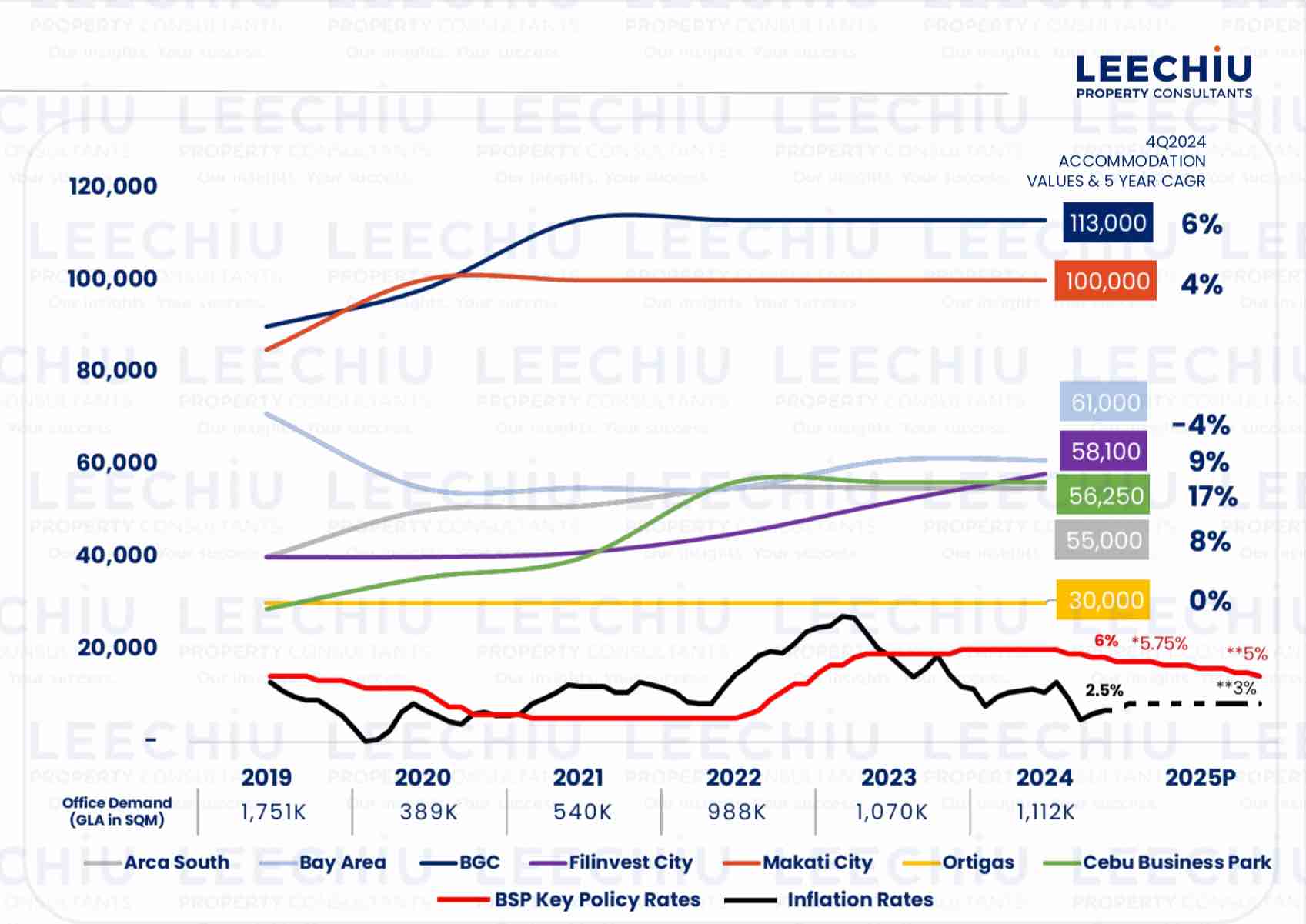
The BSP closed 2024 with a final cut of 25 basis points, which reduced the key policy rate to 5.75 percent, despite the inflation rate going up slightly from 2.3 percent in October to 2.5 percent in November. The BSP key rate is used by banks to determine the interest rate they charge on loans to companies as well as consumers, including as housing loans.
ALSO READ
These 10 Developers are Building Over Half of All New Hotel Rooms in the Philippines
Haraya Residences Levels Up Vertical Living With Organic Design, Common Spaces
“It’s very comforting news that the Bangko Sentral ng Pilipinas (BSP) seems to be maintaining its further monetary easing,” said Leechiu Property Consultants (LPC) Director for Investor Sales Tam Angel in a recent news briefing. “This is critical at this stage of the real-estate economy because we feel, in general, the property sector is trading at support levels. And of course, a lowering interest-rate environment will provide the much-needed stimulus in this sluggish market.”
Further cuts are expected to bring rates down to 4.75 percent to five percent in 2025, which supports economic growth, while maintaining price stability. “That already factors in Trump 2.0,” Angel said, referring to the re-election of real-estate mogul Donald Trump as President of the United States.
LPC also projected inflation rates for 2025 and 2026 at 3.3 percent and 3.7 percent, respectively.
“A lower interest-rate environment will provide confidence to the market,” Angel said. “Developers will launch more projects, and investors will be encouraged to take positions given lower funding costs. Once we hit close to five percent [policy rate], we think that’s when we’ll feel it in the retail buying, whether it’s the condos or the lots.
“If you’re a strategic buyer, you buy now, you’re anticipating in two to three years, you’ll be borrowing. And it seems like that’s the point in time when interest rates are at its lowest,” he added.
The LPC executive said that property stocks have remained resilient despite the high interest rates, which began after the pandemic. The stocks have stabilized around 2,360 index points between 2016 and 2024.
“The consolidation period for the last three years appears to be the result of a lack of investor confidence due to the high interest rates,” he said.
The top five property stocks during the period include: SM Prime Holdings Inc., with a price-earnings ratio of 17.27; Ayala Land Inc. (P/E 12.63); AREIT Inc. (P/E 14.84); RL Commercial REIT Inc. (P/E 12.71); and Megaworld Corp. (P/E 3.19).
“The property sector of the stock market is the most sensitive to interest rate fluctuations,” Angel said. “What’s important to us is that the BSP continues easing monetary policy and continues to cut rates, albeit at a slightly more conservative tone, because they are keeping a closer eye on the global markets and they’re also watching how Trump 2.0 develops. But with the continued rate cuts, the property sector will finally see some upward momentum.”
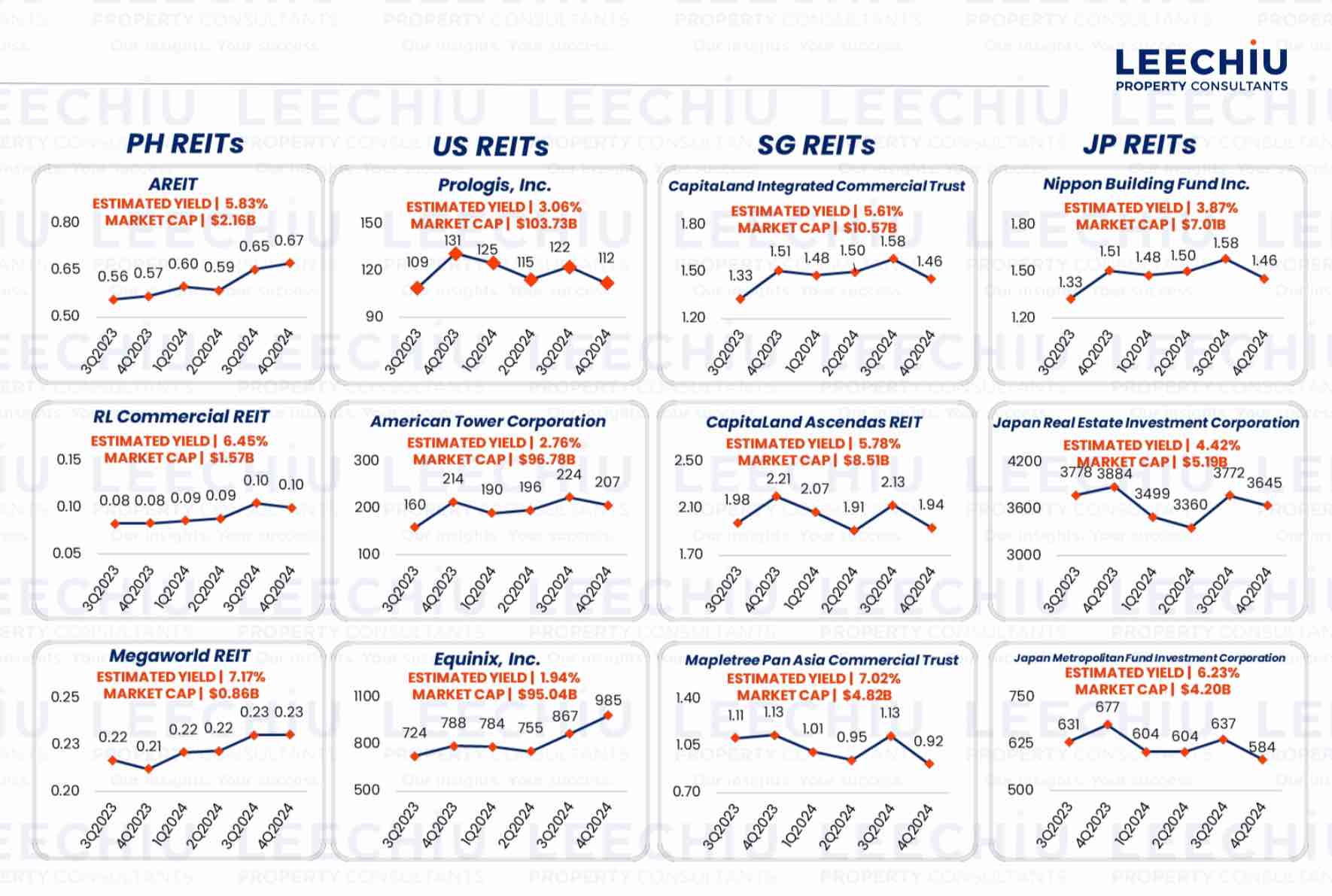
Meantime, Angel advised investors that they stand to get better yields if they invest in Real Estate Investment Trusts (REITs) in the Philippines, instead of those in established markets abroad. A REIT is a company that owns and operates properties from where it earns income. Many of the country’s top real estate companies have set up REITS over the last few years.
According to Angel, Philippine REITs were among the earliest beneficiaries in the Philippine Stock Exchange from the lowering of the BSP key policy rate. He cited the stocks’ year-on-year growth, “which ranged from as high as 44 percent for PREIT (Premier Island Power REIT Corp.), 20 percent for RCR (Robinsons Land Commercial REIT), and 19 percent for AREIT.”
This means that, compared to markets abroad, Philippine REITs continue to be an “attractive investment option, still offering yields of six to 10 percent amid the challenges in the PSE. It outperforms global counterparts like Japan (3-5 percent), the United States (three to four percent), and Singapore (five to six percent),” he added.
