
Canva's Grip on Philippine Creatives, Explained

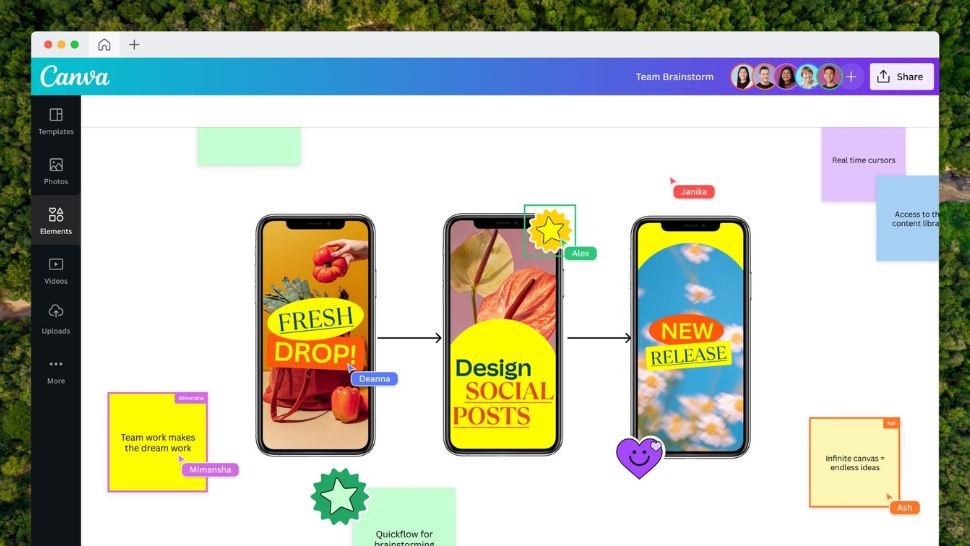
You’d be hard-pressed to find a Filipino creative or entrepreneur that hasn’t heard of Canva. What was once a simple visual layouting platform has evolved into a fully-fledged productivity machine. Since Canva began in 2013, users have created 13 billion designs on the platform, with 180 new designs published every second. The platform boasts more than 100 million active users and 10 million paid subscribers per month, 4.7 million of which pay for Canva’s premium features, and thousands of which hail from Fortune 500 companies. Schools, NGOs, and MSMEs use the platform in their daily operations, so much so that job openings now list “Canva” as a skill, not just a platform.
Canva, Tech's Next Big Thing
It’s no surprise why the industry views Canva as a competitor to tech juggernauts Microsoft, Google, and Adobe. Like their more established counterparts, Canva launched an entire collection of services called the Visual Worksuite, which includes Canva Docs, Canva Websites, Canva Whiteboards, Video Background Remover, Canva Print Expansion, Data Visualization, and Remote Control for Presentations. These services, which are available on the Canva website, cover all the bases of visual storytelling—Canva Websites lets users publish websites for free, Canva Whiteboards allows users to collaborate with teams, and Canva Docs gives users the chance to edit and layout documents how they wish. It’s a fully visual collection that follows Canva’s new maxim, which is that “the future is visual.”
Canva co-founders Cameron Adams, Cliff Obrecht, and Melanie Perkins

While the company’s founding members maintain that the Visual Worksuite wasn’t intended to “compete” with companies like Adobe and Google, it’s impossible to not draw comparisons. In an era where the workplace is becoming increasingly visual and data-oriented, Canva is keeping up with the times by providing a worksuite that anyone, from freelancers to business owners, can benefit from.
From marketing specialists and work-from-home moms to social media managers, Canva is one of the rare unicorns that can adapt to anyone’s lifestyle. Guided by the philosophy that design can empower lives and careers, the platform is popular in Australia, its founding country, as well as the U.S.A., Brazil, Mexico, Spain, and Indonesia, to name a few.
But it’s the Philippines where Canva has grown a wildly loyal following made up of students, teachers, small business owners, and more. With seemingly little effort, Canva grew an organic community made up of thousands if not millions of Filipinos who open their Canva tab first before even looking at Adobe or Office. Because as early as 2014, Canva recognized that Filipinos excel in two areas: creativity and customer service.
The Perfect Market Fit
As a matter of Pinoy pride, most probably know by now that one of Canva’s founders, CEO Melanie Perkins, is one-fourth Filipino. But it was actually a Filipino freelancer we have to thank for Canva’s expansion into the Philippines. According to the head of growth Maisie Littaua, Canva’s first Philippine employee in 2014—Hazel—was tasked to help out with social media support and customer happiness. In a chat with Canva co-founder Cliff Obrecht, he revealed that they were so impressed with her work that their Manila office expanded from there.
Fast forward eight years and Canva’s Philippine office is now a team of 750 people. Globally, the company has over 3,700 employees, but the Philippines is one of its largest international offices, and since it started localizing content for Filipino in 2019, it’s become one of its customer strongholds.
Early on, Canva realized the power of Filipino creatives. There are entire Facebook groups and pages dedicated to Canva tips and tricks for Filipino designers, and there are even Filipino freelancers who’ve made a living on Canva by selling or creating designs. Canva, for some, has become a source of income.
Then there’s the customer service—or customer happiness—side of the equation. There’s a reason why there are hundreds of call centers in the Philippines. This is customer service central.
Canva Philippines' country manager Yani Hornilla-Donato and head of growth Maisie Littaua

“I think that Filipinos can really connect with our users apart from just the language that we use. It's also how we interact with our users. There's an added level of care and concern for our users in general,” shared Littaua. “But aside from that, Filipino creativity has been at the center of Canva Philippines. So this is where we grew our design team. The first 40,000 templates were created by Filipino designers. [Our library] was founded on Filipino creativity.”
Both of these elements together worked toward strengthening Canva’s grip on its Filipino user base, but it was Canva’s localization strategy in 2019 that sealed the deal.
“[It] was quite obvious that the resounding theme was that ‘we want local content, we want locally relevant content. So then we started ingesting a lot of local photos, fonts, templates, and it was quite honestly easy, because we have a lot of designers who are already here,” shared Canva Philippines’ country manager Yani Hornilla-Donato.
Now, there are Canva designs for Filipino public holidays and even Filipino fonts like the iconic jeepney font. All of these were created by Canva Philippines’ host of local designers to appeal to the local market, a strategy that not many big tech companies have succeeded at. Speaking a universal language might help a company expand, but it's when they learn the local culture and language that they gain a solid foothold in a new market.
The Philippines’ Role in Canva Global
Within its first two years, Canva was already making rounds in communities in the Philippines, University students were using Canva as early as 2014 to get them through college, and small businesses were already signing up for Canva Pro and Teams to access the platform’s wide range of features. For the most part, Canva’s growth in the Philippines can be credited to word of mouth and referrals.
“In the Philippines, we have been focusing on organic growth. It’s one of the fairly easier markets because it’s primarily English-speaking. For markets like the Philippines, for example, it’s about 90 percent organic,” said Rob Kawalsky, head of product.
It’s been a while since we’ve seen any brand sustain organic growth without spamming consumers with ads. Considering the return on investment that users get from Canva’s whole host of features, it’s easy to see why it’s heavily recommended. At just P399 per month or P3,990 per year for a team of five people, Canva is the most affordable worksuite available to Filipino creatives and professionals.
Canva's chief marketing officer Zach Kitschke and head of product Rob Kawalsky

“We have over 30 communities online on a global level, three of which are here in the Philippines. We have over 200,000 people in the Philippines as part of our communities, whether that's for education, businesses, or freelancers,” said Littaua. “We did initiate very many of the earlier communities but you can see that a lot of our community members have started their own pages and groups to help each other out. The beauty of it is that it's not really exclusive. Our platform aims to make it as accessible as possible.”
By communities, Littaua refers to the users that actively engage with each other on all things Canva. It’s one thing to get customers to use a platform, but it’s another thing entirely to get them to actually talk about it. Given that the Philippines is the social media capital of the world, it’s not surprising that Filipinos were quick to adapt to Canva. Historically, the Philippines has always been one of the first markets to experiment with any new platform, whether that's Instagram, BeReal, or in this case, Canva.
“The Philippines has always been a really important part of Canva’s story. We set up the office there in 2014, which is after we launched in 2013. So effectively since the very beginning. One of the reasons that we first launched was the fact that the community was so creative—there was a huge design community in the Philippines. It’s been a real sense of pride for everyone to see the Philippines become one of our top 10 markets,” said Zach Kitschke, chief marketing officer of Canva.
Beyond a Platform
Any business’ primary goal is customer loyalty, something that Canva has seamlessly achieved over the years. It wasn’t an overnight sensation but a slow burn that grew Canva into more than just a design platform. Canva Facebook groups are now dedicated to helping creatives make a living, gain more clients, and in some cases, connect people together.
The platform, which prides itself on telling visual stories, has facilitated countless inspiring stories over the years. From a daughter who made a Canva poster to find her long-lost mother to a teacher in the province who used the platform to create graduation photos for her students, Canva’s become the backdrop to people’s lives.
At this point, Canva is more than a platform—it’s a skill, a verb, and in the Philippines, it’s a culture in itself.
