

How Plush Toys Weave Opportunities for the Women of Negros Oriental


Ever seen a plush toy with colorful and unique patterns made of denim jeans and second-hand clothes? Look closely because it might be the upcycled products that are revolutionizing the women of Negros Oriental.
These plush toys are made by Tagpi-Tagpi, a circular economy initiative coined from the Filipino word for patching things up. It’s only apt for this social enterprise that goes beyond putting pieces of cloth together but also toward weaving opportunities for its artisans.
Tagpi-Tagpi aims to empower women in coastal communities by providing them with training opportunities that enhance their skills and entrepreneurial mindset while also benefiting the environment.
Women artisans in Dauin, Negros Oriental, proudly showcase their intricately-made plush toys

Their income varies based on the sizes and quantity of products they can finish in a day. For every medium piece, they could earn up to P150. In a day, they could finish from 20 to 30 pieces, but their production is highly dependent on the number of orders they receive.
“If we finished 100 pieces, we'll have P15,000 that we could divide with the four mothers. We divide it into four mothers because every mother has a different role that amounts to a different pay,” the women of Tagpi-Tagpi explained.
ALSO READ
How Social Entrepreneurship Beats Charity Work
8 Unique Social Enterprises You Need to Know
Creating Opportunities Through Tagpi-Tagpi
Leny Luzarita, 57, from Dauin, Negros Oriental, started working at an early age of 10. Even though she had a strong desire to finish her studies in her youth, she was left without a choice but to help in supporting her family.
Leny Luzarita is one of the many women artisans working with Tagpi-Tagpi

"Our mother didn’t want us to go to school. She wanted us to work. Even though there were people who offered us opportunities to study, they didn't allow it. They wanted us to work and create banig. I envied other kids who were playing and going to school. My mother said, "If we were to follow them, what are we going to eat for dinner?" Tears burst as Luzarita recalled the memory from her childhood.
She said that her educational attainment affected her chances of landing a job, but she doesn't blame her parents because that's what they could afford at that time.
Rosalie Tautjo, 48, also a resident of Dauin, echoed Luzarita’s sentiments. While she completed high school, landing a job was still a struggle.
Both women shared that a popular way to earn money in their community is by working in hotels and resorts. Dauin, after all, is known for its beautiful beaches that draw in tourists. However, these resorts only accept applicants with experience and who are between 18 and 30 years old. Luzarita and Tautjo are past that age.
In a release by the Philippine Statistics Authority last July 2024, it was mentioned that 2.38 million Filipinos are jobless, leaving the country’s unemployment rate at 4.7 percent. Data from PSA also shows that the labor participation rate among women (51.2 percent) is lower compared to men (75.4 percent).
Currently, Luzarita and Tautjo both work for Tagpi-Tagpi.

Meaningful Work
Lorlyn Campania, 34, Tagpi-Tagpi’s Negros Oriental Island Manager, confessed that in the past, they don’t really give importance to the ocean’s well-being, but this initiative inspired them to embrace the importance of environmental conservation.
Campania explained that these waste materials are often disregarded, not knowing that they could still be made into something useful and, in their end, earn extra income.
“Whenever I go to the market, and I see a piece of plastic like those junk food wrappers, I pick them up, and then as I arrive at our house, I wash them up. When my grandchild falls asleep, my hands would start cutting these plastics. Even though I am just at our house, taking care of my grandchild, I could still do other things,” Luzarita also shared.
The United Nations Environment Programme (UNEP) identified that every year, 19 to 23 million tons of plastic waste are produced globally. It is equivalent to 2,000 trucks of garbage polluting bodies of water. The Philippines contributes to these looming scenarios as it produces 2.7 million tons of plastic waste annually, and 20 percent of these end up in the ocean, according to the speech of the Philippine Environment Secretary on Earth Day earlier this April.
On the other hand, a study by YouGov Business revealed that three out of ten Filipinos discard their clothes after using them for the first time. In a 2023 release, UNEP reports that the fashion industry is accountable for from two to eight percent of global greenhouse gas emissions. The industry is also responsible for pollution and consumption of 215 trillion liters of water annually.
Sewing the Fate of Tagpi-Tagpi
In early 2017, MJ Lamoste, 29, founder of Tagpi-Tagpi, moved to Apo Island, Negros Oriental, for a project she was working on. She witnessed that even though Apo is a very resource-rich island, people’s economic status doesn’t seem to improve.
MJ Lamoste is the founder of Tagpi-Tagpi
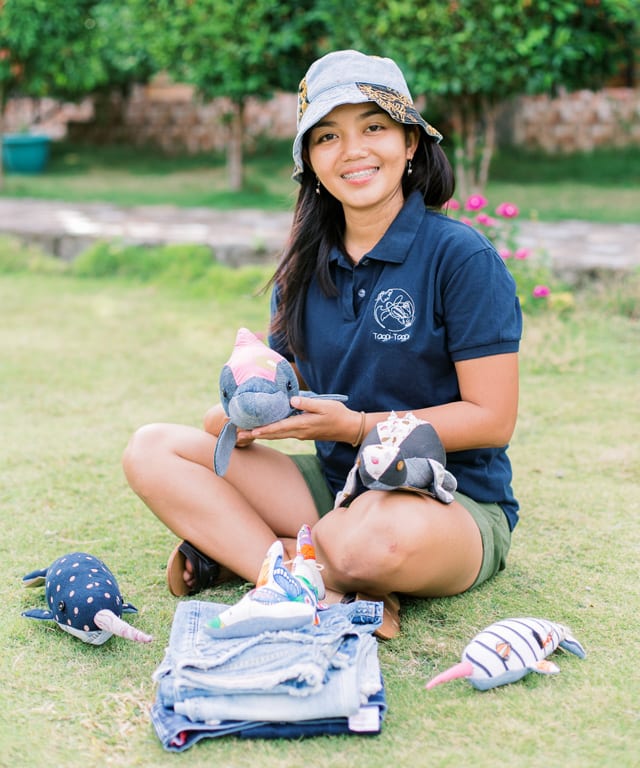
Tagpi-Tagpi was born when Lamoste met a woman on Apo Island who had just delivered her child but continued working by fetching and delivering water for different households. That scenario pushed Lamoste to act about the situation of women on the island.
"I am so shocked because, as a new mom, you're supposed to rest and let your body heal. When she said that she needed [to work] to support her husband, I couldn't help myself but to ask myself why?" Lamoste shared in disbelief.
Lamoste added that the women in Apo were not allowed by their husbands to work outside the island, which limited their opportunities.
Lorlyn Campania, for example, works as an on-call housekeeper. Despite her excellent skills in housekeeping, her husband won't allow her to work far from their home.
Lamoste recalled her efforts in convincing Campania's husband to let her wife work with Tagpi-Tagpi. This later created a butterfly effect among women in their community.
"It is normal for us Filipinos to be invited to eat in each other's homes. So, my first approach was to cook at their place. When I already convinced one mother, she was the one who did all the work to convince other women to work together as a team because most of their husbands didn't want them to work. Through one mother that I have convinced, we were able to convince the others too," shared Lamoste.
Choosing the circular initiative to help the women of Negros Oriental was very personal for Lamoste. If she would do something related to ocean conservation, she wanted to work with and for the community as well.
In creating the plushies, they cut and shredded the plastic waste collected from the ocean and then stuffed them inside the toys. Denim jeans and other second-hand clothes were meticulously sewn to create intricate patterns that resemble the Philippine flora and fauna.

Tagpi-Tagpi also provides personal development training, wherein they use an approach called ‘train-the-trainer,’ which enables them to multiply their impact in their community. Some of the opportunities they provide are upcycling workshops, mentorship, networking, and giving them resources that could help them kickstart their entrepreneurship journey.
To date, they have trained 75 women across the Philippines (20 from Negros Oriental, 30 from Dapitan, and 35 from Palawan), upcycled more than 18,000 pieces of clothes and their product has reached countries such as Philippines, Africa, Australia, Austria, America, Ecuador, France, Hawaii, Indonesia, Germany, Greece, Malaysia, Sweden, Jamaica, Palau, Portugal, Latin America, New York, and Timor-Leste.
Weaving Connections
Aside from the extra income and the advocacy that they have taken on, what Tagpi-Tagpi women truly treasure the most is the bond that was formed between them while working for this initiative.
Campania said that women in their community knew each other yet were not really close, but after working for a few years now, they have become more than a team. They’re now a family, even holding celebrations for the birthdays of their members.
They shared that they could rely on each other, especially in times of difficulty. They lean on each other and wholeheartedly offer what they can afford to ease each other’s burden.
Encouraging other mothers to join Tagpi-Tagpi is also one of their current priorities so that they can share the advantages and positive impacts the circular economy has given them. For them, a woman can do a lot more than a man can do, and their courage to do things is what opens opportunities for them.
“Para sa akin, mas maraming opportunity talaga ang kababaihan. Kasi kayang-kaya gawin ng mga nanay ang ginagawa ng mga tatay. Hindi ko nilalahat, kasi may mga asawa, hindi kayang gawin ang ginagawa ng mga nanay. Pero para sa akin, marami talagang magagawa ang nanay… Kasi kahit ano gagawin eh,” Campania said, with her head held high.
For kids, the plushies might just be toys with beautiful colors and patterns. But for the women artisans of Dauin, every textile sewn is a symbol of the courage they put in to move forward despite the adversities they experienced, treading their life with patterns full of opportunities.
Tagpi-Tagpi products are available through their website.
