Financial Adviser: 5 Worst-Performing Stocks in the PSE in 2024 and How to Profit from Them

Contrarian investors often argue that the best time to buy is when fear dominates the market and stocks are out of favor. This year’s stock market decline has created a challenging environment, with more than 45 percent of all listed companies on the Philippine Stock Exchange (PSE) recording negative year-to-date returns.
While the PSE Index has shown signs of life recently, the broader market sentiment remains fragile. Concerns about a slowing global economy and the specter of rising interest rates continue to cast a shadow over valuations.
Bond markets reflect this uncertainty. The 10-year Philippine bond yield, after falling from a high of 6.16 percent to 5.88 percent, could be going up again. A breakout past 6.0 percent could reignite fears of further rate hikes, potentially driving yields back to 6.95 percent.
For equities, this poses a clear threat: higher interest rates lower the present value of future cash flows, making stocks less attractive, and could drag the PSE Index down to test 5,700 levels.
The reality is that falling stock prices alone do not guarantee a recovery. Many stocks look cheap because they are, in fact, struggling fundamentally. However, for patient investors willing to sift through the wreckage, market downturns often provide opportunities to buy good companies at discounted prices.
The key lies in distinguishing between value traps—stocks that are cheap for a reason—and genuine bargains, where the market’s pessimism has overshot reality.
History shows that some of the steepest decliners can generate the highest returns when sentiment shifts, but this recovery is neither immediate nor guaranteed.
Last year, out of the five worst-performing stocks on the PSE, only one stock, Geograce Resources (PSE: GEO), recovered strongly this year with a return of +288.9 percent, while the rest continued to lose value. These are Agrinurture (PSE: ANI, -30.7 percent), Greenergy (PSE: GREEN, -15.7 percent), Enexor (PSE: ENEX, -14.7 percent), and LFM Properties (PSE: LFM, -10.0 percent).
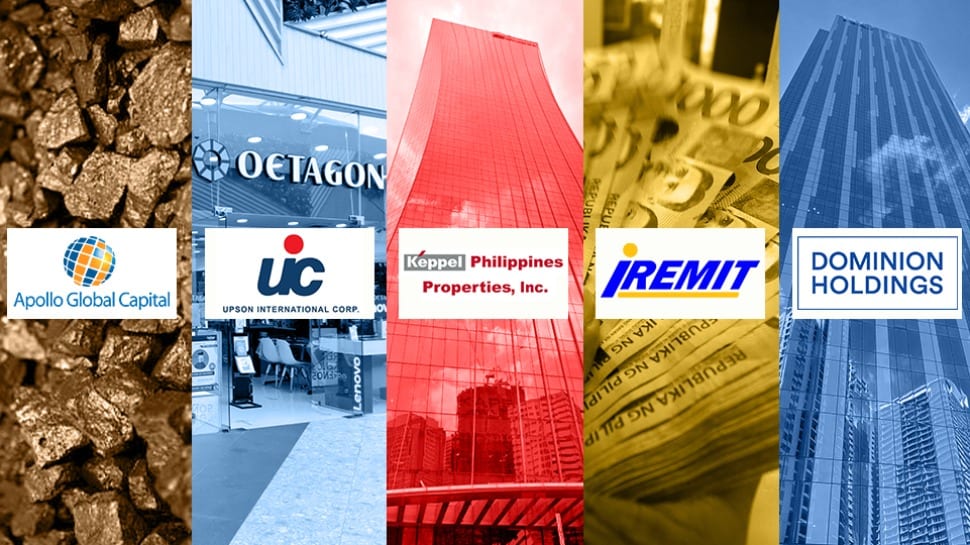
Let’s take a look at the five biggest losers in the stock market this year and let’s analyze where you can possibly pick them up:
ALSO READ
1| Apollo Global Capital
Price: P0.0042
Year-to-date loss: -67.7 percent
Apollo Global Capital, Inc. (PSE: APL) was known as Yehey! Corporation, an internet-based company that offers online advertising services before it was converted into a holding company.
In late 2020, APL’s 90 percent-owned subsidiary, JDVC Resources Corporation announced that it would start extraction of magnetite iron reserves in the seabed off Cagayan in partnership with Choi Garden owner and entrepreneur Frank Lao.
Lao at that time was reported to have contributed two deep-sea mining vessels with a net capacity of 10,000 tons per day.
APL even secured an Export Packing Credit Line from the Development Bank of the Philippines of up to $8 million, which was to be used as standby financing for its working capital requirements.
APL was one of the top performing stocks during the pandemic, gaining over 197 percent by the end of 2020. The strong buying momentum supported the stock’s further rise in January 2021, which went up by 69 percent before it peaked at P0.475 per share.
Since its announcement in 2020, APL has yet to start mining operations.
In 2021, APL raised P988 million from follow-on offering by issuing 12.35 billion shares at offer price of P0.08 per share.
APL used P711.9 million of the proceeds to acquire 49 percent equity ownership in Poet Blue Ocean, which contributed a non-cash accounting equity earnings of P97.7 million.
Without commercial operations, APL has been incurring losses. This year, the company reported its nine-month net loss of P26.8 million and its total cash reserve is down to P1.1 million. APL’s accumulated losses in its balance sheet have already ballooned to P250 million as of September 2024.
APL’s liquidity position has worsened significantly from December 2023 to September 2024. Its current ratio dropped from 0.16 in December 2023 to just 0.02 in September 2024, which indicates a severe decline in the company’s ability to cover its short-term liabilities with its current assets.
APL’s stock price has lost as much as 99 percent from its all-time high in 2021 to only P0.0042 per share. Interestingly, the current share price of APL is trading at 72.6 percent discount to its book value of P0.013 per share.
However, even if the stock price has reached its all-time low, there is no assurance that it will recover soon given APL’s current financial difficulties. APL’s recovery next year will depend on the resumption of its planned business operations and infusion of fresh capital from its majority shareholders.
2| Upson International Corp
Price: P0.69
Year-to-date loss: -57.9 percent
Upson International Corp (PSE: UPSON) is the largest IT retailer in the country with over 200 outlets that offers a wide variety of hardware and software products under multiple brand names, including Octagon Computer Superstore, Micro Valley, Gadget King, and Octagon Mobile.
UPSON’s flagship brand, Octagon, constitutes approximately 76 percent of the total outlets, while the remaining 24 percent of the outlets are shared almost equally among Micro Valley, Gadget King, and Octagon Mobile.
UPSON started as a distributor of prominent IT brands such as Logitech and Canon in the 1990s, but when the Asian financial crisis struck in 1997, the company restructured its operations and shifted its focus to a more resilient business model, which was retailing.
UPSON is owned by three partners led by its chairman, Lawrence Lee, who owns the largest stake at 39 percent followed by Ricardo Lee with 30 percent and William Lim at 27 percent.
UPSON's total revenues have grown at a compounded annual rate of 2.9 percent over the past four years, rising from P7.5 billion in 2019 to P10.01 billion in 2023. Its net income, on other hand, has seen a more robust growth of 18.5 percent per year, increasing from P85 million in 2019 to P464 million in 2023.
This year, UPSON’s total sales for the first nine months increased by 12.5 percent, from P7.4 billion in 2023 to P8.3 billion in 2024. However, higher costs of sales and finance costs led to a slight decline in net income, which decreased to P387 million from P388 million in the same period last year
UPSON has maintained a healthy liquidity position at 1.5 times current ratio. Although its debt-to-equity ratio slightly increased this year to 1.25 times, the company is able to cover its interest expenses.
UPSON also enjoys relatively high return on equity (ROE) at 13 percent for nine-month income. Assuming the company achieves the same income from last year at P464 million, its ROE should further improve to 15.5 percent.
The stock price of UPSON has lost 79 percent from its peak of P3.30 per share on its first day of listing last year to only P0.69 per share. At this price, UPSON’s 12-month trailing Price-to-Earnings (P/E) ratio stands at only 5.3 times, which is 51.8 percent lower than market average of 11 times P/E.
Moreover, UPSON is also trading at 28 percent discount to its book value of P0.96 per share. Given UPSON’s high ROE at 15.5 percent, the stock deserves to trade at higher Price-to-Book (P/BV) multiple.
If we divide the excess of UPSON’s ROE over its long-term growth rate of 6.0 percent and divide this by the difference of its cost of equity and growth, we can derive the intrinsic Price-to-Book Value (P/BV) of the stock at 1.22 times.
At 1.22 P/BV ratio, UPSON should trade at least at P1.17 per share. This gives a potential return of 69 percent from its current share price. At the target price of P1.17 per share, UPSON’s projected P/E ratio would only be 8.9 times.
Given UPSON’s solid fundamentals, the decline in the share price offers a good value investing opportunity.
3| Keppel Philippines Properties
Price: P2.95
Year-to-date loss: 57.2 percent
Keppel Philippines Properties, Inc. (PSE: KEP) is a 106-year old Philippine-based company primarily engaged in property development and investments. It was listed on the Philippine Stock Exchange (PSE) in 1989 with a focus on acquiring and managing real estate interests through its associates and joint ventures.
Over the years, the company has extended its corporate life twice, ensuring its long-term presence in the industry. KPPI is a subsidiary of Keppel Management Ltd. and part of Keppel Corporation, a Singapore-based conglomerate listed on the Singapore Exchange.
On March 25, 2023, KEP and its affiliate Opon-KE Properties, Inc (OKEP) signed an agreement to sell their stakes in SMKL to BDO Unibank, Inc. KEP sold 40 percent of its redeemable preferred shares, while OKEP sold 10 percent of its common shares.
The investment in SMKL was reclassified as “Investment in Joint Venture Held-for-Sale” with a carrying value of P2.9 billion as of March 31, 2023. The agreed sale price was P6.5 billion, less transaction costs of P35.2 million, resulting in a net purchase price of P6.49 billion. After accounting for taxes and costs, KEP recorded a net gain of P2.68 billion from the sale.
During this period last year, KEP shares surged over threefold, rising from P2.80 per share to a peak of P9.90 per share. However, profit-taking by investors led the stock to close 2023 at P6.90.
Early this year, KEP distributed P4.4 billion in cash dividends from the proceeds of its sale of interests in SMKL. Following this announcement, KEP shares more than doubled, reaching a high of P17.48 per share in April.
When KEP went ex-cash dividend in May, its stock price quickly adjusted to P2.70 per share. Although the stock briefly rebounded to P4.02, it struggled to maintain its momentum and eventually declined to P2.99 per share.
Following the sale of its stake in SMKL, KEP reported a gross income of only P10.9 million for the third quarter of this year. However, with operating expenses totaling P17 million and additional tax liabilities, the company posted a net loss of P6.99 million.
As of September 2024, KEP has cash remaining of P504 million but this amount will not be likely distributed as its dividends will be limited by its retained earnings, which has balance of P135.5 million.
KEP is currently trading at twice its book value of P1.48 per share. With minimal earnings expected following the sale of its investments in SMKL, the stock is likely to eventually align with, or fall below, its book value.
4| I-Remit
Price: P0.2260
Year-to-date loss: 53.4 percent
I-Remit, Inc. (PSE: I) has been serving the remittance needs of overseas Filipinos for over two decades. It is the only Philippine remittance company publicly listed on the PSE.
The company specializes in fund transfer and remittance services, which enables it to secure transfer of money locally and internationally through various methods such as electronic transfers and courier delivery. I-Remit also offers foreign exchange services and other related financial solutions.
Operating offices in eight countries and partnering with over 100 financial institutions across 30 countries, I-Remit has built a global network to support its customers. Through its subsidiaries, the company provides additional services such as financial advisory and e-commerce, further solidifying its role as a trusted provider in the financial services industry.
Over the past three years, I-Remit, Inc. has experienced a significant decline in financial performance, particularly in terms of revenue, gross profit, and net losses due to competition, particularly GCash.
I-Remit’s total revenues have dropped by over 75 percent from P544.7 million in 2021 to only P121.2 million in 2023. Because of this, the company’s net losses ballooned from P119 million in 2021 to P370 million.
This year, I-Remit's total revenues for the first nine months continued to decline, dropping by 66 percent from P105 million in 2023 to just P36.2 million. Despite efforts to control costs, the company incurred operating expenses totaling P307 million.
As a result, I-Remit posted a net loss of P238 million, which, while still significant, represents a slight improvement compared to the P270 million net loss reported during the same period last year.
As of September 2024, I-Remit has accumulated losses exceeding P900 million. The company could use its additional paid-in capital balance of P391 million to offset some of these losses but would still leave an accumulated losses of P500 million.
To restructure its equity, the company will need to raise additional capital, probably via stock rights offering, in the future. However, the company needs to improve its financial performance to be able to do this. Furthermore, I-Remit has total debt of around P1.0 billion, while holding cash of P48 million and trade receivables amounting to P1.07 billion.
Share price of I-Remit has been declining since 2009, losing about 94 percent from its peak of P3.90 per share to only P0.235 per share. Unless the company is able to reverse its losses next year, the stock price will likely to deteriorate.
I-Remit is currently trading at only 30 percent discount to its book value. Given the financial challenges the company is facing currently, its stock price should trade at a larger discount to book value. At 60 percent discount, stock price should further fall to P0.13 per share.
5| Dominion Holdings, Inc
Price: P1.54
Year-to-date loss: 51.3 percent
Dominion Holdings, Inc. (PSE: DHI) was formerly known as BDO Leasing and Finance, Inc. In January 2020, the company changed its business direction, from leasing and financing services to becoming a holding company. This change allowed the company to invest in, own, and manage various real estate properties, securities, and assets from other companies.
As part of this transformation, the company officially changed its name to Dominion Holdings, Inc. DHI is now a subsidiary of BDO Unibank, Inc. (PSE: BDO), one of the largest banks in the Philippines. Although DHI is majority-owned by BDO Unibank, it is no longer subject to the same regulations as BDO Unibank since it has transitioned into a holding company.
DHI's total revenues have been steadily increasing over the past three years, rising five-fold from P57.1 million in 2021 to P343.7 million in 2023. This growth was primarily driven by a significant rise in interest and discounts, marking a major shift in the company’s income sources, with interest income becoming the dominant contributor. As a result, DHI's net profit for 2023 reached P277.3 million, a substantial increase from P43.5 million in 2021.
Trading of DHI shares was suspended following the company’s change in corporate name and primary purpose in 2020. After four years, the suspension was lifted, and DHI was allowed to resume trading.
During this time, the company paid a huge cash dividend of P1.50 per share, amounting to P3.2 billion, which represents 48 percent of its total assets.
Because of the contraction in the total assets after the pay-out, DHI’s nine-month total interest income declined by 15.5 percent to P212 million from P251 million in the same period last year. As a result, DHI’s total net income fell by 16.5 percent to P171 million from P205 million.
Given the company’s predictable revenue streams, where it derives its income mostly from interest, DHI enjoys lower risks, in the form of discount rate.
Assuming a conservative long-term growth of 1.0 percent, by dividing DHI’s 12-month trailing return on equity of 7.5 percent by its discount rate of 3.8 percent, we can estimate DHI’s intrinsic Price-to-Book Value (P/BV) at 1.97 times
At P/BV target of 1.97 times, we can multiply this against DHI’s current book value of P1.50 per share to derive a target share price of P2.96 per share.