
AI, Cybersecurity, and Technological Literacy Are Most Needed Skills by 2030


ILLUSTRATION: Igi Talao
Technological change, geoeconomic fragmentation, economic uncertainty, demographic shifts, and the green transition are the top five key drivers that will shape and transform the global labor market by 2030, according to the World Economic Forum's newly released Future of Jobs Report 2025. Their findings are based on the perspectives of over 1,000 leading global employers, who examined the macrotrends that would impact jobs and skills in the next five years.
Fastest Growing and Declining Jobs by 2030
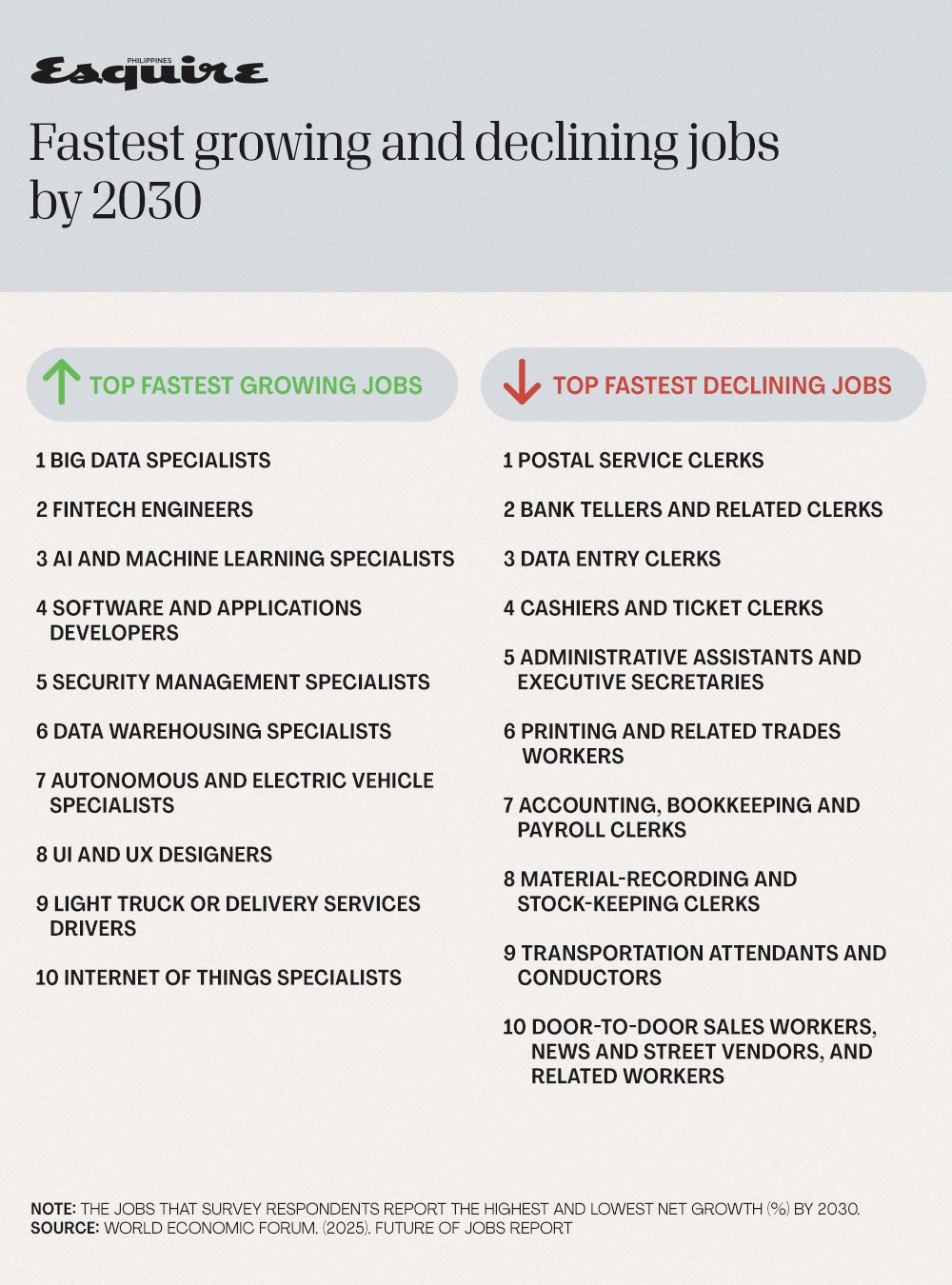
Jobs on the Rise
Broadening digital access is seen as the topmost cause of seismic shift in the world of business. Up to 60% of employers expect this trend to affect various industries, specifically AI and information processing (86%); robotics and automation (58%); and energy generation, storage and distribution (41%).
Following this macro trend, the top five fastest-growing jobs are big data specialists, FinTech engineers, AI and machine learning specialists, software and applications developers, and security management specialists. In effect, the top fastest-growing skills are AI and big data, networks and cybersecurity, and technological literacy.
Core Skills in 2025
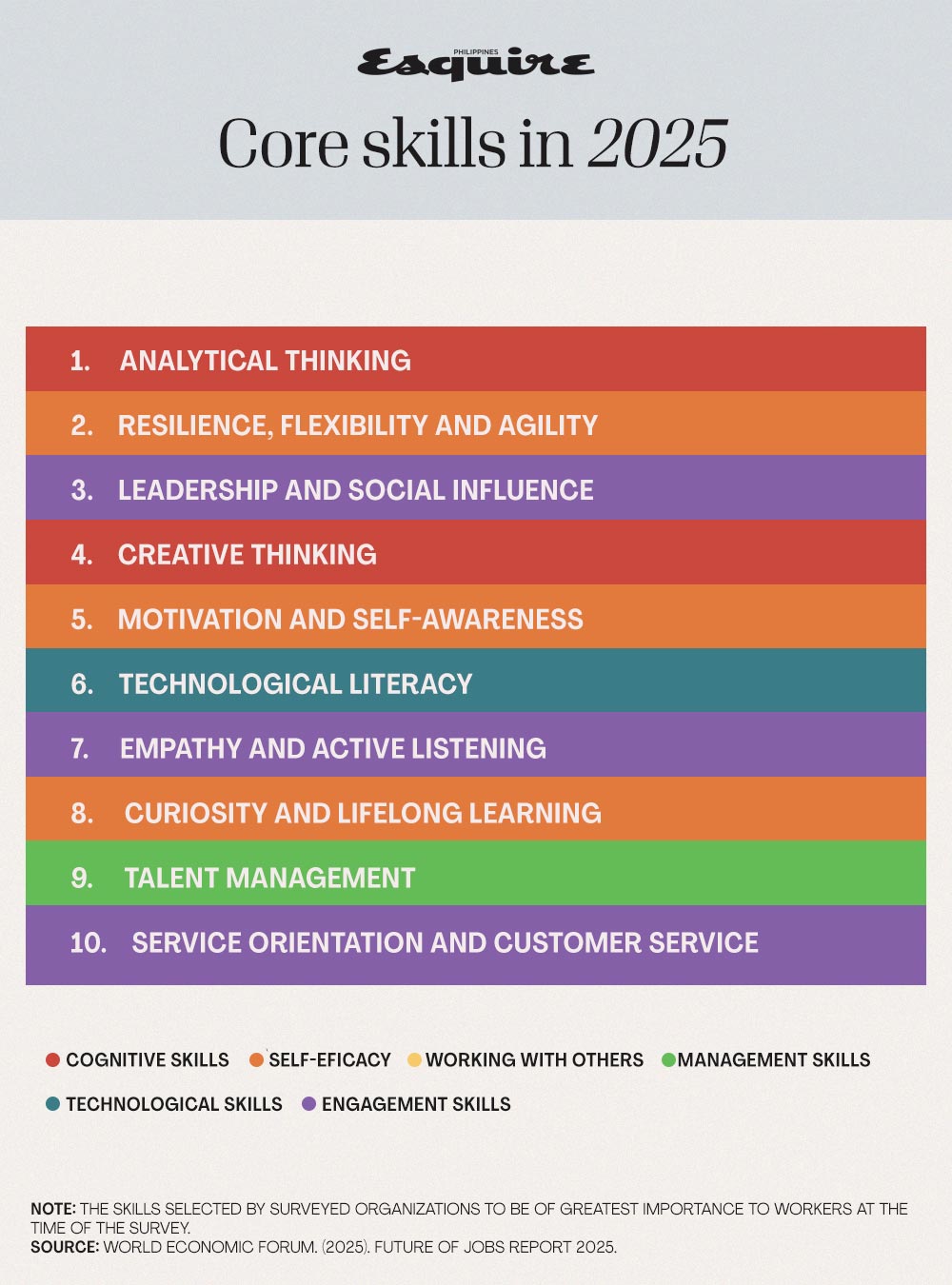
Interestingly, in the world of AI and technology, analytical thinking remains the most sought-after core skill among employers, with seven out of 10 companies considering it as essential in 2025. Following this are resilience, flexibility, and agility; leadership and social influence; creative thinking; and motivation and self-awareness, which are the top core skills in 2025.
"Skill gaps are categorically considered the biggest barrier to business transformation by Future of Jobs Survey respondents, with 63% of employers identifying them as a major barrier over the 2025- 2030 period," the report said. On average, workers can expect that 39% of their existing skill sets will be transformed or become outdated. Fortunately, upskilling (85%) is the top workforce strategy among employers. This is also why flexibility is an important soft skill in adapting to these technology-driven changes.
Top 10 Fastest Growing Skills by 2030
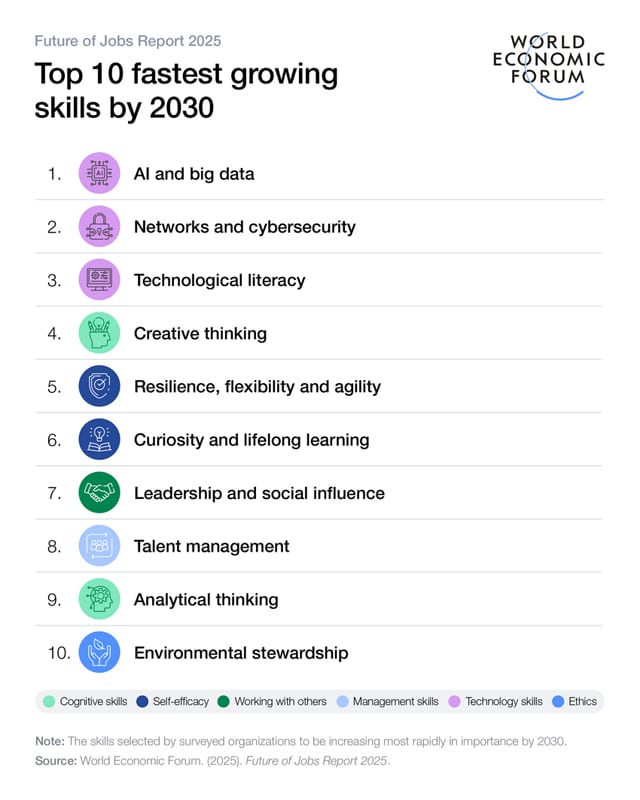
While there are a lot of opportunities for job hunters with technology-related skills, frontline job roles are predicted to see the largest growth in absolute terms of volume. Farmworkers, laborers, and other agricultural workers (#1); light truck or delivery services drivers (#2); building framesrs, finishers, and related trades workers (#4); food processing and related trades workers (#6); car, van, and motorcycle drivers (#7); nursing professionals (#8); and food and beverage serving workers (#9). This is likely because green transition trends are another labor-market driver in the future of jobs. Increased efforts and investments to reduce carbon emissions and adapt to climate change are the driving forces behind this job growth.
ALSO READ:
Today I Learned: Why Good Jobs Are Hard to Find in the Philippines
The World's Most Boring Jobs, Ranked
Jobs on the Decline
"Automation is expected to drive changes in people’s ways of working, with the proportional share of tasks performed solely or predominantly by humans expected to decline as technology becomes more versatile," said WEF in their report. Routine and repetitive jobs are likely to be relegated to automation. As it is now, 22% of work tasks are already performed by technology (machines and algorithms), 30% are completed by a combination of humans and tech, and 47% by humans alone. Employers expect an even split among the three, with tech-performed tasks increasing in percentage and human-performed tasks decreasing.
"It is in this context that the relevance of the third category/approach, human-machine collaboration (or “augmentation”), should be highlighted: technology could be designed and developed in a way that complements and enhances, rather than displaces, human work," WEF added. Up to 77% of employers agree, saying that businesses can reskill and upskill the existing workforce to work alongside AI better, while 47% are transitioning people from jobs that AI will cause to decline to other roles within the organization.
Clerical and secretarial workers, including cashiers and ticket clerks, administrative assistants, and executive secretaries, are expected to see the largest decline in absolute numbers. Similarly, businesses expect the fastest-declining roles to include postal service clerks, bank tellers, and data entry clerks. Up to 41% of employers are likely to downsize their workforce where AI can replicate people's work.
Labor Markets in Southeast Asia
Geoeconomics fragmentation and economic uncertainty are also among the five key labor-market drivers, with Southeast Asian countries the most affected. WEF reported that employers headquartered in SEA are "particularly focused on upskilling their workforce (96%, compared to 85% globally) and hiring staff with new skills (86%, compared to 70% globally), with a large number of businesses in Indonesia, Malaysia, and the Philippines also expecting to address these challenges by facilitating internal job transitions."
Employers in Singapore and Vietnam, particularly, also see finding skilled talent as the main barrier to business transformation. They're calling for policy reforms to expand the talent base in these countries.
In the Philippines, "Broadening digital access and climate mitigation and adaptation efforts are expected to jointly shape labor-market dynamics." Two-thirds of employers in the country see the skills gap as a problem in the next five years. As a solution, Philippine companies are scaling up their reskilling efforts, with 68% of Filipino workers expected to require training to meet evolving skill demands (compared to 59% globally), but only 38% of workers are reported to have completed training today (compared to 50% globally).
Employee Health and Wellbeing
While businesses transform in the robot realm, humans are still seen as, well, humans. Supporting employee health and well-being is expected to be a top focus for talent attraction, with 64% of employers surveyed identifying it as a key strategy to increase talent availability. Effective reskilling and upskilling initiatives, along with improving talent progression and promotion, are also seen as holding high potential for talent attraction. Funding for reskilling and upskilling are seen as the two most welcomed public policies to boost talent availability.
While the report highlights significant challenges, it also presents a vision for the future. Lifelong learning, cultivating in-demand skills, and fostering a culture of adaptability are key to surviving the next five years.
