
The Push For a P200 Minimum Wage Hike: What Exactly is a 'Living Wage?'

For years, labor groups have been pushing for hikes in the country’s minimum wages which are decided by regional boards. A call for a singular, national minimum wage is also being sought following regional wage boards' failure to ensure this “living wage.”
But what exactly is a living wage?
According to Amnesty International, a living wage is the minimum income needed for workers to meet their basic needs and to realize their human rights. A living wage factors in the cost of living, including essentials like food, housing, energy, water, sanitation, education, clothing and transportation. The human rights watchdog said that a living wage should be earned in a standard working week and would not need excessive and exploitative work hours to achieve.
"Granting workers a living wage can lift them out of a cycle of poverty and allows them to access their economic, social, and cultural rights," the group said on its website. "Therefore, the minimum wage, although better than nothing, is much less effective compared to the living wage and often traps people in a cycle of poverty."
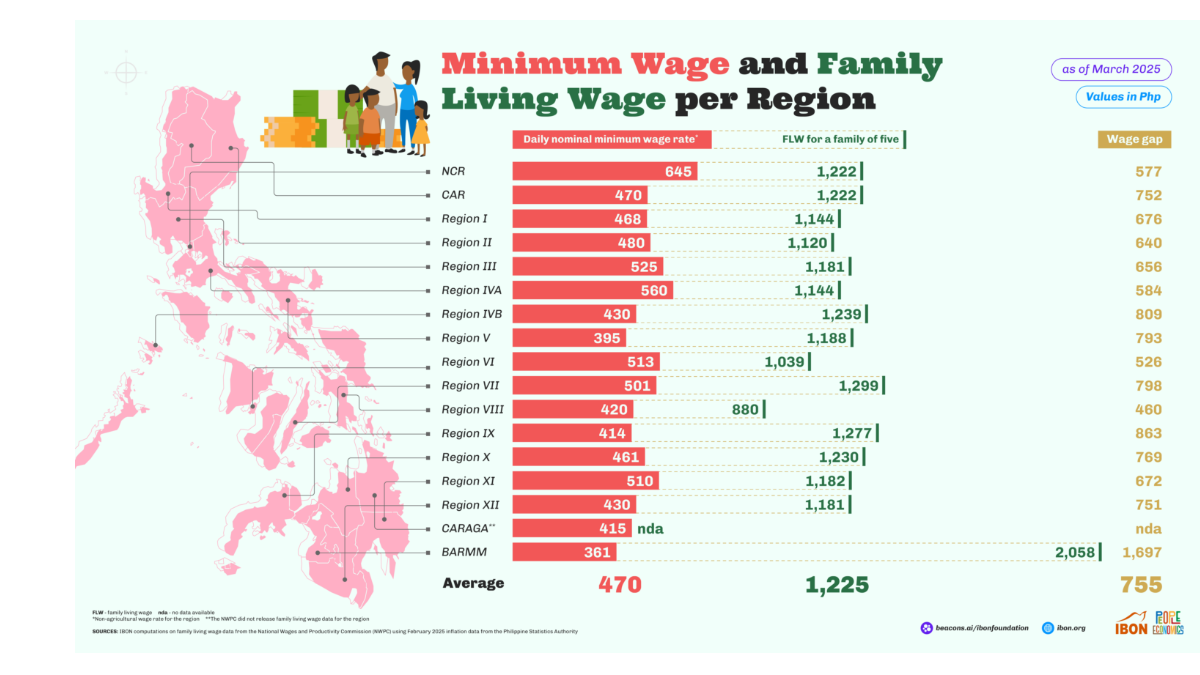
The think-tank IBON Foundation estimates that a living wage for a typical family across most regions in the country should be P1,200 to 1,300 daily as of March this year.
Sonny Africa, who is the executive director of the think tank, said it was crucial to push for a P1,200 national wage to allow workers and their families to cope with spiraling prices and improve their overall well-being.
“A national minimum wage should definitely be considered as part of the full spectrum reset of economic policies towards more domestically oriented and equitable economic development,” he said in an interview.
“Substantial minimum wage hikes including the P200 proposal are already at hand and are clearly more crucial than ever with the number of poor and hungry Filipinos having increased.”
Africa was referring to a call for Philippine President Ferdinand Marcos Jr. to sign into law a measure increasing the daily minimum wage by P200. Last year, the Senate approved a bill doing so for workers in the private sector by P100 in February.
On Thursday, May 1, when the nation marked Labor Day, Marcos called for region-specific wage increases instead of the call for a P150 to P200 legislated pay hike to help workers cope with inflation. The President said during a Labor Day address that wage increases should be studied carefully to help businesses carry them out.
"We hear the call of our workers for better wages and assure you that your concerns are being addressed through the Regional Tripartite Wages and Productivity Boards (RTWPBs),” he said.
At the House of Representatives’ Committee on Labor, there is a bill that would grant P200 across-the-board wage increases for private sector workers.
House Speaker Martin Romuladez earlier said that congressmen are likely to settle for a P200 wage hike instead of the previously sought P750 increase, as it is seen as a middle ground. Deliberations on the proposals were long overdue since the last time Congress legislated a wage increase was through the 1989 Wage Rationalization Act, which created wage boards across the country, the Speaker added.
“The only real, sustainable response to the crushing cost-of-living crisis workers face today is to restore the value of their wages eroded by relentless inflation," Josua Mata, Sentro ng mga Nagkakaisa at Progresibong Manggagawa secretary-general, said in an interview. “A P200 wage increase would lift all regional minimum wages above the poverty threshold for a family of five.”
ALSO READ
Could The Philippines Really Become A Trillion-Dollar Eonomy in the Next Decade?
The Philippines Ranks Second to Last Place in the World for Work-Life Balance
In June 2024, the Regional Tripartite Wages and Productivity Board of the National Capital Region approved a P40 increase in the daily minimum wage in Metro Manila, bringing it to P610 a day from P570 for those in non-agriculture sectors.
This was far from the P570 increase sought by the Unity for Wage Increase Now’s petition, which would increase Metro Manila’s daily minimum pay to P1,100.
“Lawmakers should consider working for a measure that would grant workers a national minimum wage. It would address wage discrimination among workers — a wage determination based on where workers work (regionalization of wages),” said Renato Magtubo, chairman of Partidong Manggagawa and a former congressman.
Various labor groups have chided the regional wage-setting system for failing to support workers since recent increases have not helped Filipinos cope with inflation and the spiraling prices of basic goods.
One Minimum Wage for All Workers
“A national minimum wage will enhance take-home pay of workers, as such spurs economic growth that would be beneficial to the economic growth of provinces and regions,” Magtubo added.
Senator Imee Marcos earlier filed a bill that proposes to abolish these regional wage boards in favor of a singular board that would set the national minimum wage across regions, which would be adjusted annually based on inflation.
Groups like the Employers Confederation of the Philippines have opposed the move for a legislated wage hike due to it likely being “catastrophic and inflationary,” with firms likely to find it difficult to pay their workers more money and eventually be forced to lay them off.
According to the latest data from the Philippine Statistics Authority (PSA), inflation in March slowed to its lowest yearly rate of 1.8 percent from 2.1 percent in February and 3.7 percent a year earlier. This was due to food and transport costs increasing at a slower rate.
The Philippine government is aiming to keep inflation within the two to four percent range until 2028. The PSA is set to release April inflation updates on May 6.
In the first quarter of the year, inflation averaged at 2.2% percent which was within the central bank’s target.
IBON Foundation’s Africa said the government should work to decide on wage hikes and social support programs, and boosting the capacity of local companies to respond to the soaring prices of basic commodities. He also cited the importance of boosting local industries, and in effect, the competitiveness of products with their global counterparts.
“The biggest push to improving job quality and competitiveness will be from the Philippines pursuing a broad-based national industrialization strategy, such as the US and other big powers are doing, and not just from labor initiatives alone,” Africa added.
