
The Arguments For and Against EDCA As Palace Announces Four New Sites

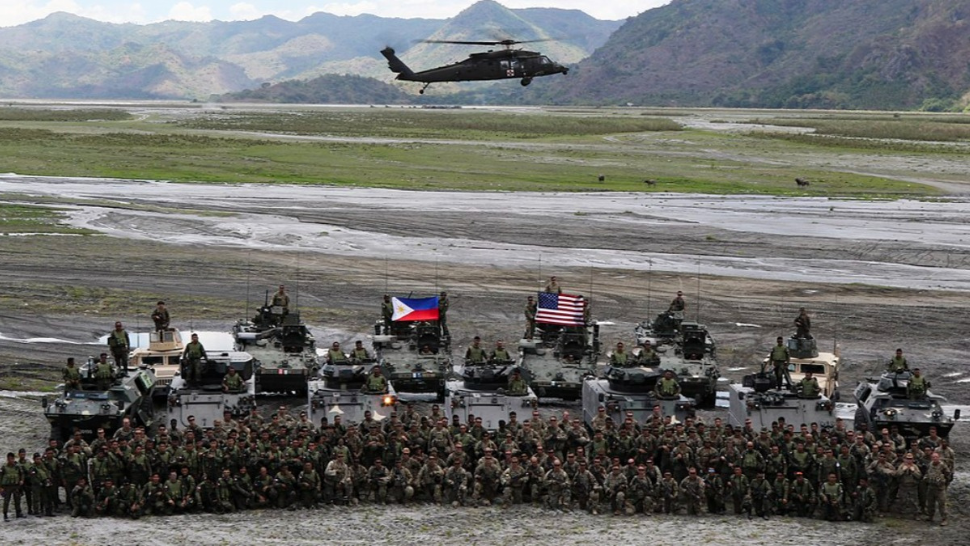
Malacañang recently announced the addition of four new Enhanced Defense Cooperation Agreement (EDCA) sites, the Presidential Communications Office (PCO) confirms.
According to the PCO, the Palace cited the following areas as “suitable and mutually beneficial," as agreed upon by Filipino and American representatives:
- Naval Base Camilo Osias in Sta Ana, Cagayan
- Lal-lo Airport in Lal-lo, Cagayan
- Camp Melchor Dela Cruz in Gamu, Isabela
- Balabac Island in Palawan
The government assured the public that the Armed Forces of the Philippines (AFP) has assessed the locations properly and were chosen to strengthen the country's defense of Luzon's eastern coast, as President Ferdinand "Bongbong" Marcos Jr. put it in a separate Army gathering last month.
PCO Secretary Cheloy Garafil added that the additional EDCA sites should “boost the disaster response of the country as the locations will also be used for humanitarian and relief operations during emergencies and natural disasters.”
However, these additional EDCA sites have met their fair share of criticism. Local Government Unit (LGU) officials were reportedly not too keen on hosting U.S. forces upon hearing the news of the EDCA expansion. But President Marcos claimed that he has already spoken to them about the significance of EDCA under their jurisdictions.
The Department of National Defense (DND), through its spokesperson Arsenio Andolong, previously explained that the EDCA sites would not be American military bases. The said locations will be utilized more as warehouse facilities for military logistics and storage.
Concerns persist though. As we wait for the sites' formal announcement, we look at EDCA's recent history, benefits, and possible dangers.
ALSO READ:
A Philippine-Made Infantry Squad Vehicle Was Shown Off to the Military
An Advanced Military Drone of the Philippine Air Force Has Crashed in Mindanao
A Recent History of EDCA
With the signing of EDCA in 2014, U.S. military personnel were permitted to conduct exercises with local troops and build facilities in our local military bases. These bases are not permanent while the agreement is effective for an initial period of 10 years. It should continue to be enforced as long as there have been no termination requests between the two countries.
EDCA was designed as a supplemental agreement that follows the 1951 Mutual Defense Treaty and the 1999 Visiting Forces Agreement. It's meant to promote long-term modernization and develop cooperation between the Philippines and the United States.
In 2016, the Philippines and the U.S. governments agreed on five locations for military bases for American troops. So far, the U.S. has provided more than $82 million for projects in the following existing EDCA sites:
- Basa Air Base in Pampanga
- Fort Magsaysay in Nueva Ecija
- Lumbia Air Base in Cagayan de Oro City
- Antonio Bautista Air Base in Palawan
- Mactan-Benito Ebuen Air Base in Cebu
Former President Rodrigo Duterte's administration had a somewhat lukewarm stance on EDCA. Duterte threatened the U.S. that he would unilaterally abrogate EDCA and claimed at the time that he had received information that American troops were building permanent arms depots in the country that could include nuclear weapons. The storage of nuclear weapons would be a violation of the terms. Duterte's questions would ultimately delay its implementation but the agreement would proceed soon after.
The U.S. government would go on to request five additional locations in Palawan, Zambales, Cagayan, and Isabela in 2022. This brings us to the recent confirmation of the four new EDCA sites.
What Proponents of EDCA Are Arguing
Proponents of the EDCA, like Defense Secretary Carlito Galvez Jr., say that the implementation of EDCA boosts Philippine security, protects maritime resources, and even allows for economic investment opportunities
Cagayan de Oro 2nd district Rep. Rufus Rodriguez also favors the agreement. Back in February, the congressman said that it is in "our national interest" to pursue and expand the said defense partnership. This should deter "further aggression from China in the West Philippine Sea (WPS) and possible Chinese seizure of islets that belong to us under International law."
He added: "More sites along our western seaboard, where Chinese aggression and harassment of our fishermen have been taking place, should be covered."
Ambassador of the Philippines to the United States Jose Manuel "Babe" Romualdez sees EDCA as a matter of deterrence, not conflict. He wrote in his Philippine Star column, "EDCA is a key pillar of the bilateral defense and military cooperation between the Philippines and the US, and the approval of four additional locations was a major decision of President Ferdinand Marcos Jr., knowing full well that it would boost the collective defense capabilities of both nations."
His argument for EDCA is that it provides us with the mechanisms of deterrence "preventing threats or actions that could escalate into confrontation, leading to armed conflict or possibly war."
The Criticism Against EDCA
Critics have expressed their concerns over the exact scope of EDCA. It could only lead us to possible geopolitical ramifications, some argue. This could mean that the Philippines could be dragged into global conflicts elsewhere, one of which is the tensions in Taiwan. Northern Luzon, where military exercises are held, is only a "stone's throw away" from Taiwan," as Senator Imee Marcos once said.
We would hypothetically be pressed to support the U.S. in such cases. Meanwhile, U.S. forces could potentially aggravate and drag more Filipinos into local armed conflicts and hostilities, pundits say.
Apart from this, the increasing presence of U.S. troops could also mean more intervention in our domestic affairs. House Deputy Speaker and Batangas 6th district Rep. Ralph Recto had earlier questioned EDCA's ultimate goal. "Are the bases the sum of our fears?" he asked.
"Ilang military bases pa ba ang sasaklawin sa darating na panahon? Are we being built up as their armed garrison in the Pacific as a tripwire to Chinese expansionism?" Recto continued.
Upon hearing the news of the additional EDCA sites in March, the Chinese Embassy warned that EDCA would do "serious harm" to regional peace.
“Whereas the U.S. claims that such cooperation is intended to help the disaster relief efforts of the Philippines and some Americans even tout the EDCA sites as a driver of the local economy, it is plain and simple that those moves are part of the US efforts to encircle and contain China through its military alliance with this country,” said a statement from the embassy. “To bundle the Philippines into the chariots of geopolitical strife will seriously harm Philippine national interests and endanger regional peace and stability."
