
A Casio G-Shock Prototype Sold at Auction for P22 Million

Many years ago, I met Kikuo Ibe, the father of Casio’s G-Shock. His journey with timepieces started off with a broken watch when he accidentally dropped his mechanical watch that was a graduation gift from his father. In Japanese tradition, fathers gift their sons with a graduation timepiece, and it understandably had sentimental value for him. It was a loss that inspired him to create what is arguably the world’s toughest watch.
The G-Shock is widely recognized as a functional and very tough watch that can stand up to any extreme punishment. However, in recent years, it has evolved into a more collectible cult status, experimenting on more premium and higher-quality materials and finishing techniques that reflect traditional Japanese craftsmanship and incorporating Casio’s full suite of top-notch technical specifications. He also came up with limited edition collaborations with various themes, artists, and organizations.
ALSO READ
Q&A: Lucerne's Vohne Yao on G-Shock's Cultural Significance, the MR-G Series, and More
The 10 Best Casio Watches to Wear Right Now
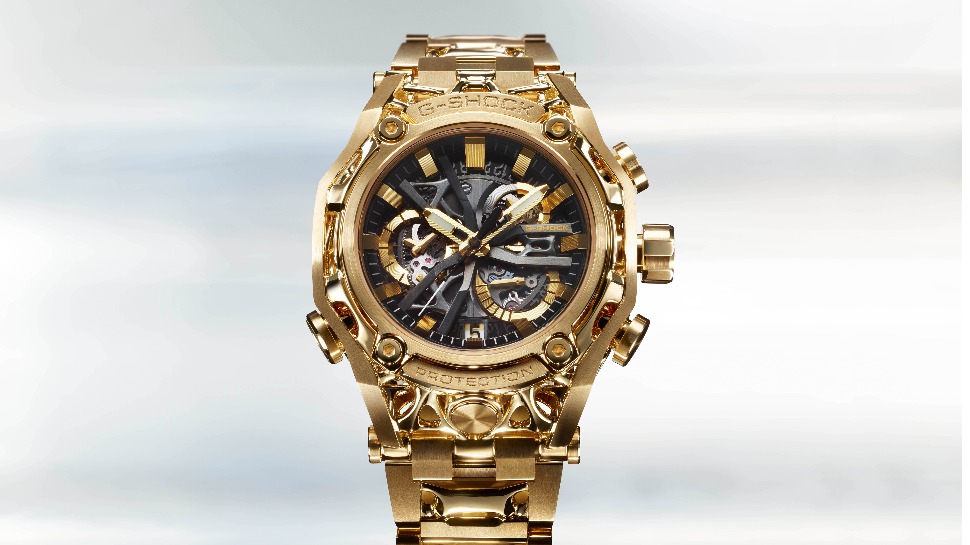
On its 35th anniversary, Casio came up with the “Dream Project,” a highly limited run of just 35 pieces of solid gold G-Shock watches priced at $70,000 (about P3.9 million). Five years later, for its 40th anniversary, Casio unveiled its G-Shock “Dream Project #2” G-D001, which is a one-of-a-kind G-Shock crafted from 18k yellow gold. Its watchcase was designed with the assistance of generative AI using 40 years of data, resulting in a 3-D model optimized to give the highest structural strength and processing methods.
“Truly a dream project, the GD-001 symbolizes the beginning of a whole new chapter for G-Shock,” Ibe said.

The AI-assisted project was further developed with human G-Shock designers, resulting in an organic and original structure, with optimal weight reduction but enhanced shock absorption capabilities. Using a unique precision-molded construction, its bezel and strap were crafted using a lost-wax casting process used in making fine jewelry, all crafted from 18k yellow gold with zero resin buffering and then hand-polished to achieve a high-quality finish and luster.
Sold under lot 79, the watch was estimated to fetch an estimated $70,000 to $140,000 at auction and was offered at no reservations. However, at the most recent Phillips’ “The New York Watch Auction: NINE,” the resultant bid became part of the highest-grossing year of the auction house’s watch department in the city. Its hammer price was a whopping $400,050 (about P22.2million), which is a new world record for any Casio timepiece. All proceeds will go to The Nature Conservancy (TNC).

The solar-powered quartz-based multifunction movement uses the brand's Multi-Band 6 timekeeping feature to receive signals from atomic radio towers around the world for to-the-second precision. Itis encased in a unique solid yellow gold shock-resistant case and comes with an analog display. Another cool feature is its dial, which is effectively transparent, thus revealing a first-of-its-kind movement construction for G-Shock. The silicon gears and ruby bearings are made visible within the brushed metal mainplate. It uses high-efficiency solar cells that are placed on the periphery of the dial to power the watch. It also has a glowing red ring which can illuminate the watch when activated for better legibility.
The “Dream Project #2” will be delivered to the winning bidder with a special display box in the shape of a tower that is partially open-worked and decorated with the model numbers of past and present G-Shock timepieces. An LED light is housed inside the box, offering indirect lighting to showcase the watch, which is an art piece in itself.

The watch is still a functional prototype, though, with the final version to be optimized for the buyer’s location, which will be delivered sometime in the first quarter of 2024. The good news is that Phillips said that the winning bidder is entitled to claim a charitable contribution deduction for the hammer price less the watch’s fair market value, in accordance with the US IRS regulations.
