
Bench VP Bryan Lim Is Making His Own Mark in the Philippine Restaurant Scene


The word scion doesn't seem fitting for a man like Bryan Lim, although he very much is one by definition. The attribute just seems too stuffy, and stuffy he is definitely not. As heir apparent to the Suyen Corporation, the company that his parents,
Upon entry to their offices in a building in Bonifacio Global City, it’s obvious that despite the modern corporate environs, minimal and bright, even in the late afternoon,
One of the many items on his agenda this afternoon is a discussion about the uniforms for
"A lot of it is still aspirational to me. What I am amazed at is how a woman can sit in a chair and pay 5,000 to 10,000 pesos just to feel good."
“My parents and Uncle Ben have always been open to new ideas and are supportive of new opportunities,” he says. “If we present something and they like it, they will never ask, can you do it? They assume that when you ask, you are confident you can make it work.” Under his direction as the vice president for business development, Bryan is tasked to initiate discussions once a potential partner has been identified, negotiate contracts, and then see the idea through to store opening. With the new food group alone, he definitely has his hands full. “They encourage us to delegate and dispense advice as needed, but they want us to find our own vision and solution to make the business model work.” When asked whether there is a particular reason that all their recent concepts have origins in Japan, he replies that it is merely coincidental. The Japanese, he says, have been very aggressive in regional and international expansion, and to an observer keeping tabs, that theory would hold true given the number Japanese dining establishments that have opened in Manila over the past few years. The success of the one-idea restaurant that
Like most sons from traditional Chinese-Filipino families, Bryan’s first job was working for the family business. He spent the first few years in product development for Bench’s undergarments learning the ropes and trying to understand the company culture. “Even though you have a family culture that you are familiar with, there are differences, and you only notice them when you begin to work together. There are unwritten rules and you don’t know what they are,” he says laughing. Through his stories, e reveals just how close they all are, and till now, the family still chooses to always have lunch together when everyone is around. “My mom and uncle Ben are very close and we grew up with him. We used to live together in a compound in Taguig and when he moved to Makati we were always at his house. Having lunch together is very important for us. It’s a time where we can discuss things or just catch up with one another.”
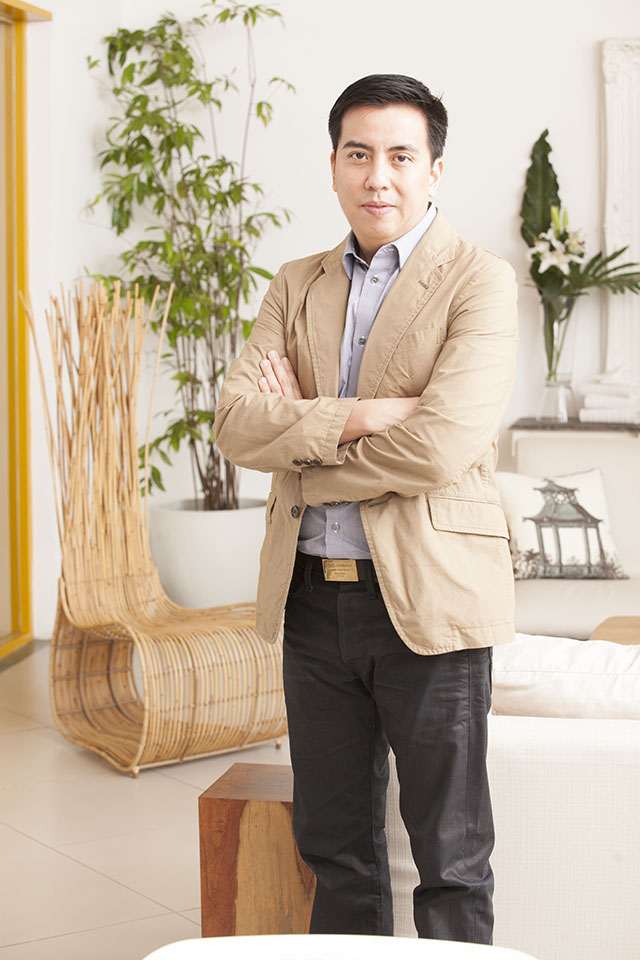
With all the dynamic and global businesses that Suyen manages, Bryan shares that the one that he is most fascinated by is the salon business they started with Alex Carbonell in the mid-2000s. “Really?” I ask, almost disappointed that he doesn’t share my enthusiasm for all of the high-design pieces they host at Studio Dimensione. “Don’t get me wrong, I am really a fan of the designers and what they do,” he explains. “But a lot of it is still aspirational to me. What I am amazed at is how a woman can sit in a chair and pay 5,000 to 10,000 pesos just to feel good. It’s something that is not tangible yet generates a large amount of business based on someone coming out looking and feeling better about themselves. That idea really interests me.”
As we attempt to timeline the growth of the company we see that its rise has been a series of small, slow developments, instead of a single year with one gigantic leap. “You have been there through that growth,” I point out in an attempt to highlight his role in Suyen’s success. But the self-deprecating Bryan still seems reluctant to accept the compliment. His eyes are drawn once again to the rolling rack of chef's garb, and as if thinking out loud, he says, “My parents and uncle imagined a shirt shop when they first opened. It’s our challenge to make sure we keep finding new ideas to keep ourselves, and everything they worked so hard for, relevant.”
This story was originally published in the August 2015 issue of Town&Country Philippines.
