

Manuel Zamora Jr.: Wealth, Business Empire, and Life Outside Work

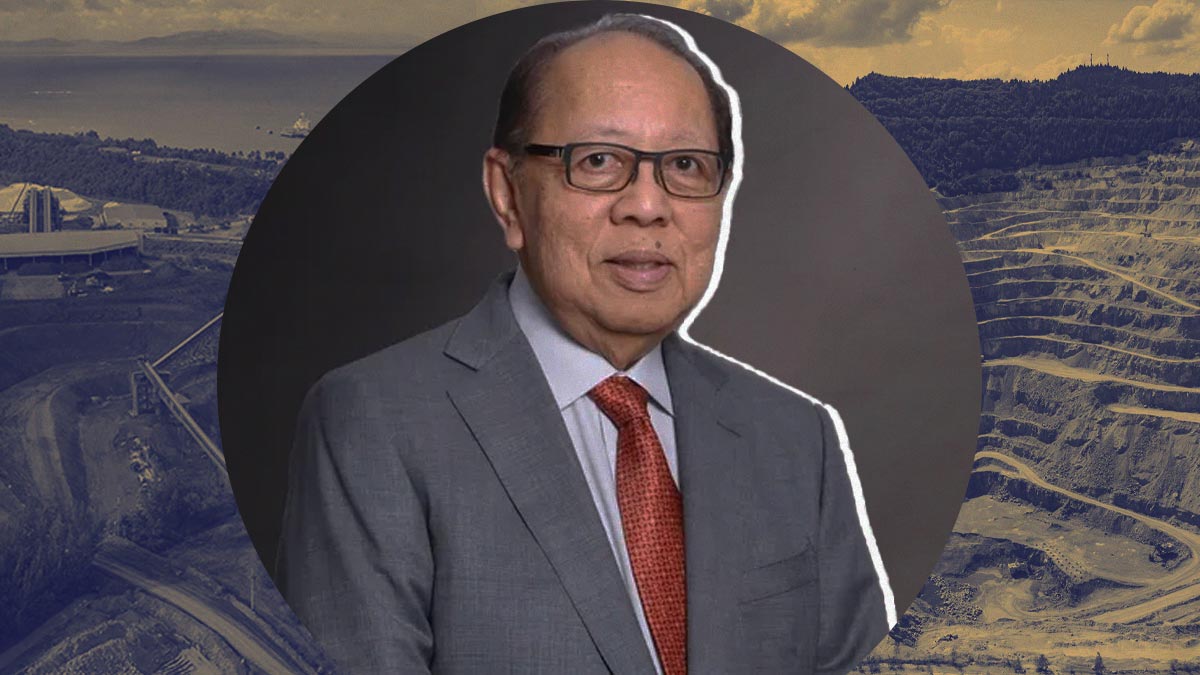
ILLUSTRATION: Igi Talao
Manuel Zamora founded Nickel Asia (PSE: NIKL), which was officially incorporated with the Securities and Exchange Commission on July 24, 2008. It owns five mines operated by its subsidiaries: the Rio Tuba in Palawan, operated by Rio Tuba Nickel Mining Corporation; the Taganito mine, operated by Taganito Mining Corporation, and the Tagana-an mine operated by Hinatuan Mining Corporation, both in Surigao del Norte; the Cagdianao mine in Dinagat Islands operated by Cagdianao Mining Corporation; and the Dinapigue mine in Isabela operated by Dinapigue Mining Corporation. Nickel Asia is now the Philippines' largest producer of lateritic nickel ore and one of the largest in the world.
Net worth: $500M
Age: 85
ALSO READ
16 Richest Filipinos in Forbes' World’s Billionaires List 2024
The 14 Richest Billionaires in the Philippines in 2023
In His Youth
Manuel Zamora Jr. holds science and law degrees from the University of the Philippines. He placed third in the Bar Exam in 1961.
His foray into the mining industry started in 1969 at the age of 28. At the time, Leonides Virata (of the Philippine-American Life & General Insurance Co) was trying to jumpstart Rio Tuba Mining, a small mining company in need of a major incorporator, after geologists accidentally discovered a vast deposit of lateritic nickel ore while looking for a possible concession of land for logging operations near the Rio Tuba River in southern Palawan. Virata, however, was called upon by former president Ferdinand Marcos Sr. to be his trade secretary. He reached out to Zamora, who worked at the Program Implementation Agency (now the National Economic & Development Authority) under the Macagapagal administration.
Zamora invested 60 percent of the company's initial subscribed capital, while American copper mining company Calumet & Hecla contributed $800,000 for a 40 percent share. Calumet & Hecla later sold its shares for $4 million to Japanese companies Pacific Metals Co. and Nissho Iwai. Rio Tuba only loaded its first nickel shipment to Japan in 1977, 11 years since ore deposits were discovered.
"The mining business requires a great deal of perseverance and deep, deep pockets," he was quoted in an article by Forbes.
Manuel Zamora Jr.'s Business Empire
Nickel Asia produces two types of nickel ore: saprolite ore (high-grade and mid-grade) and limonite ore (high-iron and low-grade). It was incorporated in 2008 to house all of Zamora's mining investments and businesses under one umbrella.
Its first operational site, Rio Tuba Nickel Mining Corporation (1977), exports saprolite and limonite ore, and provides limonite ore and non-mining services to the adjacent Coral Bay Nickel Corporation (CNBC). CNBC operates a hydrometallurgical processing plant, the Philippines' first nickel refinery and the first large-scale facility in the work. It was a joint venture between Zamora and Sumitomo Metal Mining established in 2005.
Taganito Mining Corporation (TMC) was established in 1987 in Claver, Surigao del Norte; and its area of operations is within the Surigao Mineral Reservation. TMC exports saprolite and limonite ore, and provides limonite ore and non-mining services to the adjacent Taganito HPAL Nickel Corporation (THPAL), which is a majority-owned subsidiary of Sumitomo Metal Mining with shareholders Mitsu & Co and NAC. THPAL is the first company in the world to employ High Pressure Acid Leaching (HPAL) technology, which is an efficient way to turn low-grade nickel ore into a high-grade intermediate product.
Cagdianao Mining Corporation (CMC) was established in 1999 in the Dinagat Islands in the Caraga Region. The mining site draws water from the Maraguing Watershed and is located within a declared Mineral Reservation site.
Hinatuan Mining Corporation (HMC), a.k.a. Tagana-an Nickel Project, started operations in 2008 in Surigao del Norte. It disposes of its nickel ore stockpiles on Manicani Island, Guiuan, Eastern Samar. Stockpiling is the controlled storage of mined materials—such as ores, waste rock, or overburden—in designated areas.
Dinapigue Mining Corporation (DMC), which was established in 2018 in Isabela, covers an area of 2,392 hectares.
NAC sells its high-grade saprolite ore to Pacific Metals Co., Ltd. (PAMCO); mid-grade saprolite ore is sold to Japanese and Chinese clients; the high-iron limonite ore is sold to Chinese clients; and the low-grade limonite ore is used in the Taganito and Coral Bay processing plants.
In 2023, NAC announced expansion plans by opening two new mining sites in the southern Davao Oriental province through a deal with two domestic companies. However, in February 2024, NAC said that its letter of intent to be the mining service contract for Hallmark Mining Corp. and Austral-Asia Link Mining Corp had been terminated. Hallmark Mining Corp. has a Mineral Production Sharing Agreement of the mining site in Mati and San Isidro, while Austral-Asia Link Mining Corp for Mati and Gov. Generoso.
NAC is also eyeing mining sites in Bulanjao, Palawan; and Manicani in the Leyte Gulf.
Nickel Asia's Impact on Philippine Economy and Society
NAC's vision is to "contribute to sustainable national development by adopting [their] Environmental, Social, and Governance Roadmap in order to achieve the highest standards in the responsible utilization of our country’s natural resources." Responsible and sustainble mining is at its core, which was laid out in 2021 and operationalized in 2022.
In January 2024, the company submitted its emissions reductions targets to the global Science Based Targets Initiative. It also claimed that they're the first Philippine company in the mining industry to do so.
“For 2030, NAC has committed to reduce its greenhouse gas emissions by 42 percent and achieve SBTi’s bold Net Zero Target by 2050 by heavily investing in new technologies and prioritizing the use of market-available hybrid models in all its mining operations,” NAC said in a statement.
Outside the Boardroom
Zamora officially retired from NAC and became chairman emeritus in 2018. Gerard H. Brimo was appointed chairman and CEO, while Martin Antonio G. Zamora was named president of NAC and its subsidiaries.
Back in 1998, Zamora was Estrada's chief fundraiser when he ran for president. His younger brother, Ronaldo, served as representative of the lone district of San Juan from 1987 to 1998, then from 2001 to 2022. Ronaldo's son and Zamora's nephew, Francis, is currently the mayor of San Juan.
