Vivian Que-Azcona: Wealth, Business Empire, and Life Outside Work

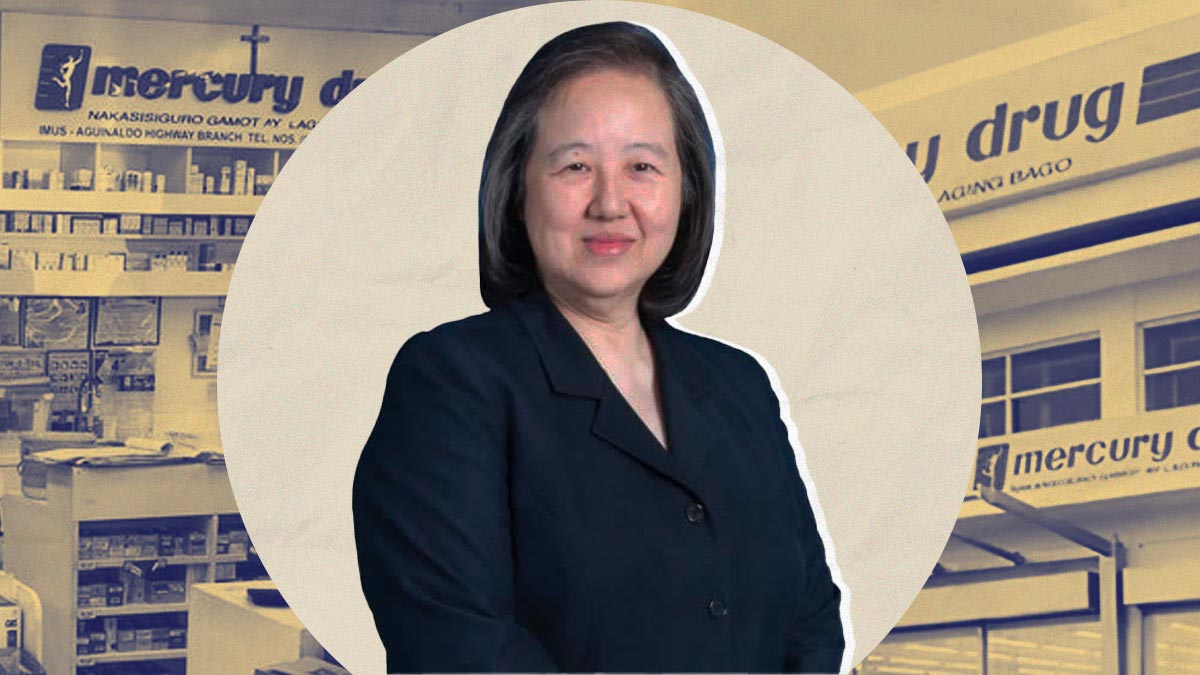
Vivian Que-Azcona is the president of Mercury Drug Corporation, a leading drugstore chain in the Philippines. She remains its largest shareholder, with her net worth at $1.2 billion. The Que siblings ranked 16th in Forbes' Philippines' 50 Richest in 2023. Her journey from an entry-level staff assistant to a top executive is a testament to her dedication and leadership prowess.
Under her stewardship, Mercury Drug has not only expanded its reach across the nation but has also become a trusted name in the healthcare industry, consistently winning accolades for its service and reliability. She was awarded Woman Entrepreneur of the Year by the Asia Pacific Enterprise Awards in 2021.
Net Worth: $1.2B (Que siblings)
Age: 68
ALSO READ
16 Richest Filipinos in Forbes' World’s Billionaires List 2024
The 14 Richest Billionaires in the Philippines in 2023
In Her Youth
Vivian Que-Azcona, born on September 1, 1955, comes from a family involved in the pharmaceutical industry. She is the eldest of eight siblings. Her father, Mariano Que, founded Mercury Drug in 1945, but she was not handed the legacy on a silver platter.
After graduating cum laude with a Bachelor of Science in Pharmacy from the University of Santo Tomas, she joined the family business. She started at the ground level, working her way up from a staff assistant to the company's top executive. She learned the various facets of the business—from inventory and stock control to marketing and finance.
Azcona was appointed Assistant General Manager in 1980, then Vice President and General Manager in 1984, and finally President in 1998. She still holds the presidency position as of writing.
Vivian Que-Azcona's Business Empire
Mercury Drug was founded by Chinese-Filipino businessman Mariano Que (1921 - 2107). He got into the pharmaceutical industry by working as an employee at Farmacia Central along Calle Rosario (now Quintin Paredes Street) in Manila. Farmacia Central was one of the primary pharmacies in Manila prior to the onset of World War II.
After the country's liberation from Japanese occupation, medicines were a scarce and costly commodity. The Que patriarch recognized the dire need for affordable medication and invested his entire savings of P100 to buy a bottle of sulfathiazole, known as a "wonder drug" at the time. He sold these drugs in single doses, then eventually bought an assortment of medicine and peddled them through the streets of Manila through a pushcart. This marked the beginning of Mercury Drug's journey, with the first store opening on March 1, 1945, along Bambang Street, Manila. The following years were marked by the opening of several stores.
By 1948, the company had introduced a customer delivery service, ensuring vital medications were conveniently available to those in need. The self-service format was adopted in 1963 at its store in Makati City, enhancing customer convenience, which set the standard for all subsequent outlets. The 24-hour store service was introduced in 1965 at its Quiapo Plaza Miranda branch, ensuring round-the-clock access to medications.
The 1960s and 1970s saw further expansion and technological advancements within Mercury Drug. In 1967, the company installed a temperature-controlled warehousing system, ensuring the quality and efficacy of its pharmaceutical products; in 1969, it installed biological refrigerators. By 1976, Mercury Drug started operating in Visayas and Mindanao.
Azcona was appointed assistant general manager of Mercury Drug in 1980. The following years were marked by significant milestones, such as the inauguration of Mercury Drug's head office in Quezon City in 1982 and the introduction of professionalization programs for its staff in 1984.
Azcona was appointed vice president and general manager in 1984 and, by 1998, assumed its presidency. When her father passed away in 2017, Azcona had already been leading the company for 19 years.
The turn of the millennium brought with it an array of services aimed at enhancing customer engagement and loyalty. In 1999, Mercury Drug launched its website, and by 2000, it introduced the Suki Card, a loyalty card that offers rewards and points without annual fees. In 2012, Mercury Drug opened its first drive-thru pharmacy service at the San Juan Greenhills Ortigas store.
Mercury Group of Companies Inc. (MGCI) was incorporated in 1972, the same year it acquired Tropical Hut, which is one of the oldest food chains in the Philippines. The fast food restaurant was established in 1962 and was incorporated as Tropical Hut Food Market, Inc. in 1965.
Tropical Hut has 22 stores in Luzon as of July 2023. Eighteen of these stores are in Metro Manila, and seven of them operate 24/7.
Mercury Drug's Impact on the Philippine Economy and Society
As the second oldest drugstore chain in the Philippines, Mercury Drug is a leader in the country's pharmaceutical retail market. It was reported in 2001 that the local drugstore controls about 70 percent of the market, while Oxford Business Group reported in 2015 that Mercury Drug has more than 50 percent, with Watsons coming in second with a six percent share.
Mercury Drug stands as a major employer in the public health management industry. It has a network of more than 1,200 stores nationwide with over 15,000 employees. The drugstore was awarded Employer of the Year by the Personnel Management Association of the Philippines in 1996.
It has also played a crucial role in ensuring the availability of affordable medications across the country, including remote areas, thereby supporting national health agendas. It has a rewards system through a free Suki Card and gift certificates available to the customers. In-store vaccinations like adult flu shots, in-store and call-in pharmacy counseling services, and body check-up machines are also available at Mercury Drug stores.
Outside the Boardroom
Azcona's philanthropic efforts are carried out through the Mercury Drug Foundation, which is a private, non-stock, non-profit organization organized and registered with the Securities & Exchange Commission in 1983. It facilitates various outreach programs that provide free medicines, medical services, and safe potable water to underprivileged communities across the Philippines. Mercury Drug Foundation also offers full scholarships to pharmacy students, partners with schools to distribute first aid and hygiene kits, and facilitates feeding programs.
Vivian Que-Azcona is married to Edward Azcona.