
What It's Like to Drive the Lamborghini Huracán

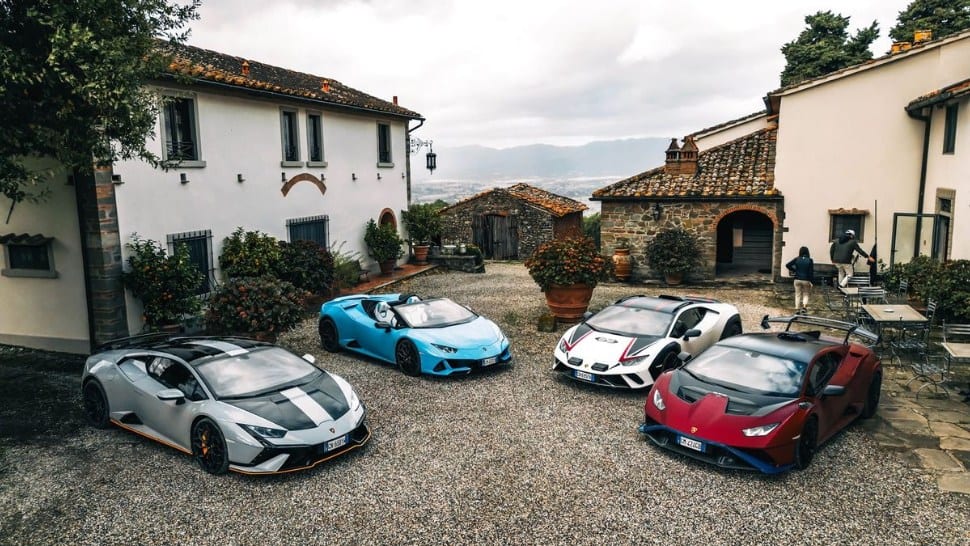
"Are your parents nostalgic for communism?" I ask, already knowing the answer. "Not at all." Next to me is Karl, an Estonian journalist, with whom I have been sharing a Lamborghini Huracán for a few hundred kilometers now. Karl, who I first drove a Huracán Sterrato, then an Evo Spyder, and finally a Tecnica with, is the son of a Protestant pastor. He's almost forty years old like me. He remembers the world before—Estonia freed itself from the USSR in 1991—and he grew up in the world after, and he's someone you don't listen to the V10 scream—you are speechless, ecstatic at the same time—with your nails on the passenger door (covered in sublime Alcantara, of course), it's nice to say a few words. Concluding that only those who have not experienced it can be nostalgic for communism and that from him, it was a thing; with us, it's completely different, even if he calls it the same.
But how did we end up talking about stuff like this?
Because we're traveling in a Lamborghini in a wonderful area of Italy, of course, starting from Forte dei Marmi we will return to Sant'Agata Bolognese, crossing the Apuan Alps and the Tuscan-Emilian Apennines, then descending from Abetone towards Emilia. But above all because we are in a part of Italy that could not merge so much on a symbolic level even if it wanted to. Between Tuscany and Emilia we pass road signs indicating Sant'Anna di Stazzema and Zocca, Nazi massacres, and Vasco Rossi, but also indications of state roads that would take us to Reggio Emilia to the CCCP exhibition which everyone, everyone in this period has passed and some kilometer further and from the Gothic Line we would arrive in Piazza Lenin in Cavriago. Going back to our departure, from Forte dei Marmi, we could have peacefully shook hands with Briatore at Twiga, or even asked Jerry Calà to leave the Capannina and come with us, leaving behind the melancholy of the end of the bathing season. Tout se tient.

At 8:00 a.m. on a Wednesday, we set off from Forte dei Marmi. For those who have never been there or have a distant memory of it, in 2023 it is a paradise fit for oligarchs. Perfect street furniture, green too, easier to find a Dior handbag than a greengrocer. It is said that the oligarchs—especially Russian ones—are not doing too well, but it is doubtful: once one oligarch dies, another one rises—and they are not the only global billionaires, on the contrary. In fact, in Forte dei Marmi you clearly feel the sensation of no longer even being in Italy but in an area destined for the 1 percent of the 1 percent of the richest on the planet, where pleasant places such as the Caffetteria il Giardino survives, miraculously opened in a town that prepares for hibernation in autumn.
Getting on board a Lamborghini Huracán requires you to deal with something between 610 and 640 HP and list prices ranging from 200,000 to 312,000 euros, depending on the model, and it can rise a lot depending on the options. To start, in the morning, we get on a dirt road: 610 HP.

The Sterrato was a brilliant oddity from Lamborghini: a Huracán produced in 1499 units, four-wheel drive, taller than a "normal" Huracán, widened wheel arches, less extreme tires, more civilized mapping, and all suited to the road as well as a light off-road vehicle. A bit like the Porsche 911 Dakar—with a slightly more affordable price list: 230,000 versus 270,000 euros: and, in any case, good luck finding one, if you can afford it—it is the continuation of the supercar with other means, the extension of dominance from the asphalt to offroad.
If a child sees a Huracán Sterrato he smiles because it looks like a Hot Wheels—at least that's what the columnist I would like to host suggests to me: my four-year-old son—and after all, it doesn't even look like a real car. Instead, it is the perfect car to go up from Forte dei Marmi to Cava Valsora. In the rain and between the hairpin bends, having to gain confidence—perhaps you will remember another test on these pages, the Lotus Emira: it had 200 HP less—it is the ideal Lamborghini, probably together with the Urus. As highlighted by anyone who has tried it, the Sterrato is a car that immediately gives you confidence and serenity that is counterintuitive compared to its shapes. Appearances can be deceiving, because the Huracán Sterrato is visually aggressive, almost overloaded with symbols—the additional headlights, the roof racks, the wheel arches with visible screws... but when driving it is tame and reassuring, as much as a 610 HP Lamborghini can be. Perfect, therefore, for climbing from the Forte to Cava Valsora, and from Cava Valsora to reach Ciocco, where Karl and I, under an even more intense rain, after having not even crossed banks of fog but directly through the clouds, choose, like D'Annunzio, to change. To take the car least suited to the climatic conditions we find ourselves in a Huracán Evo Spyder.

Another aesthetic world compared to the Huracán Sterrato, the Evo Spyder is less overloaded symbolically and aesthetically. The model we chose is a wonderful light blue, and before leaving Ciocco I hear the car talking: "But what are we doing at Ciocco, where do you want to go, at Abetone? But you're crazy, it's cold... let's go to the French Riviera." Roof tightly closed, and off we go, but it's not a car to be used like that—like all spiders, even the best, it has an infinitely more complete and harmonious design when open than closed—and we adapt to the circumstances. The Evo Spyder is a completely different car compared to the Sterrato, you can feel all the 640 HP. You have to give it a polite address, as it should be, even if with the electronics of today's supercars it's really difficult to make a mistake—unless you're being stupid. But that's another matter: even with a panda if you act stupid it can get bad.
From Ciocco we arrive at Abetone, passing through autumnal forests, with red and gold foliage. Wonderful, sure but it also produces endless carpets of damp leaves on the asphalt, a wet asphalt, because, as has not yet been remembered enough, it's been raining. The weather conditions would be prohibitive for a normal car, let alone for a Huracán Evo Spyder, and compared to the Sterrato it is another world, you feel less protected from mistakes and it is above all the weather conditions that require caution. At least until we arrive at Abetone, and Karl and I, now familiar both with each other and with the vehicles, switch from the Evo Spyder to the Huracán Tecnica, with which we set off again toward Ponte Samone, province of Modena.
The Tecnica, 640 HP, has a peculiarity: rear-wheel drive, while everything we had driven up to that point had all-wheel drive. In the meantime, it stops raining, which is a good thing. Another good thing is that a 640 HP rear-wheel drive on a 2023 Lamborghini is not a rear-wheel drive on a Countach from forty years ago where relying on divine mercy was, if not mandatory, recommended. A rear-wheel drive in a 2023 Lamborghini is essentially as balanced to drive as an all-wheel drive, and again, as long as you don't overdo it, you never get the feeling that disaster is around the corner. Also because these cars rarely end up in the hands of those who really know how to drive them, at Lamborghini they know this, and they design them with infinite engineering care so that they can all be driven by anyone.

From Ponte Samone our journey is ending. We arrive towards Sant'Agata Bolognese along the last state roads of the day, with the hills thinning out into the Po Valley, the weather changes to beautiful, then simply cloudy, then the sun sets between the warehouses, street lamps with orange lights and darkness of industrial zones, a dark requiem climate. Because this, for the Huracán, was "the last dance": it will go out of production in 2024, its legendary naturally aspirated V10 will retire, and its successor will be hybrid, like the Revuelto which paved the way. However, there is something to really rejoice about: for having driven something exceptional one last time, which will no longer exist tomorrow.
From: Esquire IT
