
The Blade Runner Effect: Nissan Goes Full Cyberpunk With Its Latest EV Concepts

TOKYO—A lot has changed since Nissan introduced the first mass-produced electric vehicle, the famous Leaf, to the market in 2012. With a more discerning customer base and the changing electrified landscape, the pioneering car brand wants to lead a new EV revolution.
The brand's newest EV concepts are all about futurism (like, maybe way into the future here). As a matter of fact, it has gone full cyberpunk, with the introduction of five new EV concept cars during the Japan Mobility Show (JMS) 2023.
“In reality, what's coming next is an explosion,” Nissan Motor Corporation Global Head of Design Alfonso Albaisa says of the EV market. "We make something for the next generation of people who want to challenge the smooth car with something that is quite outrageous, including that interior."
Nissan had earlier unveiled its first EV concept cars, which include Nissan Hyper Urban and Nissan Hyper Adventure, leading up to the JMS. Four of the concepts were displayed on the digital 3D billboard Cross Shinjuku Vision in the Shinjuku district of Tokyo over the past few weeks leading up to the unveiling of the Nissan Hyper Force, an all-electric high-performance supercar.
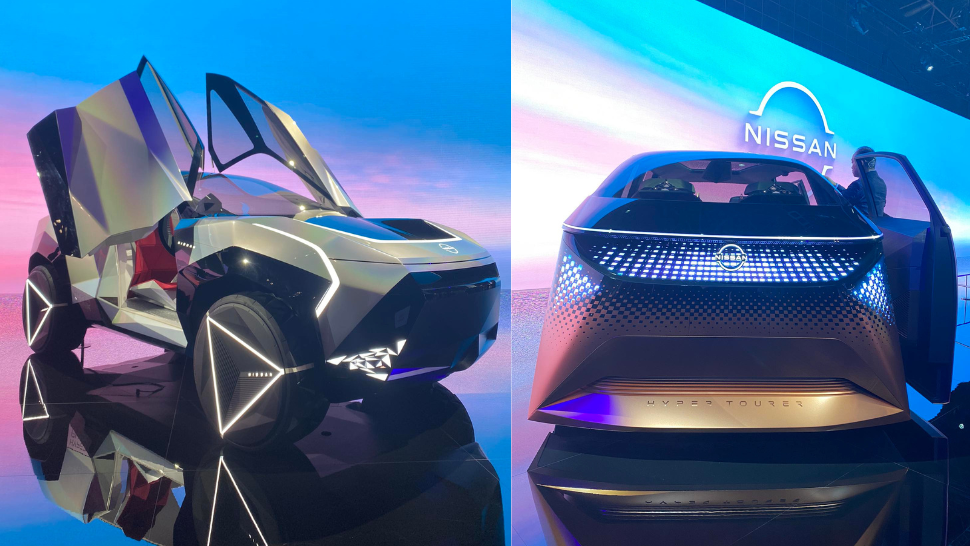
The Hyper Force's wide and planted proportions and sleek curves accentuate its bold geometry. This is a glimpse of the possibilities for the supercar segment, its designers say. It is envisioned to be a successor to Nissan's high-performance vehicles of the past, if they had an EV facelift.
The Nissan Hyper Tourer, on the other hand, showed the audience the possibilities of Nissan's V2X functionality and EV Technology Vision. Its exterior is made up of smooth body panels and sharp character lines.
The Hyper Tourer’s design features a digital mask that blurs the lines between the grill and the body.

"I know that I'm like the grandfather looking at the grandson or granddaughter thinking they're wonderful. It's about how technology [has shifted], even creating technology [the way my generation did]. Digital models were not polygons," he says. "They were called nerves or points and lines and surfaces. But the new generation of kids make their own digital model. They don't need professional models."
According to the chief designer, most of these designs come from a team inspired by gaming motifs, retro trends, and cyberpunk imagery. Of course, each vehicle takes into account downforce, which is arguably the most important aspect of designing these new-wave EVs. They wanted to have the wind breeze through these cars' faces.
But the thing with managing aerodynamics in EVs is the fact that this ends up creating cars that have a similar feeling. "They're all smooth, they're all a bit sleek. What I think is happening, and I know in my company it's happening, there's a little rebellion."
ALSO READ:
Manila to Albay on One Tank of Gas with Plenty Left to Spare: Driving the 2023 Nissan Kicks
How the Heck Did a Nissan GT-R End Up Swimming in Cebu?
Meanwhile, the Hyper Punk is a car designed for content creators and artists. It's symbolic of how Nissan hopes to embrace phygital (physical-digital) realities. It's a next-gen crossover that exhibits multifaceted and polygonal surfaces. Hence, the bolder look carries over to the interior, with its origami-styled elements.
“Hyper Punk is crazy. It shows freedom, the new electrified generation, [influenced by gaming and the Metaverse]. Many of my young designers live in the Metaverse," Albaisa adds.
Nissan Motor Corporation President and CEO Makoto Uchida at the Japan Mobility Show with the Hyper Force and a closeup of the Hyper Punk.

The Hyper Tourer's ultra-low center of gravity, combined with the advanced e-4ORCE all-wheel control system, makes for smooth and flat acceleration and deceleration.

While these are some interesting concepts conceived by the brand, snippets of these things will soon be rolled out over the next few years. "We don't like to make show cars just as a throwaway exercise," he quips.
Some of these key features include the next-gen e-powertrain, offering better efficiency with its smaller inverter; the upcoming V2X Intelligent Charging Management System, allowing for better autonomy while optimizing efficiency in batteries; e-4ORCE all-wheel control system; and the fully customizable HMI Service.
“More than ever, you don't always have to be a purely futuristic car. In the modern era, it's to be inspired by yesterday,” he concludes. “It just has to look and feel completely tomorrow.”
