

How Abdulmari Imao Reinvigorated the Mythos of Muslim Mindanao

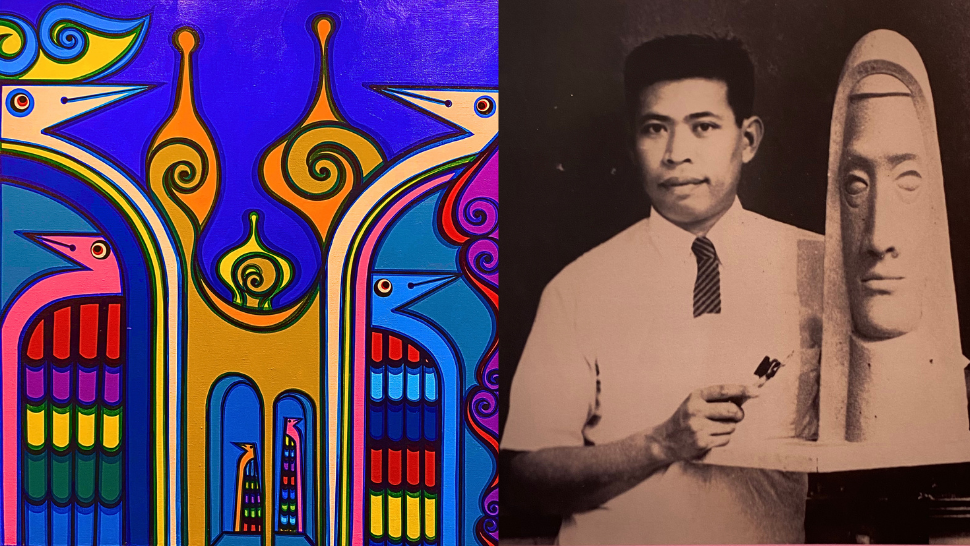
Standing in the middle of A Life Without Borders at the Design and Arts Campus in the De La Salle-College of Saint Benilde, Manila, I can't help but think about the tapestry of Moro culture unraveling in front of me.
I am in the presence of Abdulmari Imao's signature crescent moons, okir, naga, and sarimanok, and they are divine. Standing among a collection of sketches, sculptures, paintings, and photographs of Imao is akin to immersing yourself in the legends of Sulu. More than the myths and motifs, the genius of Imao lies in how he ultimately came to represent the rich and varied ways of Mindanao.
See, the National Artist's iconography is emblematic of the transmutation of Moro culture in Philippine art. It was through his deep exploration of Islamic motifs and Mindanaoan heritage that he consciously championed and reexamined what it meant to be a native son of the Sulu archipelago. He reconciled the place of the Moro artist in the Filipino contemporary; thus, by extension, finding the Filipino artist's voice in the global contemporary sphere.
"Imao constantly championed and promoted the culture and religion of Mindanao but tempered it with Western principles, creating a hybrid phenomenon that stands unique in Philippine art," notes Architect Gerry Torres, who is the curator for this collection and the director of the school's Center for Campus Art. Torres was kind enough to walk me through the exhibit himself.
Imao as a young man and Imao in his later years with his family; his sons Alkarim, Toym, Josemari, and Juan Sajid, as well as his wife, Grace, are seen in the photograph.

Torres is particular about exhibits on National Artists here at Benilde. "I believe or feel that a lot of us do not know who they are," he tells me. Before Imao, the Center for Campus Art did shows on National Artists Ramon Valera, Lino Brocka, Ishmael Bernal, Ryan Cayabyab, and even Cirilio Bautista, to name a few, accommodating different perspectives; some academic, some much more personal.
For A Life Without Borders (a title lifted from the artist’s necrological services in 2014), Torres had the pleasure of working with the National Artist's family. "The number of works in this show is significant, brought about by the fastidious archiving of the Imao family, led by Toym and Rizalee Imao," the exhibition notes read. The curator just loves the array of drawings and sketches in the exhibit, which he says are "quite important [to me] because I'm interested in the process, in the art-making process.
"I feel that sketches of artists about whatever project they do are evidenced by sketches. The germ of the idea is in the initial sketches."
ALSO READ:
Joey Ayala's Real Thoughts on Being Nominated to be a National Artist for Music
How a German Artist Fell in Love with the Philippines—and a National Artist
The exhibit opens with Imao's sketches. We can see some original studies, like the ones he did for some monuments that were never made or for some of his early sculptures when he attended the Rhode Island School of Design and as he taught at the University of the East.
Seen here, too, is Imao's early examinations into his epochal sarimanok and its primitive forms. There are also designs for cars, jewelry, and logos, like the one for Miss Universe 1974. Some of his first attempts at Islamic calligraphy are on display, as well. Drawing was an obvious obsession. "I feel that sketches of artists about whatever project they do are evidenced by sketches. The germ of the idea is in the initial sketches," the curator emphasizes.
Architect Gerry Torres shows us around the Center for Campus Art gallery.
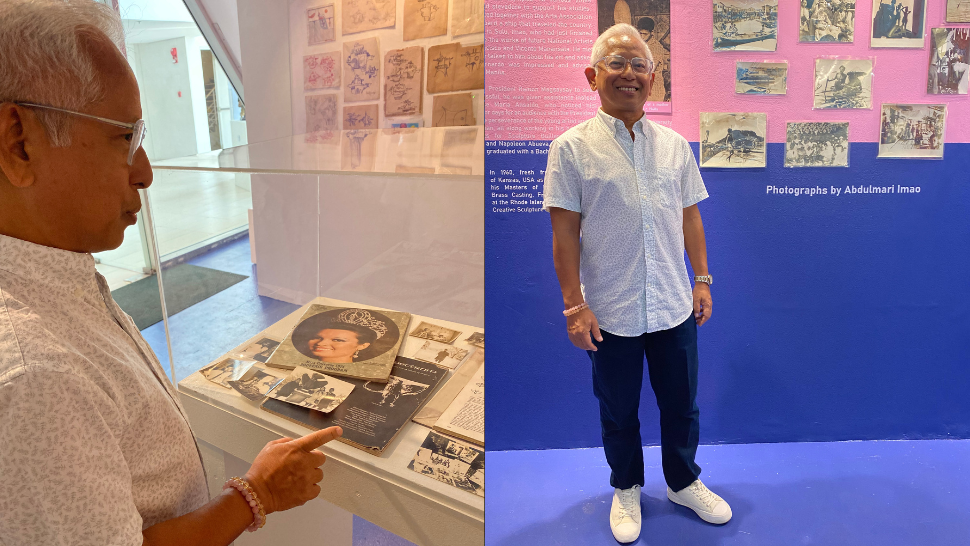
"So as you can see, he is a compulsive drawer. It's funny. Sometimes, he would draw on the back of receipts. These would be sketches in pencil, pen, and crayons or colored pencils," Torres tells Esquire Philippines. "He would draw around the clock. He would draw a perspective, and on any material he could get his hands on."
Records, receipts, letters, you name it, he drew on it. Religion, of course, was omnipresent in his artistic reckoning. Imao was consumed by it. But that doesn't mean he succumbed to its would-be social and religious limitations. He even broke Islamic practice by drawing the human figure, as seen in the nudes he rendered. Islamic art doesn't focus on the figurative, after all. It's more about symbolism.
"He did not allow himself to be boxed in by the conventions of religion." It also helped that Imao worked during a period in time that had not yet seen Islamic fundamentalism as a threat, the curator points out.
Imao's calligraphic art and National Artist medal.

A Life Without Borders traverses Imao's diverse multi-media art practice in its different scales during the various points in his life, from life in poverty in Mindanao to a distinguished elder statesman for Philippine contemporary art. This exhibit shows more than 50 year's worth of virtuosity.
Imao was one of the finest sculptors in the land, and one of our brightest cultural researchers, too. He went from being a star sculptor under the tutelage of fellow National Artists like Guillermo Tolentino and Napoleon Abueva at the University of the Philipines to becoming a scholar who pursued three postgraduate studies in his life. He received the Smith-Fulbright and Kansas University scholarships, as well. Whether it was metal, brass, or just about any other medium, Imao was just exceptional.
When he wasn't drawing or sculpting, he was busy being a photographer elsewhere. He captured the ins and outs of his own life, as well as the lives of the Tausug, Samal, and Badjao people in the South. As someone who studied Documentary Motion Picture Production and Scientific Photography at Columbia University, he understood the importance of distilling the essence of subjects and showing their truest selves in the residue of their being and environments, how each interacted with one another.
Shots from the main gallery.

In an interview with Nick Joaquin in 1969, Imao once said:
"I have been working on the sarimanok style. This is a design I am trying to improve, revitalize. That is why I have been doing research on this Muslim motif: to develop it into another design which will be distinctively Muslim.”
In the main gallery of the exhibition hall is where we're treated to Imao's Sulu. Torres tells me that he wanted to have a panoramic gallery with the paintings, which were meant to represent the land, skies, and seas of Sulu (basically, the kind of imagery native to Sulu). Yes, there was a copious amount of blues and pinks, as we'd expect from an Imao show. The metal and wood sculptures present had also been strewn together to approximate the Sulu archipelago.
"When I went to the studio of Imao, I saw these paintings on the wall. So I thought of putting them around, like what Paris did for the Water Lillies of Claude Monet. The floor of the gallery is blue because it symbolizes the sea of Sulu," Torres says. "[As with his Imao,] we chose pink for the sky because when the sky is pink, the sun will be beautiful the next day."
The artist's birthplace reveals itself in the colors, elements, and shapes Imao used throughout his career. We mainly associate Imao with the brand of Sulu blue that's consistently been displayed in his work, or even with the Muslim motifs omnipresent in his practice, like the crescent moon, okir, naga, and sarimanok (with that familiar fish in its beak).
"As you can see here, even if his motifs are the same, the way he combines them is never the same. He also did landscapes and if people will read into this, [they'll] see it's like [he's untangling] the character of Sulu," the curator claims.
"He was always looking at nature. He saw the colors of the fish underneath the sea and applied it to his work."

Of course, these were his personal theses as a child who grew up Tausug in the islands of Sulu, someone who came from a family of boatbuilders, whose knowledge of houses, boats, furniture, weapons, grave markers, textiles, and utilitarian objects came to inform his perspective and future practice. Maybe we know him, too, for the cadence in which he arranged and rearranged the ancient Hindu and Islamic values of Southern Philippines among his works. Just impeccable.
"Imao's works are very beautiful and very optimistic," says Torres. "If you look at his figures, you can see that they're always smiling. I don't know if it's the eyes or the lines of the mouth, but to me, that's joy."
His sculptural sensibilities, we can see, have strongly been influenced by mid-century Scandinavian design, as well. Imao, himself, noted this in an interview with Nick Joaquin in 1969, as well. The artist was awarded the New York Museum of Modern Art Travel Grant to Europe and Scandinavia back in 1963. While there, he studied these countries' aesthetics, zeroing in on the emphasis on light, neutral-heavy palettes, curvilinear forms, and natural textures.
Interestingly, as a response, architecture students were asked to design high-rise buildings in Bonifacio Global City inspired by the artist's work. "Like I said, BGC lacks character," the curator quips.
We see Imao in the forms and finishes of the designs, "how they were able to twist and then curve the edges," as Torres mentions. "They were able to translate it into architecture either through the building shape itself or inside the building." Imao is evident in the railings, windows, tiles, and the like. The curator says that this is proof of a serious attempt at cultivating a culture-sensitive urban landscape. The students even had these designs patented, just in case an ambitious project needs them in the near future.
Torres adds: "They were able to, in the process, not just work with a different input for their design but they were also able to know the first Moro to be a National Artist."

The retrospective is a fitting salute to Imao's undulating range and legacy. He was a prolific artist who was not only a titan of Moro culture, but also of the cornucopia of the Mindanaon creative consciousness. The life of Abdulmari Asia Imao is an allegory of poverty, religion, and race, one that transcends barriers. He did so without ever turning his back on his selfhood. Imao carried the topography of the Sulu archipelago throughout his illustrious career.
His art practice reflects the dynamism of the national identity, and how it continues to be made and remade to this day, much like our ideas of local art, heritage, and patrimony. For the late great Imao, to live a life without borders was only attainable by living a full life, well-examined. And suffice it to say, he did.
A Life Without Borders: Abdulmari Imao, National Artist for Visual Arts is open for public viewing until September 8, 2023 at the 12F, Main Gallery of the Design and Arts Campus, De La Salle-College of Saint Benilde in Manila.
Sources:
- “Abdulmari Asia Imao: A Sculptor’s Story of Success” by Pam Casin, Manila Bulletin Lifestyle (2009)
- “The Saga of Abdul Imao, Sculptor” by Amadis Ma. Guerrero, Celebrity Magazine (1980)
- Citation from the Gawad CCP Para Sa Sining (1990)
- UP Diliman Information Office, UPDate Online (2014)
