

How a German Artist Fell in Love with the Philippines—and a National Artist

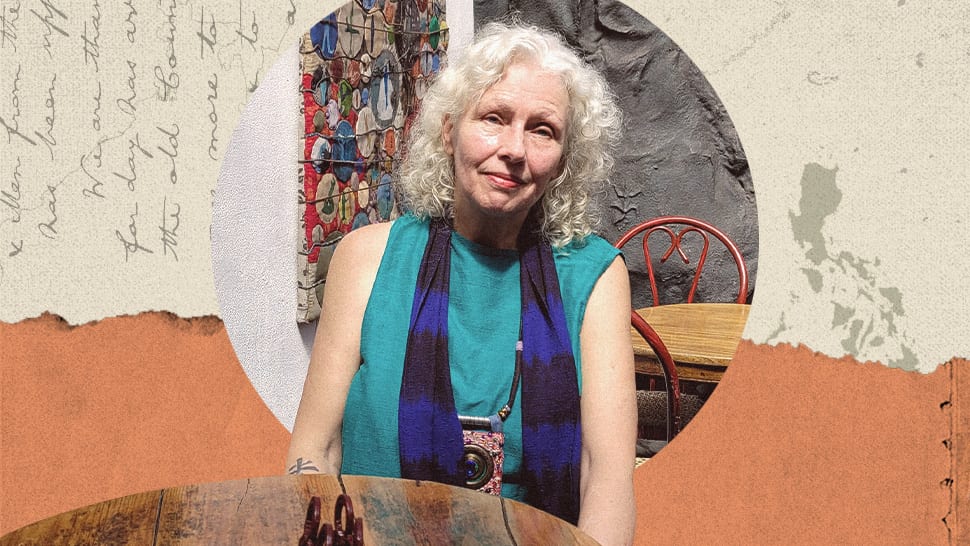
When people talk about the spouses of renowned businessmen, artists or celebrities, they’re often described as “the woman behind the personality.” But Katrin De Guia would rather be known as standing beside her husband. While the focus has mostly been on Kidlat Tahimik—a filmmaker and beloved stalwart of Filipino art—Katrin is, herself, an artist, an academic, and, above all, a mother to the couple’s three sons. Undoubtedly, she is just as accomplished and her story is no less enthralling.
Born in Munich, Germany, Katrin says she knew she wanted to be an artist early on in her life. “My aunt always said that, when I was four years old, she asked me, ‘What do you want to be? And I said, ‘I want to be a free artist.’ And that is what I became.”
A jeepney in Munich
The young Katrin went to art school in Munich, and this is where her path intersected with a brash, young artist named Eric De Guia, who the world would later come to know as Kidlat. One day in 1972, Katrin says she was walking with her boyfriend at the time when they saw someone driving around in a big, colorful jeepney around the university. It was Kidlat.
“He brought a jeepney to sell…Filipino handicrafts to enable him to write a play in the mountains,” Katrin says. “I saw this colorful jeepney, and we went, ‘Wow, look at this!’ It was October and it was really cold, but here was this open jeepney that was so colorful. You never see anything like that in Munich.”
Kidlat stopped in front of the couple and asked Katrin if she wanted to ride the jeepney with him on his way to an art exhibit. The German college student said yes.
“That was the first time we met, and he was the first Filipino I met,” Katrin says. “Oh and that was the end of the boyfriend!
“I fell in love with with his eyes, his big brown eyes,” Katrin adds.
After the art exhibit Katrin says they had a drink but then eventually lost track of each other. The attraction may have been instantaneous, but it took a while before the two officially got together.
Sharing a little house
The next time Katrin saw Kidlat was about six months later. He was walking along Leopoldstrasse, a street in Munich known for its museums and art galleries.
“I saw him walking and he had this very light way of walking,” Katrin says. “I think most Filipinos have (it), not this German ‘plonk plonk,’ heavy-landing-on-the-floor walk. For Filipinos, it's the opposite way, it goes up in the air, like you’re dancing or skipping.
“So I saw him there, and of course he already had long hair, and he grew his beard already. And then I told at that time we were looking for one more person to share a house in the countryside. It was a little house where only women lived, and we women didn't want any guy to stay there.”
But the German women apparently thought that the Filipino guy was harmless. It might have also helped that Kidlat wasn’t exactly a big guy and the house itself was small. But the house had a huge attic and Kidlat needed space for his boxes of handicrafts that he brought from the Philippines to sell during the Olympics in the city that year. So he moved in.
“And that was the beginning of our friendship and our dating,” Katrin says. “I went with him to Norway where he wrote a play. And I made my drawings, and then we traveled to the Philippines and I fell in love with the Philippines.”
The two got married four years later. Katrin said it wasn’t hard to decide to move to the Philippines.
“I really fell in love with the people, but I also liked the simplicity of life here,” she says. “Back then Munich was a small town, during the Olympics, it became more sophisticated and, and today it's, like (all about) money and fashion and film. Somehow I had a bias against that because for me, simplicity was important. I felt the Filipinos were such generous, physically beautiful, elegant people. And I felt this here was highly civilized.”
PhD in Philippine psychology
Katrin says her attempt at understanding Filipino culture eventually became research. She started hanging out with so-called “barefoot artists,” immersing herself in the world of indigenous art, and learning about the culture of Filipinos in the process.
While she started out creating art—sculptures, stained glass, and conceptual art—Katrin says she also felt it was important to report and write about culture and artists in the Philippines. She traveled all over the country meeting them and studying their craft. She had already earned a diploma in Fine Arts from the University of the Philippines, but her fascination with indigenous Philippine psychology, as well as the writings of UP psychology professor Virgilio Enriquez, inspired Katrin to pursue a doctorate on the subject, also in UP. It took 12 years of her life, but she finally earned that PhD in 1996.
“To this day I just like Filipinos and Filipino culture,” she says. “I mean, they are so underrepresented, parang it’s not a noisy culture. It’s a very silent culture. And because all the subtleties they're not really represented well. That became my way of writing about it.”
Katrin was eventually awarded several grants from the Toyota Foundation, which led her to write and publish a book called Kapwa—The Self in the Other: Worldviews and Lifestyles of of Filipino Culture Bearers. It was nominated in the 10 Best Social Sciences Publications in 2006 and was a finalist in First Book Award in 2007.
Actress, designer, mother
Katrin has also dabbled in acting, starring in some of her husband’s films and even creating the costumes in Memories of Overdevelopment, Kidlat’s love letter to Enrique de Malacca, the Malay slave who some people believe is the first person to circumnavigate the world. She is also the biggest cheerleader not just of her husband, but of their three sons—Kidlat, Kawayan, and Kabunian—all of whom inherited their parents’ creative genes and are artists themselves. They now also have four grandchildren.
Today Katrin is still by her husband’s side. After having been together for nearly half a century, she says they each have discovered nearly everything about each other.
“Now we are trying to bridge the differences more elegantly, more gracefully,” she says.
The couple lives in Baguio, a city that has bred and attracted some of the country’s best artists. Katrin says has at least one advantage over other places in the country.
“It’s really at the crossroads of indigenous culture and this super-modern, American materialistic, utilitarian culture. Somehow (it works), the cultures don't kill each other and they somehow bring out the best in each other.
“Maybe it’s too difficult in Manila now (with the pandemic), but Baguio’s small enough that people still meet. People still interact. And obviously, there are a lot of artists here, and many of them are indigenous people. We find them all over.”
