
Carlo Magno's 'Formal Parallels' Exhibit Is Anything But Formal

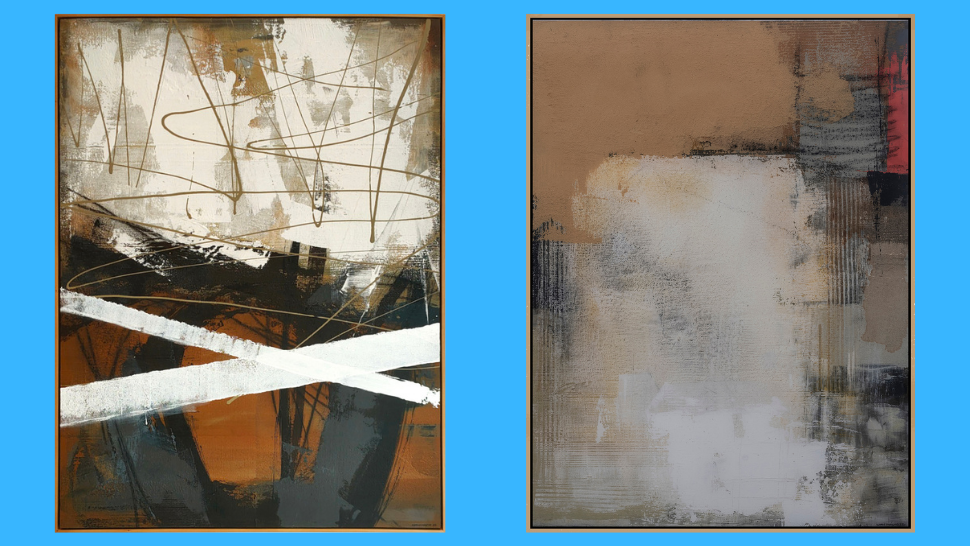
Abstract art can be confusing as hell. There is no logical criteria around here. It isn't rooted in reality nor is it rooted in any figurative enterprise. The viewer is forced to ascribe meaning on these pieces. Most of the time, it can be a drag. But for the abstractionist Carlo Magno, this is exactly what this kind of art is all about. Abstraction, after all, means taking one long drag of reality after another. The answers hang in the smoke clouds in our minds.
The country has always had a strong appreciation for abstract art. We can say that, from the '70s to the 2000s, we had the golden age for abstract exploration in the Philippines. This was especially true in the '80s. The movement gave us the Joyas, Ossorios, Aguinaldos, Abads, yadah-yadah-yadah. Interestingly, when Magno entered that same art scene in that same era, he went against the grain. He came up during a time when the local scene was veering away from modernists. Magno would find his niche elsewhere.
His YMCA prize-winning painting back in 1980, we may recall, was a portrayal of Filipino artefacts and furnishings. It was called "Bayanihan" and it put the then-20-year-old artist on the map as a hyperrealist. Magno's pieces early on would reflect a certain nostalgia and Filipino sensibility.
But then 2003 happened and his mind went elsewhere. Magno would mark his transition into a new artistic era at the time, with a show called Transformation. It was here that Magno announced that he had abandoned figuration for abstraction. He started favoring fluid motions over geometric shapes, but had still retained his textbook precision and clarity.
Known to reject an objective truth and global cultural narratives, the artist's fascination with the conceptual is on full display in his latest abstract exhibition, Formal Parallels. His mixed media pieces and sculptures possess an uncompromising attitude towards minimalism (or pseudo-minimalism, in fact), borne out of years of practice, unpredictability, spontaneity, and refinement.
"Formal Parallels" (2022) by Carlo Magno, Mixed Media on Canvas.

"Reverie" (2022) by Carlo Magno, Mixed Media on Canvas and "Blue Mountain" (2022) by Carlo Magno, Mixed Media on Canvas.

ALSO READ:
Finding Mozart in the Theatrics of Edwin Wilwayco's 'Wave Cadenza'
'Pag-Ibig at Lumbay' and All the Other Things That Janos Delacruz's Figures Want to Say
His old work was much more grounded on physical representation. So how about for his abstraction? We can measure the triumphs of abstraction in its narrative and aesthetic balance. While Magno's work here seems aloof and systematic, they strike us with the intention of form. Cool and neutral imagery is used as allegorical tools. We can sense a methodical approach to light and shadow and proper composition. In this undertaking, Magno finds the parallels between the aesthetic and emotional dynamic. That kind of harmony is what his abstract art creates, maintains, and perpetuates.
These pieces are based on formal associations between inertia and the human condition. This, in turn, opens quite the poetic vein, as seen in the informal narrations and expositions in each work. We can see multilayered images arise, from the strokes and spaces that linger. With each envelope, Magno seeks to question the fragility and instability of reality. It's a big, out-there concept, we know. But the artist isn't concerned with philosophical mumbo jumbo. His works are more about the fleeting moments that define reality. He reconfigures and repackages fluidity to cater to the subjective relationship between what's real and what's abstract in the human spirit.
"Pace" (2022) by Carlo Magno, Mixed Media on Canvas.

"Secret" (2022) by Carlo Magno, Mixed Media on Canvas.

This leads viewers to make personal associations and correlations with the works. These things are made to make us feel all existential, perhaps ordering us to lift the veil in what we are taught to see or feel. Conversely, we can still see shades of Magno's hyperrealistic undertones. There was a time when he was all about the dissection of portraiture and its various elements. Now it's about the deconstruction of ideas and its infinite components.
Both, we may argue, begin with a fully formed "whole," so to speak. Knowing this, we can better appreciate Magno's intersecting elements. This is when we can learn to comb through the texture of it all. Another leftover from his old art style seen here is his trademark architecture, which sort of serves as the foundational cornerstones of his peculiar topography.
Magno, the hyperrealist, agrees with Magno, the abstractionist, on one thing: regardless of medium, thought, or structure, reality is often only as vivacious as the gestural qualities that reshape it. Yes, it's as beautifully dumbfounding and complex as it sounds.
The Formal Parallels exhibition series runs until November 8, 2022 at Art Lounge Manila - Molito in Alabang and from December 1 to 18, 2022 at Art Lounge Manila – Podium. Magno's paintings will also be on display at the upcoming The Manila'Bang Show.
