
Charlie Co: A Retrospective That Looks Forward

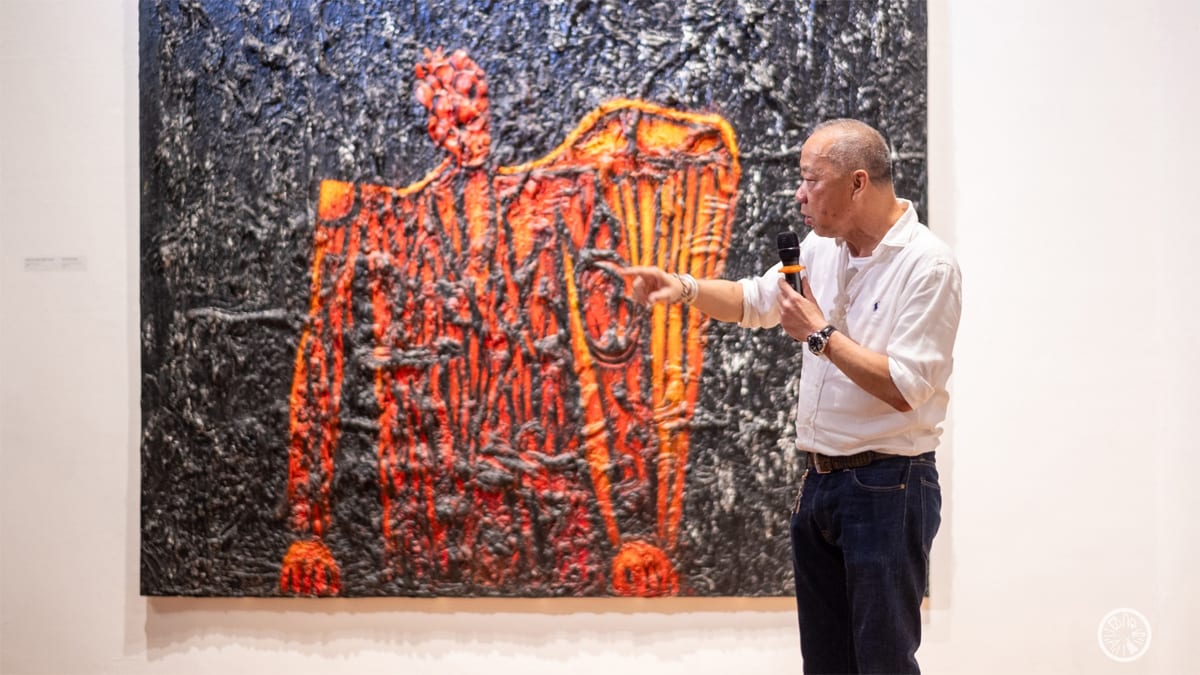
To trace the career of Charlie Co, one cannot go past his work as a progenitor of creative space. Bacolod's art hub, Orange Project, established in 2005, owes its genesis to Co and his entrepreneurial co-founder, Victor Benjamin Lopue lll. As an artist, however, Co is a destroyer of worlds. Describing his visual resumé is painting a different picture: he conjures characters in perpetual purgatory—figures who, if not writhing in physical torment, are unmistakably marked by mental and existential anguish. His canvases are populated by beings ensnared in psychological labyrinths, their vacant stares invitations to discomfort. Co’s aesthetic is grim, yes, but never gratuitous—his bleakness is meditated, and always meaningful.
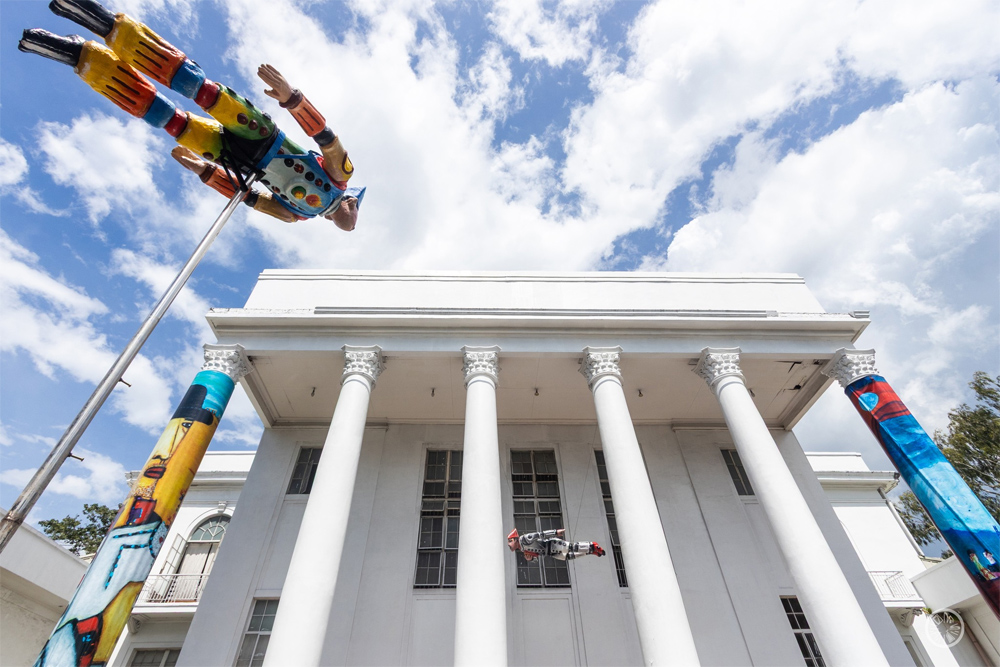
The recent retrospective of Co spans two venues in Bacolod and testifies to the sheer breadth and longevity of his four-decade career. There’s no hard and fast rule about where to begin—though perhaps I missed Boots Herrera’s curatorial cues: either you start with the two-floor sprawl of Orange Project or at the carvenous halls of the Negros Museum. The sequence scarcely matters; the venues are one jeepney ride apart. What remains certain is that every work in this tandem exhibition encapsulates what preoccupies Co at any given time: from drawings made in the '90s to works first seen in this year’s Art Fair Philippines. Together, titled Tugyan sa Tawo: Apat ka Dekada Nga Ubra ni Charlie Co, this retrospective functions less as a summing-up than as a narrative extension—an affirmation that time, rather than exhausting Co, sharpens his edge.
ALSO READ:
How Plush Toys Weave Opportunities for the Women of Negros Oriental
Sugar Wars: Looking Back at the Negros Famine of the 1980s
Charlie Co's 'Loko Loko' (2024) at Orange Project
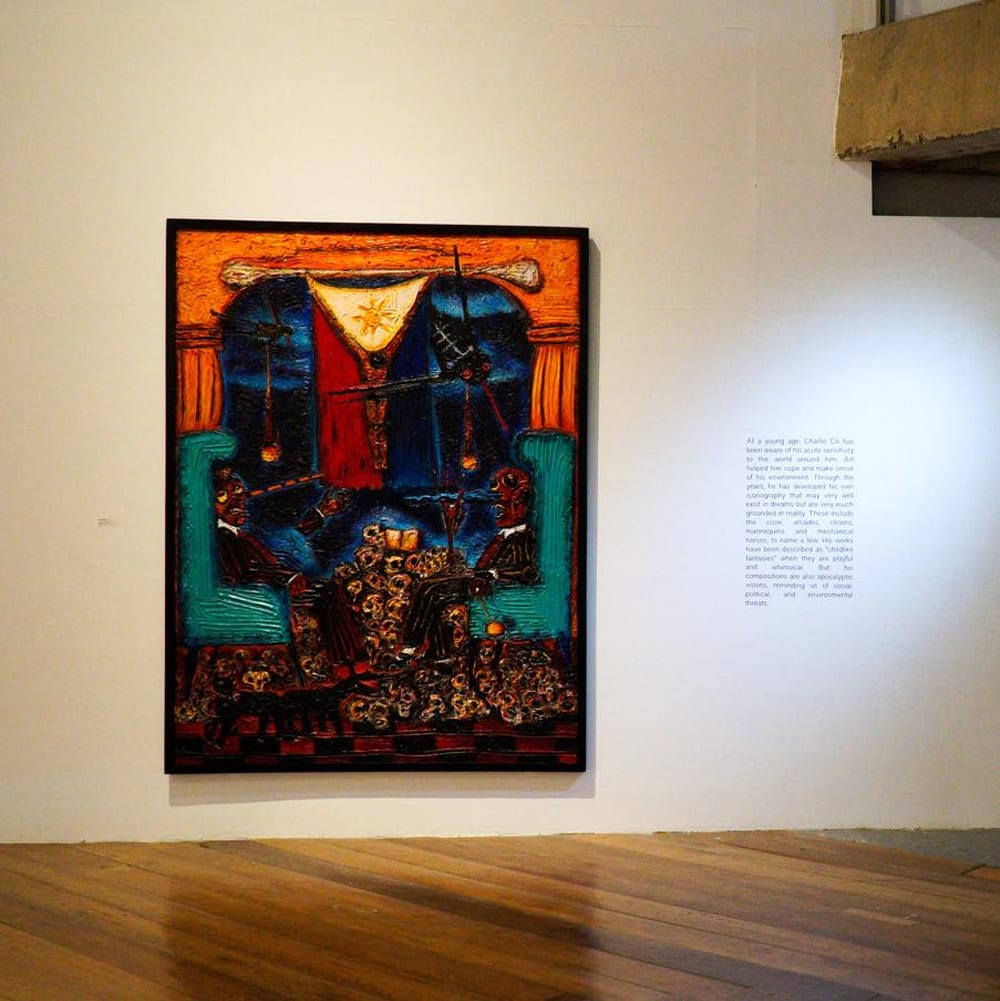
Alongside his signature use of red and blue, it is Co’s mania for the mechanical that persists throughout his ouvré. He depicts Pinocchio-like puppets, scarecrows, and other jointed oddities that oscillate between the pathetic and the menacing. In "Loko Loko" (2024), on display at Orange Project, a mound of skulls separates two deranged dummies. They sit diplomatically across from one another. Above them hangs a Philippine flag, the colors of which are parted not by wind but by the weight of a cruciform body—a Christ-like figure suspended mid-air, bisecting the national cloth. The imagery is in-your-face. The politics, imminent—which I don’t like. But Co’s scenography of his characters convincingly augments the trappings of social realism into a theater of the sinister, one that is repeatedly built and destroyed, much like the pendulum of power and resistance. In a suite of other paintings, large and small—including "New York State of Mind" (2015-2018), "The Screaming Horse: COVID-19" (2020), and "In the Eye of the Storm" (2021), his bolted beings return. Mechanical horses, clowns, mannequins—all evoke a sense of impersonality, a chilling lack of agency, as though puppeteered by some unseen, or perhaps all-too-visible, master lurking just beyond the picture plane.
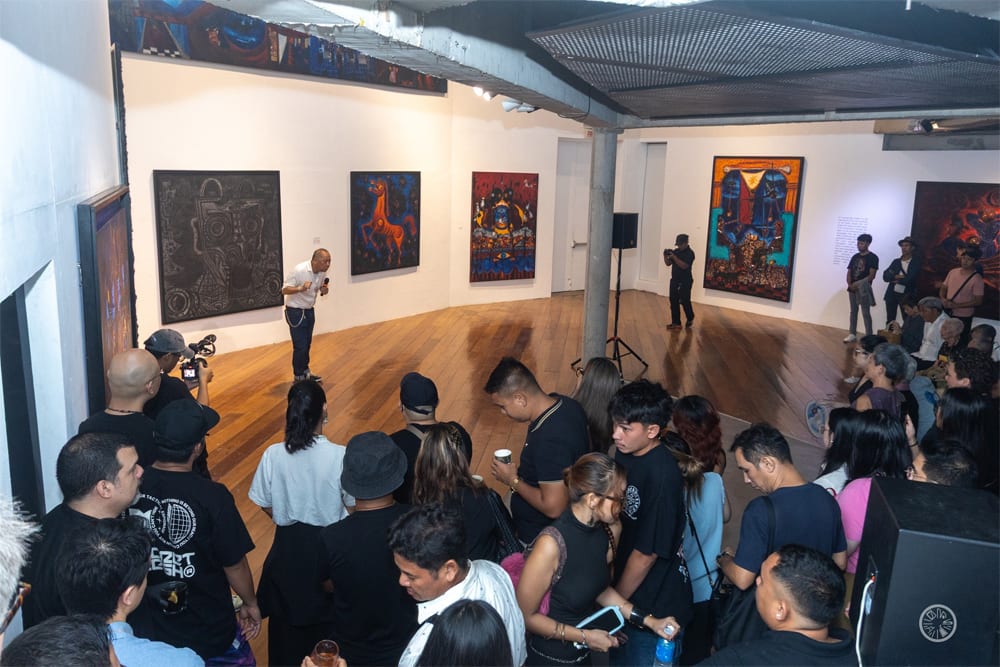
Tugyan sa Tawo: Apat ka Dekada Nga Ubra ni Charlie Co at the Orange Project
Co, the youngest of four, was born into a Filipino-Chinese household, a fact which almost always entails early exposure to the enterprising spirit. In his case, it was the family’s furniture business: his father would ask him to deliver pieces to the propertied clans of Bacolod. There, Co never missed seeing a glimpse of their Sansos and Manansalas; even the works of Ang Kiukok graced these living rooms—I surmise the preeminent artist’s Cubist and Expressionist tradition is the predecessor of Co’s own angular and agitated compositions. But Co didn’t linger long in those polite interiors. Come the '80s—a tumultuous time for a young fine arts student matriculated in his city’s La Consolacion College—Co was inducted to Pamilya Pintura, an avant-garde collective spearheaded by painter and former political detainee Nune Alvarado. Their exhibitions reached mainstream Manila, smuggled out local concerns, and by this time, Co had already imbibed the political efficacy of art. With group shows like Mga Batang Negros at the then-nascent Hiraya Gallery, he helped shed light on the famine that ravaged farmers and their families in the face of the province’s sugar decline.
This outward-looking impulse later splintered the group into factions, among them the Black Artists in Asia—Co’s home court at the time, credited to have launched in 1990 the seminal biennale VIVA ExCon (Visayas Islands Visual Arts Exhibition and Conference). The biennale operates on a peripatetic model, moving from town to city across the region for every installation. It wasn’t until halfway into the 2000s that Co found in Orange Project a permanent playground, now a mature institution with a mix of programming beyond gallery exhibitions: artists and writers’ residencies, public installations, and cultural projects that engage its immediate community. In between, Co battled health emergencies and crossed continents, representing the Philippines in the 1996 Sao Paulo Biennale, and more recently, in 2023, leading a cohort of 10 Negros-linked artists to Leipzig, Germany where, for six weeks, they were to be embedded in a new environment, live like a local, and just do what artists do: make art.
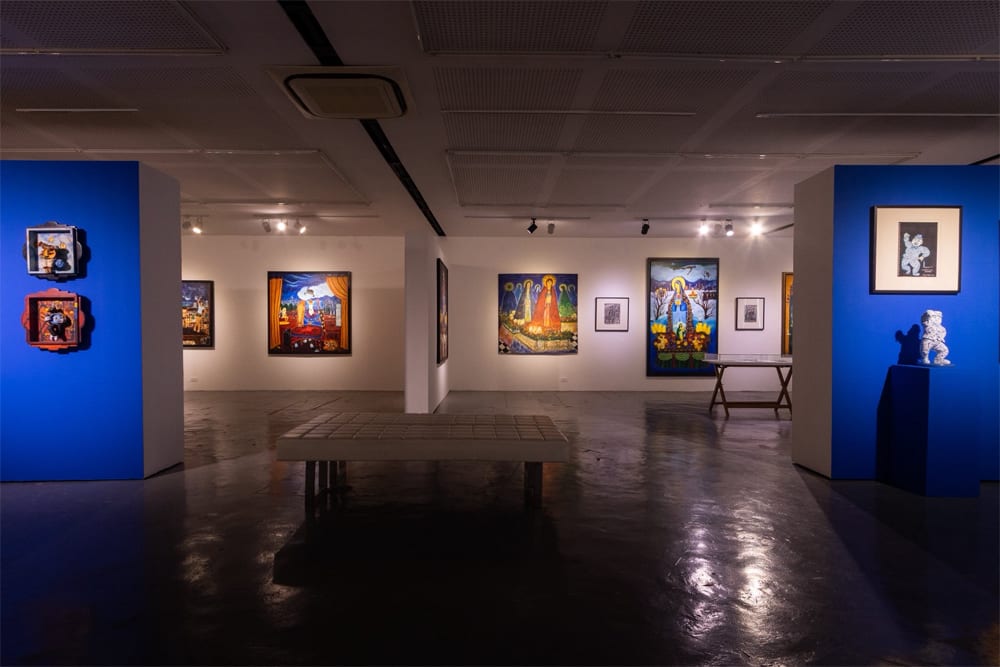
Tugyan sa Tawo: Apat ka Dekada Nga Ubra ni Charlie Co a the Negros Museum
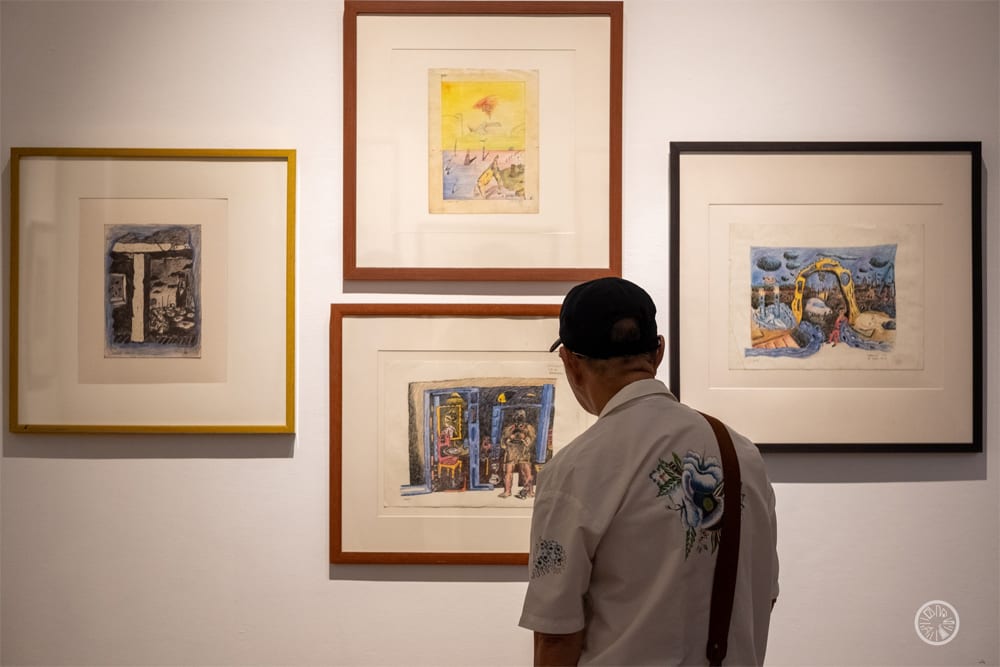
The fierce-eyed Co, now 64, has not been loyal to a single medium—though not entirely by choice. “Up until 2013, I [had] been using oil paint in my paintings,” he once confessed. “But I had to switch to acrylic paint when I underwent a kidney transplant in 2014, upon doctors’ advice, because it was safer for me.”
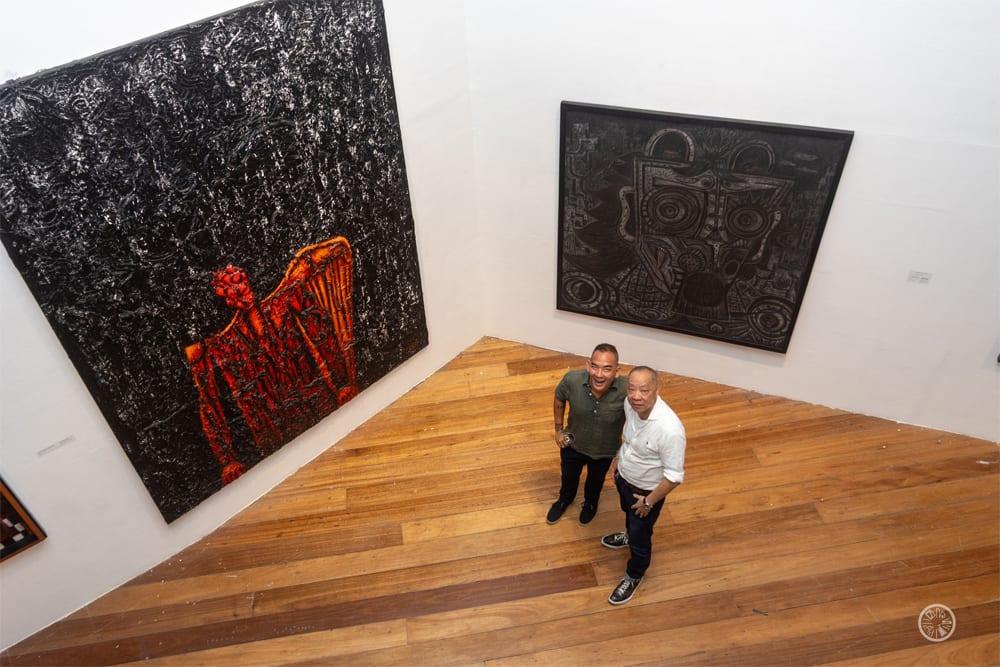
This concession to survival never vitiated his visual language. In "Fallen Angel" (2024)—a shocker of a red-and-black picture of a single-winged, haunting figure (is it Lucifer himself?)—he used acrylic on modelling paste to create this complex terrain of ridges and crevices that brought out the paint’s materiality. The resulting texture is stunning. Then there are the works that aren’t paintings at all: oil pastels on paper, terracotta sculptures, pen and ink drawings, and quasi-public art that welcomes the visitor at the Negros Museum.
If there’s a viable alternative reading to Co’s repertoire—and by repertoire, I mean to say his works and also his entire career as a work of art—it could well be through the Bakhtinian concept of the carnivalesque: upended hierarchies, unrestrained fragmentation, sanctioned chaos, if only temporarily. Could it be the reason why it is impractical to place Co in the constellation that is Philippine contemporary art? His career simply resists neatness. His eclecticism attests to that, especially in the decade immediately preceding this retrospective. In what he calls a trilogy of exhibitions, he tackled personal and political anxieties head-on. First, in 2017’s Guerra Guerra at Altro Mondo and later at Manila House, he staged a damning display of the devastating effects of armed conflict. Five years later, or two years into navigating the post-pandemic world, System Corrupted translated his planetary fears into painterly allegories, characterized by intermittent plunges into dread and disillusionment. Early this year, the series culminated in On Our Watch, a meditation on surveillance, omnipresent control, and the gradual erasure of agency—a world of watchers and the watched.
Founders of Orange Project, Charlie Co and Victor Benjamin Lopue III with the painting 'Fallen Angel' (2024)
The present exhibition does register as an abrupt epilogue to these solo shows, but it hardly feels like a biographical attempt to appraise Co’s artistic output. Rather, the chief pleasures of this show lie not in retrospection but in projection: it gestures to a future direction, one that will surely be marked, as always, by an indefatigable refusal to surrender. In this light, Tugyan sa Tawo is a time capsule not meant for interment, but for inheritance. Not because doomsday looms, but because there’s still work to be done. For Charlie Co, there is no conclusion—only continuation. He is a Negrense after all.
Tugyan sa Tawo: Apat ka Dekada Nga Ubra ni Charlie Co is on view until July 19, 2025, at Orange Project, and until August 31, 2025, at the Negros Museum, Bacolod City.
