
Book on Samar’s Cuisine Wins World Cookbook Awards

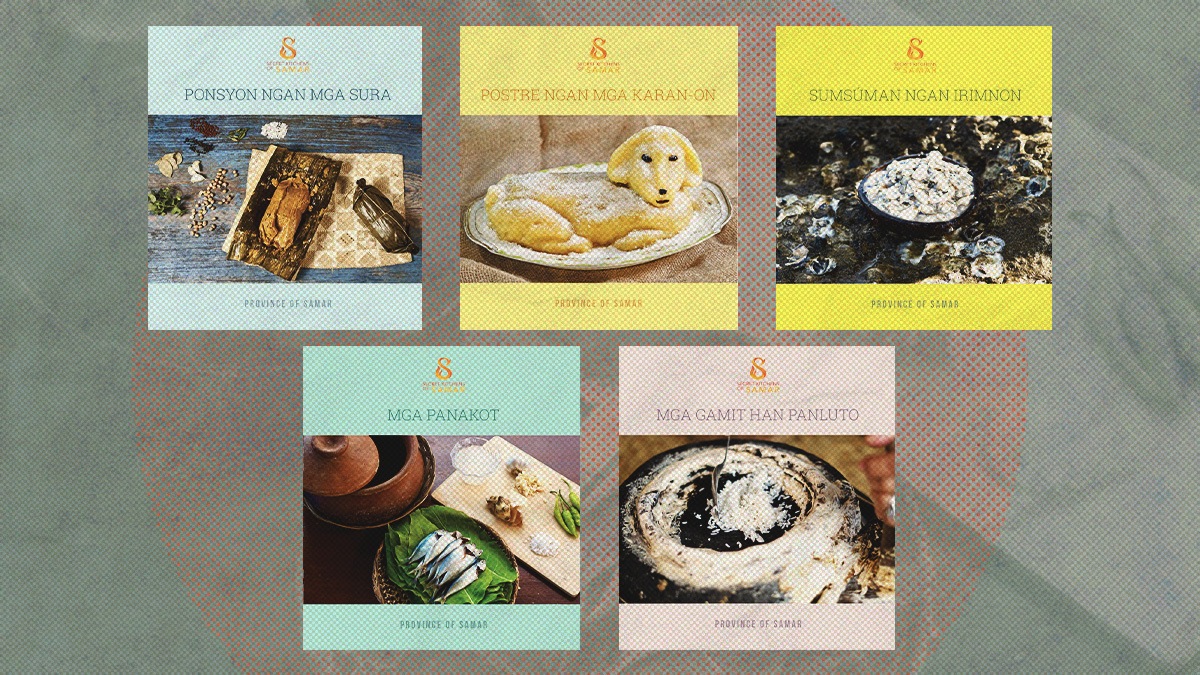
ILLUSTRATION: Igi Talao
Secret Kitchens of Samar, a five-volume book series celebrating the rich culinary heritage of the province of Samar, won Best Regional Book in the World and Best Series in the World at the 30th Gourmand Awards held in Portugal. Participated in by over 200 countries, the Gourmand Awards are the only international competition dedicated to publications on food and drink cultures. The honors were conferred during the Cascais World Food Summit by Edouard Cointreau, president and founder of the Gourmand Awards.
According to author Clang Garcia, the book was inspired by Samar Governor Sharee Ann Tan’s vision to bring Samarnon cuisine to wider recognition. “Governor Tan observed that while regional and provincial dishes from Bicol, Ilocos, Pampanga, Negros, and others have garnered significant popularity, Samar’s culinary heritage remains largely unknown. Her vision is to place Samarnon cuisine into the Philippine culinary map and eventually onto the global stage, although she acknowledges that achieving this recognition may take time,” says Garcia.
Meanwhile, Garcia’s introduction to Samarnon cuisine began in 2018 when the Regional Tourism Director, Karen Tiopes, invited her to visit the province. “I was completely clueless about Samar; I didn't even know where it was located or how to get there. But my experience during the two-day exploration on October 18-19, 2018, ignited a passion in me. I made a silent wish to return, and it seemed to linger in the air, as suddenly I found myself returning for a deeper purpose,” she said.
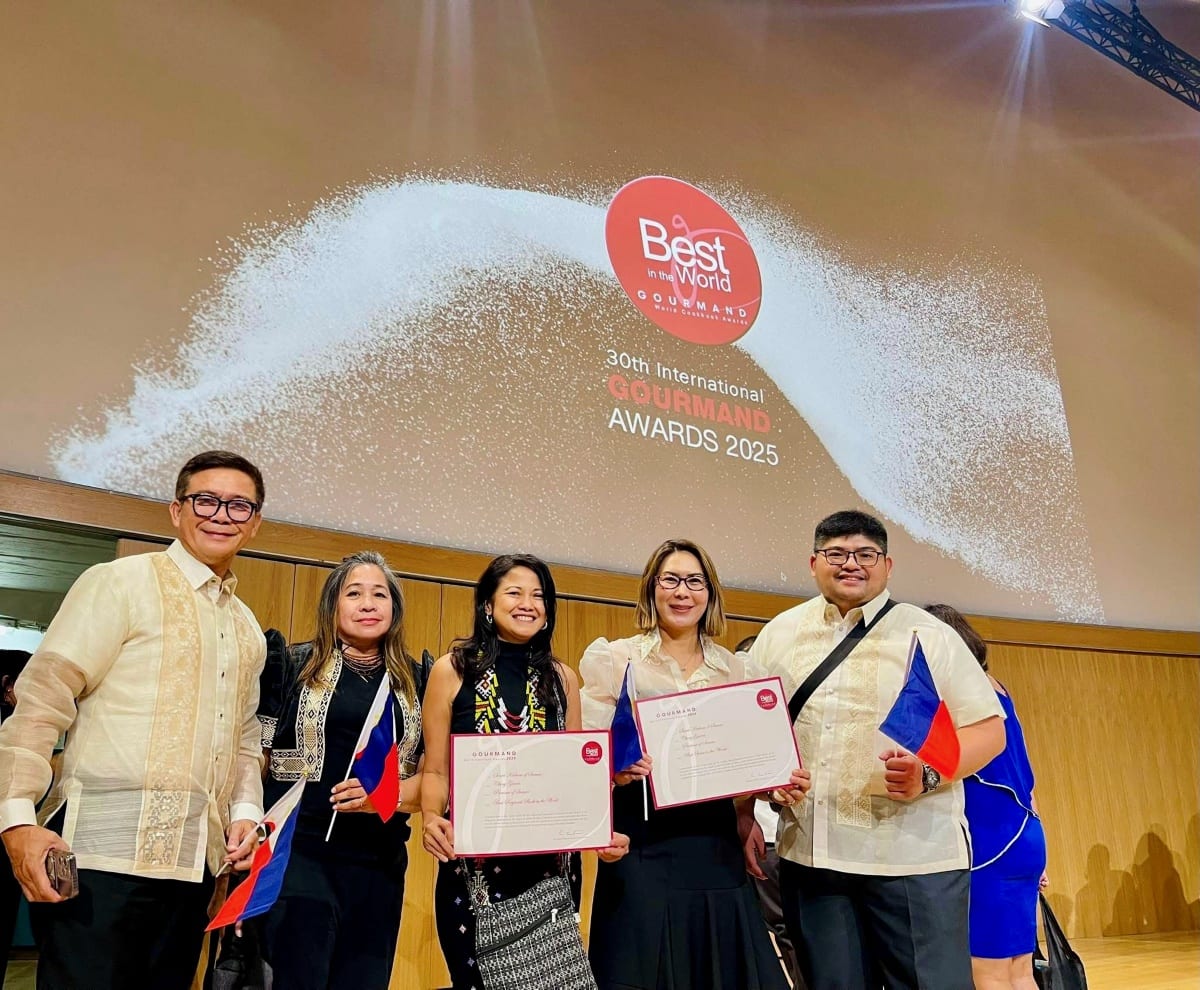
The Secret Kitchens of Samar Team proudly stands together holding Philippine flags and Gourmand Awards certificates. (From left) Marvin Rivera Piczon, Department Head of the Samar Provincial Tourism Office; Rosario Francisca Miel, Administrative Officer IV; Clang Garcia, author of "Secret Kitchens of Samar"; Governor Sharee Ann Tan of the Province of Samar; and John Michael Cristobal, Chief of Staff to the Governor.
It was in March 2020 when Garcia and her team outlined the production plans, but the pandemic put everything on hold. By August 2021, as restrictions eased, she and her team traveled to Samar to begin heritage food mapping.
“During our fieldwork, I faced the enormous challenge of documenting recipes that did not exist. I was taken aback to discover a consistent reality: mastery of heirloom recipes is rooted in sheer observation from a young age in the kitchen,” she shares. “Skills are cultivated through the sensory experience of smell, the precision of measuring ingredients by hand, the ability to adjust heat by adding or removing wood from the fire, and the tradition of praying the rosary to serve as a kitchen timer. Each step is anchored in memory reflexes, responding to stimuli without conscious thought. They just know everything by heart and soul.”
Beyond the food, the author was also surprised by the culinary culture of Samarnons. “The strong sense of family is heartwarming, with four generations often living together in a family compound. Common dining spaces have long or large round tables where family members gather to share sumptuous meals. Ingredients are bought fresh every day from the mercado (public market) to be prepared and cooked,” she observed.
ALSO READ
Diving, Pudpod, and Basyaw: Into the Heart of Eastern Samar
The Secret of Samar’s 7 Must-Try Local Dishes
Sweet Lamb
Governor Tan had a clear vision and set five themes for the volumes: Ponsyon ngan mga Sura (Celebratory and Everyday Cuisines), Postre ngan mga Karan-on (Desserts and Breads), Sumsuman ngan Irimnon (Appetizers paired with Tubâ), Mga Panakot (Ingredients), and Mga Gamit han Panluto (Cooking Tools).
Among her most interesting discoveries, Garcia says, is featured in the volume about desserts and breads. It’s about an elaborate dessert called Dulce nga Karnero (Sweet Lamb), served during Holy Week.
“I met Antonitte Acbo at her family compound and learned about a devotional offering to the church every Maundy Thursday. Preparation begins the day before as they search for the finest kino, a coconut at the midpoint of its development. The meat of the coconut is manually grated and mixed with sugar, margarine, evaporated milk, and eggs. Antonitte's daughters, Kathia Pauline, and Sharie Mae, joyfully bond while helping to shape the dessert. One forms the lamb's body, while the other focuses on perfecting the head. The edible masterpiece is left to set overnight,” Garcia says.
“As the sun rises on Maundy Thursday, the lamb is generously dusted with sugar and then placed in the sun for an entire day. This process results in a solidified, sparkling lamb, seemingly representing the Divinity of Christ as the ‘Light of the World,’” she says.
The dulce nga karnero leaves the house before 5:00 p.m., to be delivered to the nearby church as a traditional offering for the sacred reenactment of the Last Supper.
“It's a moving experience that leads to a profound reflection on how food becomes central to a solemn expression of faith. Each bite takes you back in history, to the Passion of Christ,” she adds.
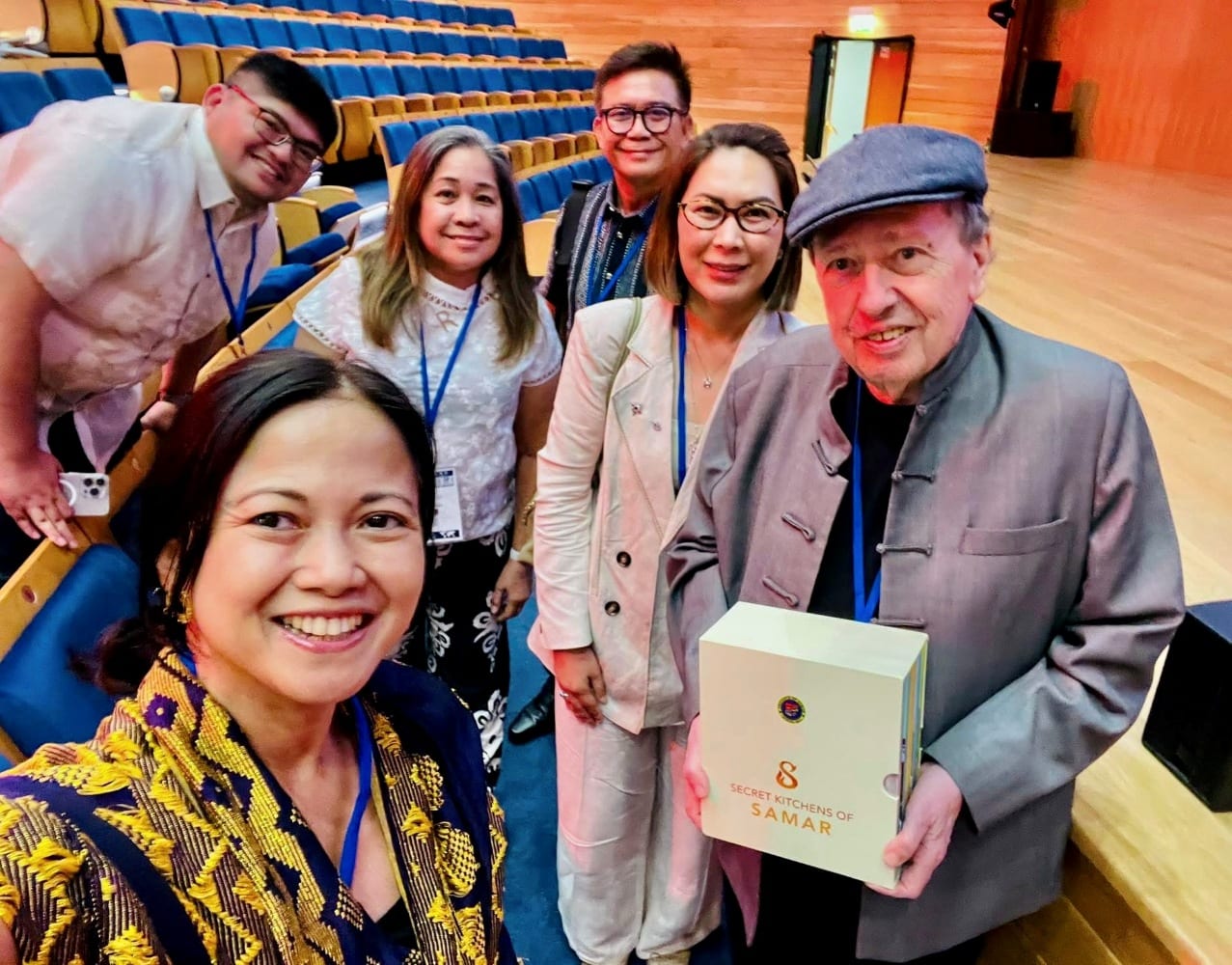
Edouard Cointreau, president and founder of the Gourmand Awards, receives a copy of 'Secret Kitchens of Samar'
The Long Road to Becoming a Gastronomic Destination
Garcia reflected on the evolution of food tourism in the Philippines, beginning with her 2007 Jeepney Tours. These tours, which catered mostly to foreign visitors, offered heritage and food experiences in Manila and nearby regions. Early efforts were met with limited popularity, but a turning point came with Madrid Fusion Manila (2015 to 2017) under Tourism Secretary Ramon Jimenez Jr. The event showcased regional dishes and local chefs alongside global culinary talents.
This momentum continued under Secretary Berna Romulo-Puyat, who launched the "Kain Na!" campaigns and funded culinary publications during the pandemic, including Secret Kitchens of Samar. With Tourism Secretary Christina Garcia Frasco leading Southeast Asia's UN Tourism efforts—and hosting the first UN Tourism Regional Forum on Gastronomy Tourism for Asia and the Pacific on June 26–27, 2024, in Cebu—the Philippines is building a stronger culinary identity, says Garcia. However, she believes that a sustained and focused campaign is still needed to position the country as a true gastronomy destination.
“I earnestly hope the ‘Secret Kitchens of Samar’ will spark interest in exploring Samar through the lens of food and gastronomy. It has always been my dream for the Philippines to become the next gastronomy destination in Asia, attracting people from around the world to experience our rich history and culture through immersive gastronomic experiences,” she says.
Garcia is currently working on her next book, which is “worth 15 years of research conducted across the islands.”
