

This Rare Max Beckmann Self-Portrait Just Sold for a Record-Price €23.2 Million in Berlin

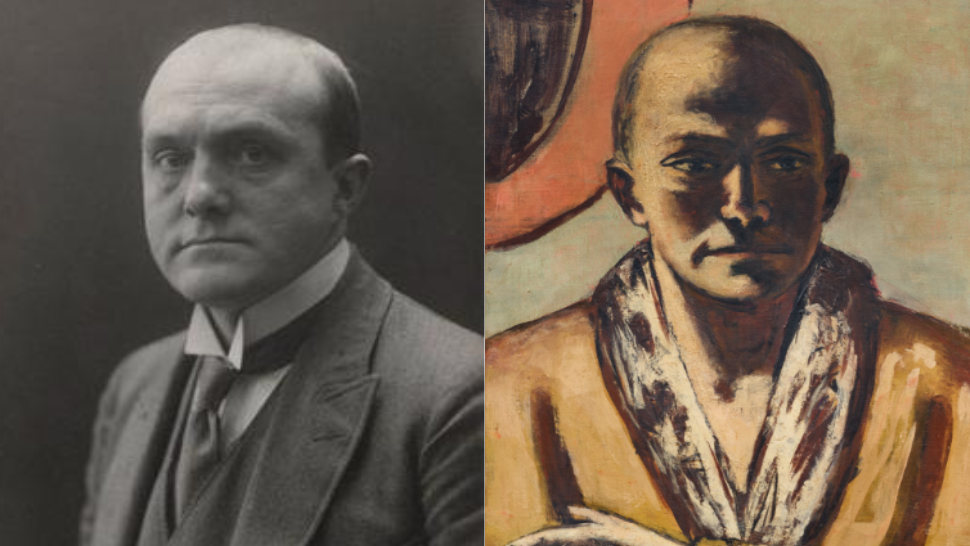
We're seeing a resurgence in interest in classical modernism these days. Just recently, German expressionist Max Beckmann's rare self-portrait, "Selbstbildnis gelb-rosa" (Self-Portrait Yellow-Pink), which had previously been kept in private hands, fetched a record price with Villa Grisebach auction house in Berlin, Germany with a €23.2-million (roughly P1.4 billion) sale. This is the highest amount ever paid for a work of art sold at auction in Germany, and the second-highest obtained worldwide for a self-portrait by the acclaimed artist.
“It is entirely appropriate for this masterpiece of the 20th century to command an exceptional price. With this success, Grisebach has set a mark where the German art market is concerned and has put Berlin back on the map as the arena for world-class auction results," says Grisebach Senior Partner Bernd Schultz.
Entering into the December 1 sale, "Selbstbildnis gelb-rosa" was poised to get anywhere between €20 million and €30 million. A buyer from Switzerland prevailed against bids from five countries. The Beckmann self-portrait was sold by the family of a Switzerland-based commercial lawyer from Bremen. He had previously acquired it from the Beckmann family, considering it his "most prized item." No comparable artwork has been offered on the German auction market since 1945, as well.
Auction night in Berlin. This might be the last time the public sees the piece ever again.

Beckmann is one of the most important theorists in the framework of Western art history post-World War. He may not be a household name (except for maybe in Germany and Austria) but he nevertheless is one of the most venerated artists of his generation. The fabled self-portrait was painted sometime between 1943 and 1944, after Beckmann left Germany for the Netherlands. At the time, the artist had been denounced by fascist Adolf Hitler as a "degenerate" artist. This ultimately led to the confiscation of 500 of his pieces from various galleries and museums.
When German troops invaded Amsterdam in 1940, Beckmann would be forced into an old canalside makeshift studio, formerly a tobacco warehouse, turning it into his refuge. Here, his self-portraits became a tool for survival, as he grappled with the threats of death, disease, and spiritual decay. His time in the city would also become his most prolific period. Beckmann eventually found himself moving to the U.S. in the decade that followed. He would meet his demise on December 27, 1950. The painting was gifted to his wife Mathilde "Quappi" Beckmann, and she kept it until her death in 1986.
Beckmann and his wife, Quappi in 1928.

ALSO READ:
The Best Things That Caught Our Attention at León Gallery's Midyear Auction 2021
A Vintage Patek Philippe Just Sold for $7.7 Million at Auction
"The political conditions that forced Max Beckmann into exile in the 1930s are fortunately incomparable to the situation in Germany today," Grisebach Managing Director and Partner Micaela Kapitzky tells Esquire Philippines.
She adds: "I do think that social situations and political conditions have always influenced art, and artists have found expression in contemporary art. In many countries today, artists are still forced underground and out of the country or cannot pursue their creative work without restrictions."
A look at "Selbstbildnis gelb-rosa." The circumstances in which the piece was made show us how artists' archive images and emotions in times of societal upheaval. Interestingly, Beckmann had always rejected the "expressionist" tag. The modernist instead pushed New Objectivity (Neue Sachlichkeit) forward in his art practice.

What stands out the most about "Selbstbildnis gelb-rosa" is that it was a departure from his usual somber hues. We see Beckmann in bolder, brighter colors. The subject is positioned "outside of any social context," except for, say the truncated red frame of a mirror, which indicates the silhouette of a studio. He seems to be in a state of limbo and radical calm, evidenced by his gaze and subtle, enigmatic smile. Quite the pictorial power in his demeanor and posture. There's something meditative about the figure, trapped by grief and despair, and about the man himself, engulfed by layers of intrapersonal turmoil.
In its past auctions of works by Beckmann, Grisebach had achieved top prices, such as the case with the €5.5-million “Ägypterin“ (The Egyptian) sale in 2018. The "Selbstbildnis gelb-rosa" sale, meanwhile, should mark new era for the German art market. Analysts say that the valuation is a sign of things to come for German auctions in the near future, as well.
"The spectacular hammer price on an international level will certainly increase the interest globally in classical modernism, especially expressionism, beyond the country's borders," Kapitzky notes.
