

Alegria's New Tasting Menu Is Guaranteed to Get You Satisfied and Full

When Chef Charles Montañez set out to offer a brand-new tasting menu at his restaurant Alegria Manila, he wanted the focus to be on the mains rather than the starters. There was nothing wrong with the old menu; in fact it’s been a go-to for many of the city’s fine dining enthusiasts in the mood for a culinary journey via an honest-to-goodness degustation. But when the creative bug hits, you often have no choice but to give in, and that’s exactly what Montañez did.
Chef Charles Montañez of Alegria
.jpg)
For P5,400++, diners get a thoughtful, extremely curated menu of 11 courses that spans cities and continents, flavor profiles and cultures. At its heart though, the dishes in this menu represent a reinterpretation of classics that may or may not be familiar to Filipino palates. This is because Montañez dug deep—like boundary-crossing, region-hopping deep—to present dishes that marry his familiarity with the cuisine of Latin America with dishes and ingredients of rural Philippines.
ALSO READ
Filipino and Latin American Flavors Collide in the Fort's Latest Degustation Restaurant
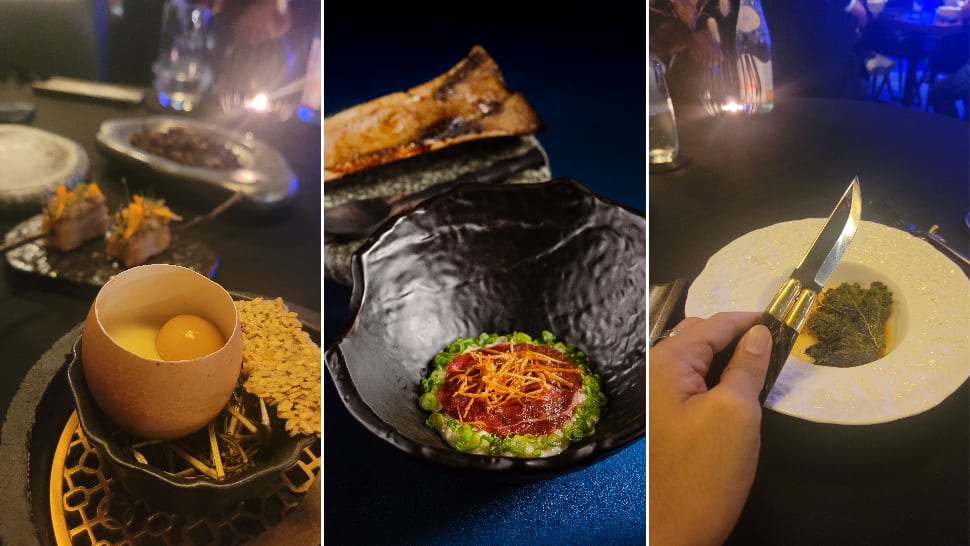
Consider the trio of starters served simultaneously. One’s a play on the humble tortang talong: smoked eggplant, drops of eggyolk poached in butter, and sundried tomatoes with caviar. The second is his take on sati—which, in turn, is Zamboanga’s version of the Malaysian satay. There are flavor notes of curry, the kaning puso is replaced with a cassava fritter, and it’s topped with prawn tartar that also carries a distinctly Filipino curry-like sauce.
Chicken sphere, chicken chawansmushi, chicken flax tostada
.jpg)
The third dish is ensconced in a rock. Smoke escapes when you lift the top half to reveal a chawanmushi, or egg custard, with a side of a chip made out of chicken and flax seeds. To get the full experience, you need to delicately scoop out the yellow sphere so it doesn’t break and it explodes inside the mouth. Take a bite of the chip to cut through the richness.
With these three appetizers, Montañez not only gets to flex his mastery of technique, he also introduces diners to the kind of journey they will go on with this menu. The next destinations will come soon enough.
Jowl etag, pickled earl grey tea grapes, burong singkamas, salsa malcajete
.jpg)
The next is “etag,” a delicacy of cured meat popular in the mountains of the Cordillera region. Montañez’s version involves smoked pork jowl and pork belly with grapes pickled in earl grey, sofrito made with jalapenos and onions, puffed rice, finished with shaved winter truffle, and aerated sauce made of burong singkamas or fermented jicama, which supplies the acid. It’s the chef’s take on the classic Ilocano dish dinakdakan.
Mango, apricot, kiamoy & pecorino palate cleanser
.jpg)
If you’ve ever wondered what a quesadilla that’s also a piaya tastes like, Alegria has an answer. Montañez combines the two into a dense tortilla topped with three different cheeses: aged comte, raclette, and goat cheese mixed with muscovado, and finished off with sunflower seeds. Have it with a side of salsa malcajete, or salsa made on a traditional volcanic rock mortar and pestle. The chef makes it a point to mention that Alegria has been using its own malcajetes since it opened six years ago.
“The older the malcajete, the better the salsa tastes,” he says. “Spices and acid get stuck within the rocks, so it produces better salsa as it gets older."
Wagyu carpaccio, adlai, smoked tripe, enoki, shallot, bone marrow
.jpg)
After a palate cleanser of mango lemon with kiamoy sauce and shaved pecorino, it’s time for the main courses. Waitstaff first bring out the noodle course, or the chef’s take on mami, the popular local noodle dish. The noodle itself is made not with wheat flour, but ubod or heart of palm, and it’s presented here flat and white. Underneath are pieces of delicate and perfectly cooked Hokkaido scallops, as well as truffle puree. The chef uses an Argentinian salsa made out of smoked oranges and burnt herbs soaked in butter and wine. There’s also house caviar made out of corn, kombu, and fish bones, while the all-important broth is made out of prawn head and chicha de jora, or a fermented corn beer. He finishes the dish off with dots of oil made from oregano, basil and parsley. It’s rich, filling, and hearty; something you wouldn’t mind eating on a stormy day.
Fish moqueca, laing tetela, sibujing, dende oil
.jpg)
The decadent wagyu carpaccio is served next with corn husk oil and adlai cooked with smoked tripe for five days, topped with spring onion and gnocchi. Montañez then whips out a kitchen torch and aims it a piece of bone, making the marrow sizzle before scooping it up and placing it on top of the dish.
“It’s to get all of the beef flavors together,” he explains.
If the dish looks and tastes familiar, it’s because it’s the chef’s play on goto or rice porridge.
Iberico pork, salsa vera cruz, horchata, kale chiharron, quinoa, red pepper, corn sabayon, with a balisong steak knife to cut the meat
.jpg)
A fish delicately cooked over woodfire is served with tetela, or a kind of tortilla from Oaxaca, Mexico stuffed with different ingredients. Similar to the earlier piaya-quesadilla hybrid, this one is made with blue corn and topped with laing duxelles—gabi leaves and mushroom cooked in coconut stew. The dish is called Moqueca, which is a kind of sauce made out of a Brazilian seafood stew. Completing the dish is a serving of sibujing, a kind of onion native to parts of Mindanao.
Course number nine is iberico pork with a salsa vera cruz and horchata foam, puffed quinoa and kale chicharron. Don’t be surprised if the waiter hand you a box with a set of balisong steak knives inside. You’re supposed to use them to cut the meat. I’m not sure about the added flourish but it is quite the spectacle to see people carving away using the knives popularly used in tv and movie shows.
Then there’s the taco course. The taco vessel is yet another variation of the quesadilla-piaya-tortilla, this time with a filling that Montañez declares will vary from evening to evening. In that particular service, it’s a chicken wing generously spiced and wrapped in a banana leaf, and a side of vegetables.
Taco
.jpg)
For dessert, there’s tsokolate and pinya (sous vide pineapple with muscovado sugar and pink peppercorn over tsokolate de batirol with pili nuts, white chocolate mousse, whipped caramel, and coconut yogurt sauce), where a piece of paper covering the dish is set ablaze tableside; and strawberry and basil (chocolate foam, over strawberry mousse, cubed flourless cake, strawberry compote, and milk tea).
Tsokolate, caramel, vanilla, and pineapple
.jpg)
It all seems like a lot, which it probably is, if you’re expecting a typical degustation with just small bites of a selection of courses, but Montañez did say he wanted to focus on mains and is giving diners generous servings of them, so consider yourselves warned. It’s always a good idea to go into any restaurant hungry, but moreso if you’re planning a visit to Alegria Manila anytime soon.
