
The Story of this Southeast Asian Restaurant in BGC and Argentina Began with a Homesick Kapampangan Chef

Hailing from cultures from all over the world, the origins of Southeast Asian food run far deeper than one would expect. Consistently complex and bursting with flavor, our cuisine tells the stories of at least a thousand different communities, and at least a thousand more traditions lost in time.
The story of Sunae Asian Cantina begins with three things: a tango of cultural identities, a homesick Kapampangan chef, and the universal hankering for honest, good food.

The ‘Halo-Halo’ Origins of Chef Christina Sunae
Those who have found themselves caught between two or more worlds know that matters of identity are never easy to explain. Chef Christina Sunae jokingly compares herself to halo-halo because of how diverse her cultural background is. Born in the U.S. to an American father and a Korean mother, Chef Christina isn’t Filipino by blood, but by heart; she moved to Pampanga when she was seven years old, after her father remarried to a Filipina. It was there in the province hailed as the country’s “culinary capital,” where she spent her formative years and developed a taste for Filipino cuisine.
Sunae moved back to the U.S. when she was 12, but her household always stayed Filipino in culture. “Last night, we just had sinigang, adobo, and torta,” she shares with us in a Zoom call, fresh off a flight from Buenos Aires to the U.S. to visit her parents. Growing up, Sunae never once forgot the dishes that her Apu (the Kapampangan term for “grandmother”) Nena made her.
After traveling and working at different restaurants since she was just 14 years old, Sunae eventually settled down in the passionate city of Buenos Aires, joined by her former Argentine husband.
A Hunger for Home
As a city built by immigrants, Buenos Aires was already a major hub for cultural diversity, and its cuisine followed suit. In that way, it shared a similar profile to the divine melting pot that was Southeast Asia—but for all the multicultural hustle and bustle that marked the eclectic city’s dining scene, Sunae couldn’t find a single Filipino restaurant.
“When I moved to Argentina, I saw that there wasn’t very much Asian food,” Chef Christina recounts. “The only thing that existed was sushi and Chinese food, and I didn’t really eat that—I eat Filipino food.”
The story of Sunae Asian Cantina begins with a tango of cultural identities, a homesick chef, and the universal hankering for honest, good food.
The Filipino Food Evangelist of Argentina
Spotting an opportunity, Chef Christina opened a closed-door restaurant, or a puertas cerrada in Spanish. Highly popular among tourists and locals alike, closed-door restaurants offered diners an entirely different experience from the city’s mainstream establishments: chefs would open up their homes and warmly welcome just few customers inside for a special full course meal. These “underground” restaurants are usually where chefs like to experiment with ideas, embracing foreign influences, creative approaches, and the like.
At Chef Christina’s closed-door, she served a four-course meal based on Southeast Asian food, but always with a Filipino course. “They knew more about Thai food,” she said. “I always included Filipino food because people have no idea what Filipino food is. I wanted to mix it up.”
Chef Christina struck gold; the restaurant saw remarkable success, growing from 25 covers to 75 covers per night. She also went from opening her house for just one night to six days a week. Later on, her puertas cerrada would become her first big restaurant in Buenos Aires: Cantina Sunae.
Cantina Sunae in Buenos Aires, Argentina

At Sunae Asian Cantina’s origin branch, Chef Christina serves kare kare, kinilaw, ensalada, Thai khao soi, and Malaysia curry with roti, among many other Southeast Asian dishes. She doesn’t prepare these dishes in the traditional way, as she uses the ingredients that are available to her in Buenos Aires, and makes her own adjustments to better cater to local diners. But whereas many chefs in Argentina try to dial down the flavors of their food to cater to the Argentine palate, Chef Christina always keeps her flavors strong, just the way she likes them.
“What we focused on is creating dishes that we like to eat, and putting those all in one place,” Chef Christina said when discussing the development of her menu. “They’re all Southeast Asian flavors—we might change things up a little bit to give it that Latin flavor. I'm living in Argentina and it's inevitable that I’m gonna have that Latin influence. But growing up with my Southeast Asian palate, I have to keep it true to those flavors.”
She also went on to open another restaurant called Apu Nena, named after her grandmother. The chef describes Apu Nena as a “tapas bar based on Asian food,” with Filipino food still at the center. “I make my own banana ketchup, everything is based on different sauces and suka,” she continues to describe. “It’s a whole bar around a grill.”
For her contributions to promoting Filipino cuisine across the globe through her two restaurants in Argentina, Chef Christina was named by Tatler as one of the country’s “Food Evangelists.”
Homecoming: Sunae Asian Cantina in BGC
Back in the Philippines, restaurateur and president of Nikkei Group Carlo Lorenzana was repeatedly hearing about Chef Christina’s hit restaurant in Argentina. Unable to resist, he booked a 30-hour flight to Buenos Aires and finally tried out Sunae Asian Cantina for himself; needless to say, he wasn’t disappointed.
“It was good. It was very familiar, at the same time elevated,” Lorenzana described. The head of Nikkei group recounted being sold by how distinctly Asian all of Chef Christina’s dishes tasted despite their Latin American influence.
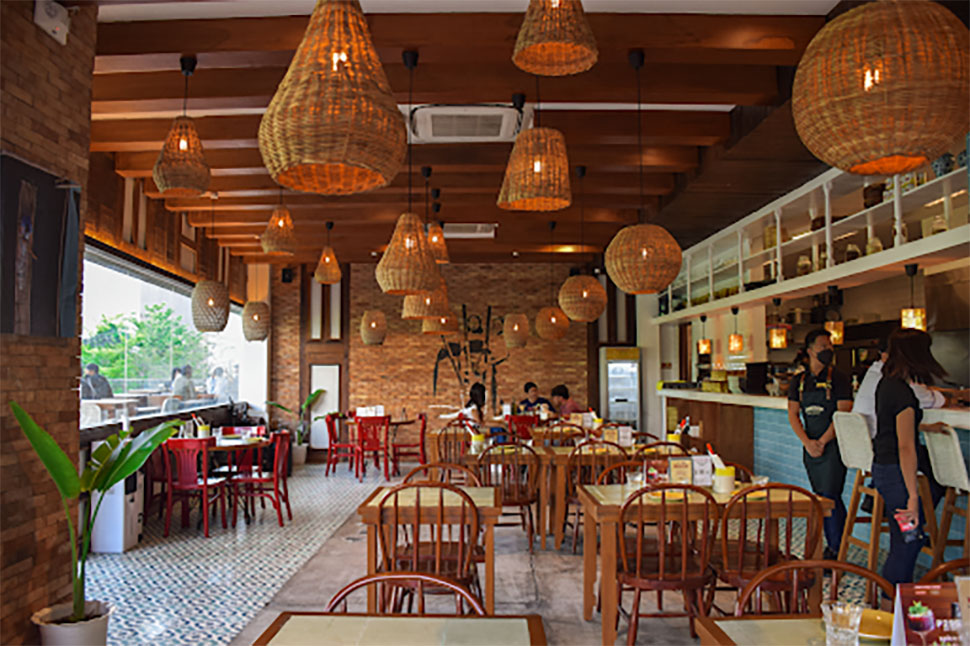
Sooner than later, Carlo and Chef Christina would join forces to build Sunae Asian Cantina in BGC; located on the breezy view deck of PSE tower and decorated with vivid warm colors, the restaurant is a breath of fresh air amid the ever-busy business district of Metro Manila.

In developing the menu for the restaurant in BGC, Chef Christina once again made some adjustments to the recipes she used for her Buenos Aires restaurant in order to better suit the tastes of Filipino diners. She achieves this by playing with sourness and saltiness, and fully honing in on her Filipino roots. “The flavor profile of Filipino food leans more toward the acidic,” the chef explains. “Everything has a little bit of sourness to it; think adobo, paksiw, and sinigang. Vinegar is essential.”
Fermentation, the chef says, is also an essential element in Filipino cuisine, hailing from how our country is fully surrounded by ocean waters. While it’s the acidity that makes us salivate, it’s this salty fermentation flavor that gives us our dishes the umami flavor.
Sunae Asian Cantina’s Szechuan siomai (left) and Sisig (right)

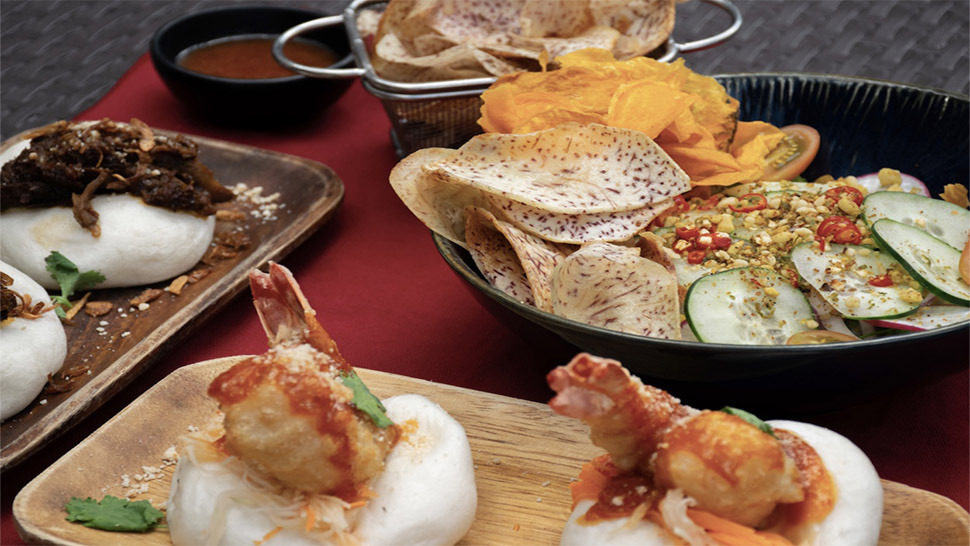
Beyond the classic well-known dishes like the sisig and siomai, Sunae Asian Cantina is highly popular for its unique twists on traditional Southeast Asian dishes. The Prawn Tempura Pao, for instance, is a special take on the old reliable siopao. Served open-faced on a soft, homemade steamed bun, it bursts with the flavor of tangy papaya salad, each pao topped with a single piece of crispy tempura.
Sunae Asian Cantina’s Prawn Tempura Pao (right) and Rendang Pao (left)

The Burnt Coconut Curry is also a popular dish, originating from Muslim Mindanao. While its dark, almost pitch-black color and bits of piercing red chili might appear intimidating to some, it actually carries a light, pleasant flavor, with a decadent aroma to match.
Sunae Asian Cantina's Burt Coconut Curry

Customers also mustn’t leave before trying the Khao Soi. Another spicy dish, it features Thai Mai curry with coconut milk, free-range chicken and egg noodles, topped with pickled mustard greens, red onions, chili, and crispy noodles.
Sunae Asian Cantina’s Khao Soi

To finish the meal, Chef Christina encourages diners to indulge in the halo-halo. “It’s not your normal halo-halo,” she says. Sunae Asian Cantina elevates the classic Filipino dessert by paying extra close attention to its presentation.
Sunae Asian Cantina’s Halo-Halo

“Christina always adds that extra artistic presentation in all her dishes,” Lorenzana says. “Nothing is shortcutted. And everything is made from scratch.”
While opening a restaurant is never easy, Lorenzana and Chef Christina’s brainchild had a particularly rocky start; Sunae Asian Cantina first opened in March of 2020, just a week and a half before the country was put on lockdown in the government’s attempt to control the spread of the pandemic. But ever since the country has been relaxing with its COVID-19 restrictions, the restaurant has been performing better and better every day.
Southeast Asian cuisine is the result of a fascinating cultural crossroads, combining the beloved dishes of East Asia with the Indian subcontinent. “The challenge with Southeast Asian is that it’s just a lot of things—a lot of flavors to register,” says Lorenzana. “Thai alone is thousands of flavors. I think it’s the tastiest food in the world, with the most ingredients, you could ever put in one dish.”
Now that travel restrictions are easing up, Chef Christina is set to come back to the Philippines this coming August, where she’ll be spending her time adding new offerings to the menu and doing several special events at her BGC restaurant.
