
Today I Learned: How a Tire Company Got Into the Business of Giving Out Stars

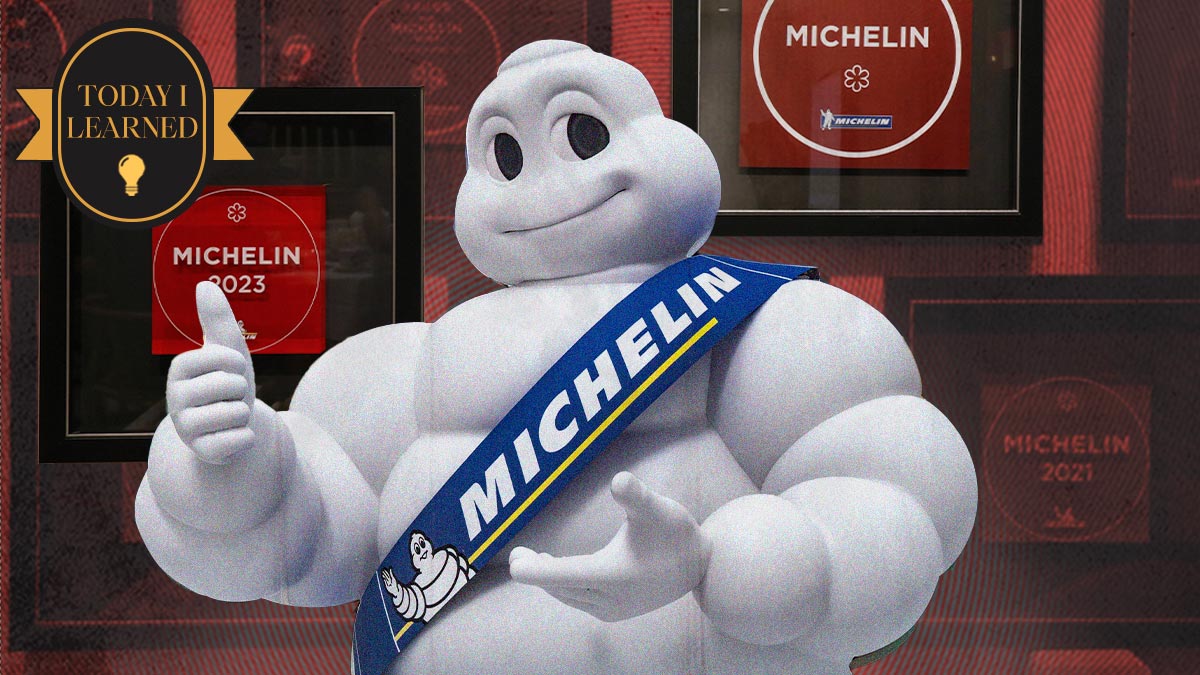
Mention the Michelin brand, and two things would probably come to mind: a mascot that looks like a stack of white marshmallows or a list of outstanding restaurants around the world. And yes, they're related: the Michelin Tire Man and Michelin Guide were both created by the French Multinational tire manufacturing company Compagnie Générale des Établissements Michelin SCA—Michelin, for short.
ALSO READ:
Michelin Has Awarded 2022 Stars to Two Filipino-American-Owned Restaurants
What It Takes to Earn a Michelin Star, According to Acclaimed French Chefs
History of the Michelin Guide and the Michelin Stars
Michelin's story dates all the way back to 1829 when a Scottish woman named Elisabeth Pugh-Barker married Édouard Daubrée, an entrepreneur from Auvergne. Elisabeth was the niece of the chemist Charles Macintosh, who discovered that rubber was soluble in benzene. Her uncle once made her bouncing balls out of all the rubber, and she eventually created these rubber balls herself. She also introduced this use of rubber to her husband.
In 1832, Édouard Daubree launched a farm machinery business with his cousin, Aristide Barbier. Their products included hoses, valves, fittings, and joints, which used rubber. The founders, however, died in 1863 and 1864, and the Barbier-Daubree Company faced difficulties. Knowing that rubber had a future in the industry, Aristide's daughter, Adele (who was married to Jules Michelin), saved the company with the help of her sons Andre and Edouard Michelin. Edouard took the reins and renamed Barbier-Daubree Company to Michelin and Cie. The brothers also found new rubber applications, including rubber tires for bicycles and carriages as well as brake pads for hackney cabs and horse-drawn carriages.
One day, in 1891, a random cyclist with a punctured tire appeared at the Michelin and Cie factory. The tire was glued on, which made the repair much more difficult. Edouard Michelin, faced with this challenge, ended up creating and introducing a detachable tire. This was what became the modern tire, which can easily be removed and repaired. With the Michelin and Cie's tire, French cyclist Charles Terront won the first Paris–Brest–Paris cycle race, beating the second competitor by eight hours.
In 1895, the brothers then took an interest in the burgeoning automotive industry and mounted car tires on a vehicle called Eclair. While it didn't win the Paris-Bordeaux-Paris race, it was the first car to ride on air through the pneumatic tires.
The Michelin Man was born in 1898, 28 years before the first Michelin Guide was created.
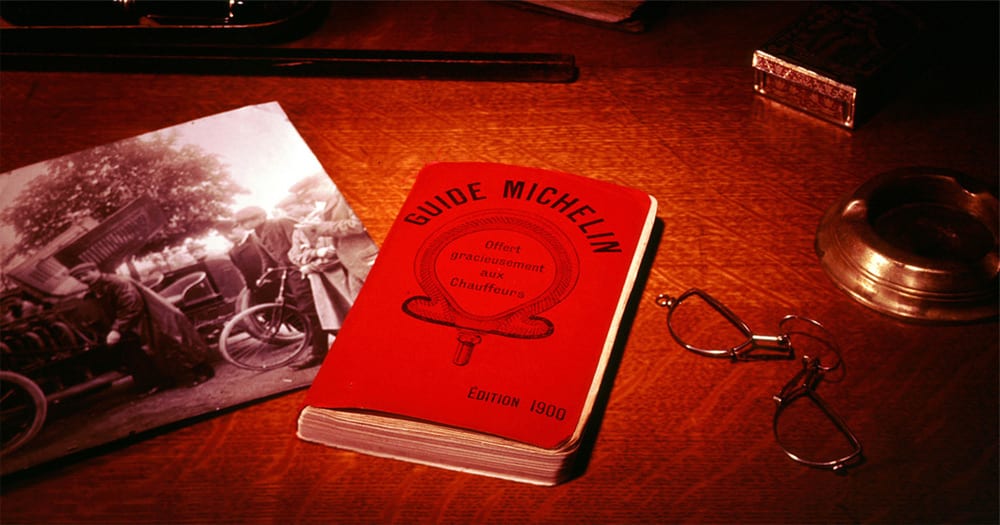
In 1900, France was home to fewer than 3,000 automobiles, and the brothers saw an opportunity to boost car and tire sales by encouraging road travel. To this end, they published a red booklet called the "Guide Michelin," a free booklet filled with travel tips, maps, and information on mechanics, gas stations, and, crucially, restaurants. Up to 35,000 were produced. This guide was distributed to promote the use of automobiles and, by extension, Michelin tires.
The guide's initial purpose was utilitarian, but it quickly gained popularity, leading to its expansion throughout Europe and Northern Africa. By 1920, the guide had evolved into a commercial product, sold for seven francs, with an enhanced focus on quality and content following the adage "man only truly respects what he pays for." The Michelin brothers eliminated advertisements and introduced a system of anonymous inspectors who visited and reviewed restaurants. This marked the beginning of the Michelin Star rating system.
The first Michelin Star was awarded in 1926 to French fine dining establishments. The single star was already a huge honor and a rare accomplishment. The system expanded in 1931 to include a hierarchy of one, two, and three stars, each representing a different level of culinary excellence. One star indicated a "very good restaurant in its category," two stars signified "excellent cooking, worth a detour," and three stars denoted "exceptional cuisine, worth a special journey."
The guide's influence grew despite interruptions during World Wars I and II. Notably, during World War II, the U.S. government reprinted the 1939 Michelin Guide for its detailed maps, which aided Allied forces during the D-Day invasion. In the 21st century, the Michelin Guide expanded its reach beyond Europe, entering the U.S. market in 2005 with a focus on New York City. Today, the guide reviews restaurants in select cities worldwide, including Chicago, Los Angeles, and San Francisco, and covers 30 territories across three continents.
The Michelin Guide Methodology
Earning a Michelin Star is a rigorous process, with inspectors responsible for determining which establishments merit the coveted stars. They adhere to six core values. First, they maintain anonymity so they do not receive any special treatment, which is essential to credibility. They're independent and full-time Michelin Group employees and are not linked to any other organizations. They also have expertise in the food, dining, and hotel sectors. Reliability, passion, and quality are also important.
They follow Michelin’s historical method based on five universal criteria to ensure consistency between each selection, including:
- Quality of products
- Mastery of flavor and cooking techniques
- The personality of the chef represented in the dining experience
- Harmony of the flavors
- Consistency between inspectors’ visits
The anonymous Michelin inspectors visit the restaurants throughout the seasons, for lunch as well as for dinner, both at the weekend and during the week, to ensure that they are able to observe consistency. They also try to eat as many dishes as possible over a year.
The Michelin Stars is an annual award. While they seek out new Stars, existing Star restaurants are also continually reassessed.
Michelin Guide in the Philippines
Michelin announced on February 17, 2025, that the Michelin Guide has arrived in the Philippines and is expected to launch in 2026. It is set to focus on restaurants in Metro Manila, Pampanga, Tagaytay, Cavite, and Cebu.
"Our Michelin Inspectors have been following the evolution of the Filipino culinary scene with great excitement. The country’s deep-rooted culinary traditions, combined with a strong openness to global influences, create a uniquely diverse dining culture," shared Gwendal Poullennec, International Director of the Michelin Guide.
"In Manila, we see young, talented chefs redefining Filipino cuisine with fresh perspectives, while Cebu, as a leading tourist destination, offers an impressive range of dining experiences with world-class hospitality."
