
April Fools' Is the Worst Day of the Year for Fake-News Believers

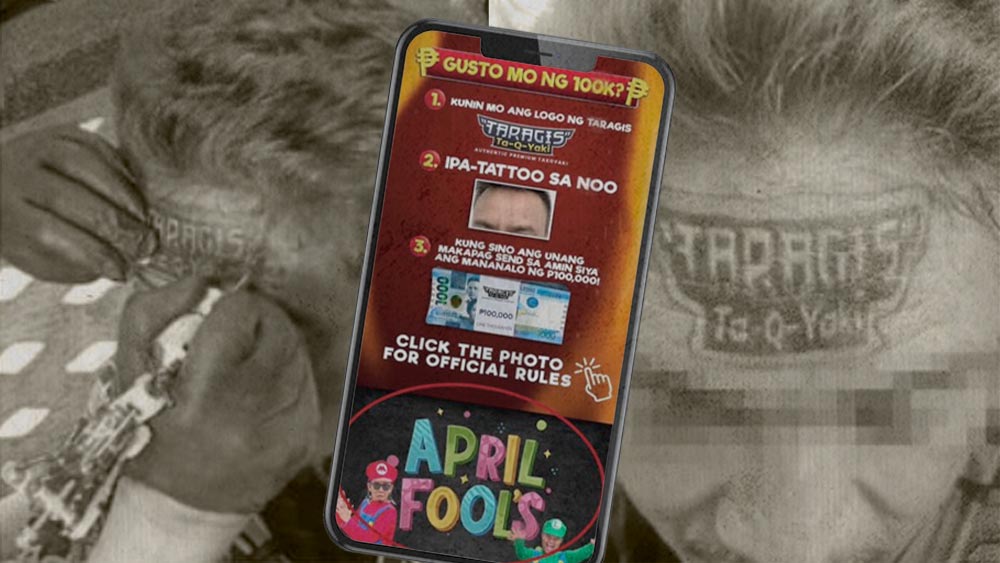
April Fools' Day, which is celebrated every April 1, is that day of the year when jokes, pranks, and even hoaxes are celebrated. But in this day and age of prevalent misinformation and disinformation on social media, is making online jokes and misleading followers still appropriate? Should pranksters be careful about what they joke about? Should followers be responsible for believing in so-called "fake news"?
Taragis Takoyaki's April Fools' Day "Challenge"
These questions were raised after local takoyaki restaurant Taragis stirred controversy online after posting an April Fools' Day "challenge," boldly captioned "Kaya mo bang gawin para sa 100k?!" The instructions require customers to have the logo of Taragis Ta-Q-Yaki: Authentic Premium Takoyaki tattooed on their forehead in exchange for P100,000 in cash.

One Ramil Albano commented on Taragis' post with a photo of himself having the logo tattooed on his forehead. "Sir, nag-pm po ako sa inyo ginagawa na po wait po ako ng chat ninyo," he added in all caps. The next comment shows the completed tattoo with the caption, "Sir, ako na yan, nag-PM po ako."
Later in the day, Taragis' Facebook account said they had "received a number of messages claiming that [their] post was executed and that someone had taken it seriously.
"Let this serve as a reminder to us all how important reading comprehension is.
"It's April Fools' Day. Never trust anything or anyone. The same as any other.
"Once more, Taragis Takoyaki is not accountable for the events that occurred.

Both posts were removed on Tuesday morning, April 2, following a backlash of comments. As nothing is ever deleted on the Internet, screenshots of Taragis' posts have gone viral for the wrong reasons.
On the flip side, support is pouring in for the man who had the tattoo made, especially after the people of the Internet found out that he is out of a job and is caring for a sick daughter.
Health and beauty brand Project Glow Up, posted on April 2 that they will be giving Albano P100,000 "for being dedicated in taking up the challenge full-heartedly." They clarified that this was not a prank, and all he had to do was send a message to their page.
Other establishments are also chipping in: BOSS Philippines with P10,000; Micchiatos Coffee with P5,000; PONG's Buffalo with P1,000; and more.
Conflicting comments have come out: Is it the fault of the joker or the "jokee"?
This article has been updated to include new information.
The Aftermath of Taragis' April Fools' Day Fiasco
In the afternoon of April 2, Taragis posted a video online showing that the stall's owner, Carl Quion had personally apologized to Albano. They have also decided to give the P100,000 cash prize to the Facebook user.
“Sa lahat ng nagkaroon ng negatibong pananaw sa naging April Fool’s post namin, humihingi ako ng tawad. At sana magsilbing aral ito sa ating lahat … na maging responsable tayo sa lahat ng inu-upload natin,” Quion said in the video.
Albano also explained that he took on the challenge to be able to provide for his son living with Down's syndrome.
"Para sa bunso kong anak, pang-tuition, at service noong anak kong bunso [na] may down syndrome," he said.
People on the Internet, however, are now questioning the veracity of the whole fiasco. Social media users have pointed out dubious observations, including the quick completion of the tattoo, lack of common swelling and redness after getting a tattoo, and other logistics-related elements.
"Fake News" as a Problem in the Philippines
In the Philippines, it seems that April Fools' Day can be a problem among believers of "fake news," more so if these posts intended to be pranks cannot be easily spotted.
A Social Weather Stations (SWS) survey conducted in December 2021 found that only 48 percent of Filipinos find it "easy" to spot "fake news," whether on television, radio, or social media. This means that more than half of the population may fall into the trap of misinformation and disinformation. The percentage of Filipinos who say that they can spot "fake" news is highest in Metro Manila (34 percent) and among college graduates (26 percent). The survey was done through face-to-face interviews with 1,440 adults, with equal portions of respondents from Metro Manila, the rest of Luzon, Visayas, and Mindanao.
In addition, a Pulse Asia nationwide survey in September 2022 revealed that nine out of 10 Filipino adults believe that the prevalence of "fake news" is a problem in the country. The survey also said that "an overwhelming majority of the country’s adult population (90 percent) have read, heard, and/or watched fake political news; internet or social media (68 percent) and television (67 percent) are the leading sources of fake news about government and politics."
And while funny posts on April Fools' Day are not as harmful as spreading misinformation and disinformation about government and politics, it can be a joke gone wrong when you dangle the promise of hundreds of thousands of pesos in front of those who could use the money. We don’t have the idiom “butas ng karayom” and a whole movie Kahit Butas Ng Karayom... Papasukin Ko (1995) for nothing. According to the Philippine Statistics Authority, poverty incidence in the Philippines stands at 22.4 percent (25.24 million Filipinos) in the first half of 2023.
Other brands have less damaging April Fools' pranks, including Sunflight Air, which joked about rolling out the "Transparent Air Sickness Bags." They're "leak-proof," "sturdy as a rock," and can even "ensure peace of mind for all travelers" because you can "clearly see the contents."
KFC introduced their "crispy, flavorful, and totally edible bucket." Along with the post is a comment that has also gone viral: "sa hirap buksan ng gravy takeout container nyo, araw-araw April Fools sa KFC. Umayos kayo," by songwriter Mikey Amistoso.
Emirates, which is known for their April Fools' Day posts, announced the construction of "Dubai’s newest supertall tower" starting on February 31, 2025. The (fictional) residential megaproject, Emirates Residences, is "inspired by Emirates' beloved in-flight experience."
Posts like these are far more responsible than the one made by Taragis, as they either mentioned April Fools’ Day or put enough warning signs that it’s all just a joke. After all, there’s no February 31 in the calendar.
History of April Fools' Day
But why do we make (and celebrate) jokes on April Fools' Day? Much like how much of the day is full of jokes, its exact history is full of mystery.
According to some historians, the celebration possibly dates back to 1852, when France shifted from using the Julian calendar to the Gregorian calendar as stipulated by the Council of Trent. This change moved the celebration of the New Year from the end of March to January 1. Those who were slow to get the news or failed to recognize the start of the year had moved to January 1 and became the target of jokes and hoaxes. They were often tricked into believing the beginning of the year is still on April 1, making them the butt of pranks and earning them the title of "April fools."
The connection of April Fools' Day to the ancient Roman festival of Hilaria, celebrated at the end of March, adds another layer to its history. This festival involved people dressing up in disguises, engaging in merry-making, and playing jokes on each other. It was a time of joy and celebration, echoing the spirit of modern April Fools' Day celebrations. Similarly, the festival's association with the vernal equinox, a time of year known for its unpredictable weather, further cements the day's connection to themes of unpredictability and jest.
In Scotland, the celebration of April Fools' Day evolved into a two-day event, beginning with "hunting the gowk," where people were sent on wild goose chases, and followed by Tailie Day, which involved pranks played on people's derrieres. This tradition of elaborate hoaxes and playful deceit spread throughout Britain in the 18th century, further embedding April Fools' Day into the cultural fabric of Europe. Historical references also suggest that similar traditions of merriment and foolery existed across various cultures and periods, from the Roman Saturnalia and the medieval Feast of Fools to the Indian festival of Holi.
International Fact-Checking Day
Interestingly, there's also the International Fact-Checking Day celebrated the day after April Fools'. April 2 of every year is dedicated to appreciating the tireless efforts of fact-checkers worldwide, who work diligently to uphold facts and combat misinformation. It was launched in 2015 by the International Fact-Checking Network (IFCN) at Poynter. This nonprofit media institute based in Florida provides fact-checking, media literacy, and journalism ethics training to citizens and journalists.
In the Philippines, International Fact-Checking Day is taken as the perfect opportunity among media outlets and journalist groups to raise awareness about the importance of fact-checking. Some of the ways to combat the spread of "fake news" are to develop a critical mindset, always check the sources and other outlets reporting the story, examine the evidence, and not take images at face value.
Taragis' Facebook post did not have a disclaimer that it was an April Fools' Day joke or any mention of ridiculous information, such as a fake date or a fake place. While it does have a few warning signs, they're things not everyone knows. One example is that it's void of any DTI number or registration, which is required for online contests, especially one giving away money. The Facebook page is also rife with social media stunts, which the local restaurant uses to get more followers.
Also not to be missed: There’s the fact that the “challenge” was posted on April Fools’ Day. And that just means we have to be extra wary about what we see online.
