

Avatar: The Way of Water Is Better Than the Original in Every Way

Avatar is a cultural oddity. James Cameron’s 2009 space epic earned a gajillion dollars and ushered in a theatrical gold rush era of 3D. At the time, it seemed as if 3D cinema was the wave of the future. Films that were never intended to be in 3D were digitally retrofitted to be viewable in 3D for that extra moviegoer money. Every big movie was coming out in 3D.
And then it just stopped. Movies were still coming out in 3D, usually shot in 2D and converted via post-production, but fewer and fewer theaters were showing 3D films. And people mostly forgot Avatar. The biggest movie of all time (before Avengers: Endgame briefly took the title from July 2019 until March 2021), the one that broke all the records and pushed the boundaries of film became a hazy memory buried under the cascade of movie franchises in the years that followed. People stopped talking about Pandora and the blue-skinned Na’vi. People didn’t even think about Avatar. Nobody expected a sequel, nobody asked for a sequel, and yet here we are 13 years later with a sequel.

Why it took Cameron 13 years to come up with a sequel to a film that grossed almost two billion dollars in a month and a half probably has some Hollywood execs in knots. But it’s not that simple. “It’s not a no-brainer,” explains Cameron, “do you want to call down the lightning strike again in the same spot? You know, it’s a lot to live up to.”
Well, yeah.
When Cameron takes us to Pandora again, we need to feel the same wonder we did the first time we visited it. We need to feel the breath of the panther-like Thanator as it readies to pounce. We need to flinch and get out of the way when the Hammerhead Titanothere charges into the audience. We need to be back in Pandora for The Way of Water to be worthwhile.
Cameron understands this. “I think it’s important for a sequel to honor what the audience loved about the experience the first time. But also to get them off-balance [and] do things that they don’t expect. There are a lot of surprises in terms of where the story goes in this film that we’re not putting into the trailers and the TV spots and all that. You kind of have to experience it.”
Here’s the good news: he nails it. James Cameron absolutely does it again. Avatar: The Way of Water starts off slow with a recap of what Jake Sully (Sam Worthington) and Neytiri (Zoe Saldana) have been up to for the past decade. Spoiler alert, they’ve been busy. Jake and Neytiri now have four kids including an adopted daughter, Kiri (Sigourney Weaver), who was born, Immaculate Conception style, from the dead body of Dr. Grace Augustine’s (also Sigourney Weaver, of course) avatar. Wait, she was pregnant? Yes, keep up. And she gave birth even after she’d died? Yes, yes, this is science fiction. Who was the dad?!? Why do you ask so many questions? Just get with the program.

Cameron found a way to bring Sigourney Weaver back through some unexplained, mystical way, but Kiri is all sorts of weird and cool, so put a pin on all those questions for now. The story starts to pick up when Jake and Neytiri are forced to flee the forest home of the Omaticayas and seek refuge with the water clans because they’re being hunted by the avatar of Colonel Miles Quaritch (Stephen Lang). What?!? Quaritch is back?!? And he’s an avatar now?!? Yup, Cameron’s brought back everyone who was only mostly dead (Michelle Rodriguez isn’t back because she’s all dead).
The Sullys eventually meet with the Metkayinas, water Na’vi with teal skin, and appeal to their chieftain Tonowari (Cliff Curtis) and his mate Ronal (Kate Winslet) to grant them sanctuary. Once The Way of Water gets to the water, it hits the ground running and really starts to take off. Why are my metaphors all mixed up? Because Avatar: The Way of Water is a sensory overload that just hits you from all angles that it can really get overwhelming. There’s just a lot to take in.

When Cameron stated in an interview that people should take a bathroom break “any time they want,” when watching the 3 hour 12 minute epic, it was because he said viewers, “can see the scene they missed when they come see it again.” It sounds like hubris coming from anybody else, but James Cameron knows big cinema better than anybody. It turns out, he’s right. People will watch it again, or at least they should.
Avatar: The Way of Water is a sensory overload that just hits you from all angles that it can really get overwhelming.
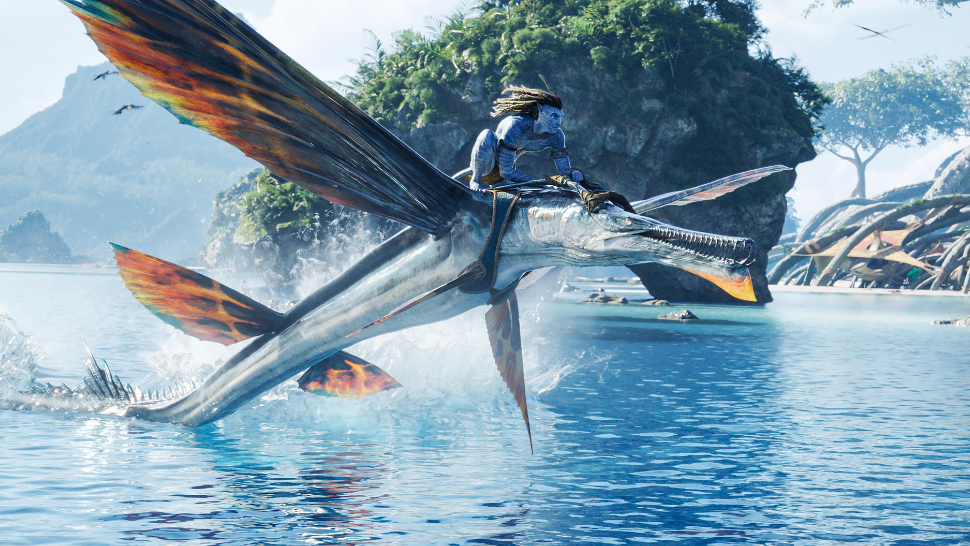
And it’s not just because Avatar: The Way of Water is a singular cinematic experience much like the first film was, either. Cameron not only employs cutting edge filmmaking technology, he pioneers them. The innovations of 2009’s Avatar paved the way for most of modern cinema’s performance capture. The Way of Water brings an alien world to life in greater detail and realism than any other film before it. When the massive whale-like Tulkun crosses the screen, it’s almost close enough to touch. Cameron brings you to see an even more fascinating part of Pandora, and it’s simply insane.

But The Way of Water is more than just a vacation on Pandora. The focus is on Jake and Neytiri’s new roles as parents, colored by Cameron’s own experiences. “It also goes a lot deeper, in terms of the heart and the emotions. I was inspired by the fact that both Zoe and Sam are parents, and I’m a parent of five, and so we wanted to get into the family dynamics, and the responsibilities of having kids.”
The Way of Water is genuinely a family adventure in a way the first film never was. In fact, it’s a family adventure in a way very few films are, with so much focus on the relationships between the two adults and their teenage boys, Neteyam (Jamie Flatters) and Lo’ak (Britain Dalton), Kiri, and their youngest daughter, Tuk (Trinity Jo-Li Bliss). And then there’s the mysterious Spider (Jack Champion), a human who grew up among the Na’vi after being left behind during the exodus of the first film because babies can’t go into hyper sleep. Spider’s parentage factors greatly into the story and parallels his Na’vi friends’ struggles and conflicts.
There’s just so much richness in all the relationships among the characters that it feels significantly more relatable than the first film.
Even the Metkayina Na’vi family have room to grow, with Winslet’s Ronal every bit the mama bear that Neytiri is. “There are different ways for a female to be strong,” Cameron relates. “And Kate’s character, she goes into battle six months pregnant, and she does not hesitate. When her kids are in jeopardy, boom, she’s on the move.”
There’s just so much richness in all the relationships among the characters that it feels significantly more relatable than the first film. Parents will easily identify with Jake and Neytiri, and Tonowari and Ronal; kids can take their pick from any of the Na’vi children, who all go through very human experiences, because as it turns out, the Na’vi and humans aren’t that different, after all. Popular Na’vi kids still bully the oddballs, Na’vi boys still get into pissing contests, and Na’vi adolescents get all googy-eyed at each other. Just like humans.

Except, of course, humans are still the worst. Even with a Na’vi shell, Quaritch is still every bit of the jerk he was in the first film but with a familial monkeywrench just to keep things interesting. The humans, the Sky People, have come back to Pandora to do what humans do, which is mess with nature and kill beautiful things in the name of money. It’s not very deep, but at least it isn’t Pocahontas, anymore. There’s a little bit of Moby Dick, though.
IMAX was made for films like The Way of Water, and stories like it are why giant screens exist.
Avatar: The Way of Water is a sequel that’s inarguably better than the original in almost every way. From a technical standpoint, the 3D is far more immersive, seamless, and makes Pandora very, very real. It’s cinematically breathtaking and should be viewed on the biggest screen possible. IMAX was made for films like The Way of Water, and stories like it are why giant screens exist. If the last three years made us turn to streaming services for our films, Cameron’s magnum opus should remind us of the spectacle of large format cinema. Movies on our teensy-weensy television screens are nice and all, but there’s simply nothing like visiting an alien planet through a screen the size of a building.
And then there’s the story about family. By turning Avatar: The Way of Water into a family saga, Cameron expanded its scope while giving it more heart. 3D films probably won’t be making a huge comeback anytime soon, but Cameron reminds us all of how truly great 3D cinema can be. It’s still unlikely that Na’vi names will ever enter the cultural zeitgeist like Yoda or Vader, but The Way of Water builds upon a truly beautiful world with a solid story and emotional core, as well as sets up a third film. Hopefully, it won’t take another 13 years because you’ll definitely want to visit Pandora again.
