
Review: Furiosa: A Mad Max Saga Achieves the Impossible by Making Fury Road Even Better

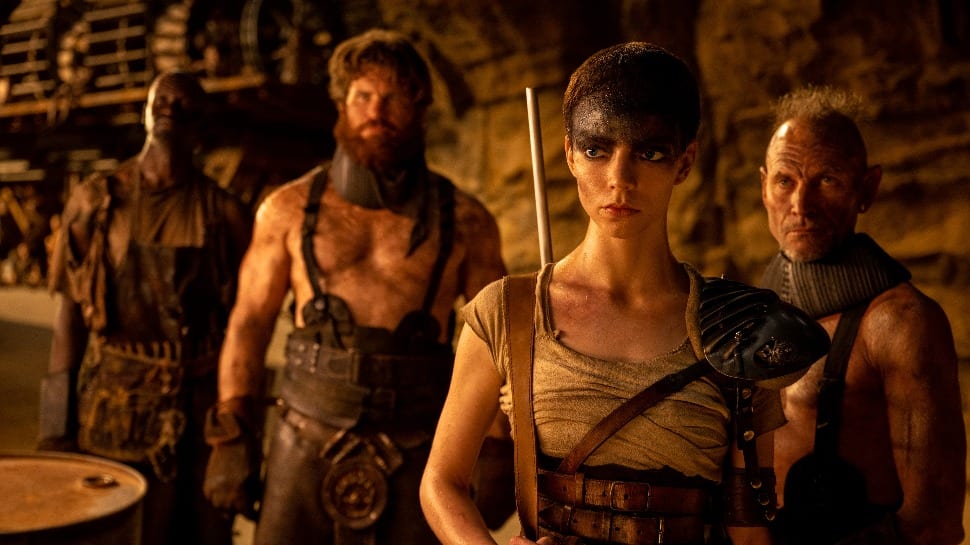
It’s George Miller’s own fault that Furiosa is something of a disappointment. This isn’t to say that Furiosa: A Mad Max Saga is a bad film. It isn’t. In all likelihood, in fact, Furiosa will be remembered as one of the best films of 2024, a stellar batch that so far includes Denis Villeneuve’s Dune: Part Two and Rose Glass’ Love Lies Bleeding. By all reckoning, Furiosa is a cinematic tour de force, the rare summer blockbuster that elevates itself to art, and a memorable sensory experience with some of the most beautiful and poetic visuals ever shot for an action film. There’s just one problem: it was made after Mad Max: Fury Road.
Fury Road is one of the greatest films of the last 50 years and arguably the greatest action film ever made. It’s essentially a 120-minute car chase, an insane ride into the post-apocalyptic wasteland world of Mad Max that never lets up on the gas, a film with unparalleled cinematic language that stunned audiences when it hit theaters in 2015 and left an indelible stain in our collective consciousness. There’s nothing quite like it, thanks in no small part to Miller’s editor wife Margaret Sixel, whose lack of experience with action films resulted in Fury Road’s singular storytelling cadence. Miller’s fourth Mad Max film, a sequel that gestated over 30 years, set the bar so high that as much as it isn’t fair for anyone to expect Furiosa to be better, we all want it to be.
ALSO READ
What is the Best Marvel Animated Series and Why Is It X-Men ’97?
Review: Shogun is a Masterclass in Slow Burn Storytelling
And why shouldn’t it? Sixel is still editing, albeit now sharing the billing with Eliot Knapman, who assisted with Fury Road. It stars the charismatic Chris Hemsworth, arguably a bigger star today than Tom Hardy was during Fury Road. The titular Furiosa is played by the scintillating Anya Taylor-Joy, a worthy successor to Charlize Theron. All the elements necessary to one-up Fury Road are there. Not least of whom is George Miller, the auteur who always manages to surprise and subvert expectations.
Let’s get this out of the way: Furiosa is only a disappointment in that it’s hard to like it better than Fury Road. It is, in all other respects, an incredible piece of cinema. If you’ve had the strange misfortune or questionable life choice of not having seen Fury Road, then it’s strongly recommended that you watch Furiosa first. Although there’s a montage of scenes from Fury Road that serves as the film’s epilogue and allows Furiosa to be a decent standalone film, it works best as a prequel. It whets the appetite for Mad Max: Fury Road, which is really a Furiosa story that only happens to feature Max Rockatansky as a side character.
If Fury Road was a non-stop adrenaline rush that forgets to put on the brakes, Furiosa is like a sports car that conscientiously makes a full stop at every intersection. Broken down into five parts, each chapter is ushered in by a title card that forces audiences to take a breath. It’s Miller’s way of saying Furiosa isn’t Fury Road and isn’t meant to be. It’s paced differently by intent; a five-course meal that happens over 15 years versus the forced beer bong guzzle of Fury Road, which happens over three days. When the film opens with a young Furiosa (an outstanding Alyla Brown) picking fruits in the idyllic Green Place, it only amplifies Theron’s anguish in Fury Road when she realizes her homeland of abundance is no more. When she is kidnapped, having ventured too close, too bravely, to marauding bandits, her mother (Charlee Fraser) gives frenetic chase across the desert wasteland, first on horseback and later on motorcycle. It’s intense, and when she picks off Furiosa’s captors one by one with a sniper rifle, it’s a reminder of how badass the Vuvalini are.
We are then introduced to Hemsworth’s Dementus, a self-styled messiah who leads a nomadic biker gang with grandiose melodrama and a distracting prosthetic proboscis. He isn’t necessarily worse than the repulsive Immortan Joe (Lachy Hulme), just necessary. Immortan Joe is the embodiment of misogyny and the patriarchy, the unquestionable final boss in the story of Furiosa, feminism incarnate, who spirits Joe’s wives away in order to take them to a fabled land run by the women. Dementus is this level’s superboss before Immortan Joe’s final boss, but he’s one hell of a bad guy.
Dementus is unpredictably cruel, for whom sadism and brutality is demonstrative. It’s easy for characters like Dementus to feel two-dimensional, but Hemsworth is magnificent and seeing his (d)evolution across chapters is a real treat. From calling himself Red Dementus, where he shifts from messiah to king; to labeling himself Dark Dementus, which signals the start of his downfall. Dementus may not be the enemy of feminism Furiosa was born to destroy, but he’s certainly instrumental in shaping who she is. In their final encounter, Dementus asks, “do you have what it takes to make it epic?”
The question is aimed at Furiosa, but we all know the person who’ll answer is Miller. And the answer, without question, is yes. Furiosa is epic in every way imaginable. Miller ventures into biblical territory with parallels of the forbidden fruit and Furiosa as Eve, culminating in an unexpected and grotesque reimagining of the Tree of Knowledge. That the fruit is a peach, analogous in a myriad of ways to womanhood, only compounds the imagery. As Furiosa rides off in her thirst for revenge, the History Man (George Shevstov) dubs her the Angel of Vengeance, the Fifth Horseman of the Apocalypse. It’s a bold claim, but we know that Furiosa is good for it.
Anya Taylor-Joy doesn’t appear until maybe an hour into the film, with the earlier chapters focusing on the young Furiosa. And when adult Furiosa finally does show up, she barely has any speaking lines. Fortunately, ATJ has the widest, most expressive eyes in Hollywood and because nobody is better than George Miller at showing and not telling, Furiosa is a masterful visual narrative similar to Fury Road. In fact, the scenes where Furiosa has lengthy speaking lines, her Bambi-style trauma-fueled rant against Dementus, are the weakest part of the film. But even Furiosa’s weakest parts outshine ordinary action films because the frames are so arresting and instantly iconic. From the bleak, bleached landscape that make it seem like the two are in nothingness to the alternating angles of worm’s eye and bird’s eye views of Furiosa and Dementus, respectively, Furiosa conveys more through its framing than some entire film scripts.
Despite vivid, heavily saturated colors being such a significant part of Fury Road’s visual language, Miller has stated that his vision for the film was for it to be told in black and white and Fury Road’s Black & Chrome edition does just that. It’s a more primal, more visceral perspective of Furiosa’s journey told in high contrast. On the other hand, color is an essential part of Furiosa that it would be interesting to see if Miller produces a monochromatic cut. Without color, the Green Place loses its verdancy and stark contrast against the wasteland. Without color, Red Dementus is just Black Dementus. Praetorian Jack’s (Tom Burke) green flare to instruct Furiosa to escape would be indistinguishable from a red flare. That said, it’s almost certain George Miller has a far more elemental, art film cut of Furiosa in mind because there’s a rawness to each frame that begs to be seen in high contrast monochrome.
The best way to appreciate Furiosa is to kill the notion that it’s supposed to be better than Fury Road the way every next installment of the Fast and Furious franchise keeps getting bigger and more ridiculous. Furiosa does have some bigger things, such as deeper, more expansive world-building where we understand the synergy between the three strongholds of the Citadel, Gastown, and the Bullet Farm. There are more characters, which means that despite the title, there’s no singular focus on Furiosa herself. Furiosa: A Mad Max Saga is not as great as Mad Max: Fury Road because it isn’t meant to be. It’s a standalone story that instead makes Fury Road so much better, like a video game DLC that isn’t necessary to finish the game but enriches your experience, anyway.
Mad Max, in many ways, has always been a car story. Furiosa is at its best when it remembers that. The chases across the desert, particularly the war rig sequence where Furiosa proves invaluable to Praetorian Jack as she single-handedly fends off raiders, is one of the most exhilarating parts of the film. It bogs down when it flits between locations and characters. Despite its flaws, Furiosa is still one of the best prequels ever made and demands to be viewed on the biggest screen with the best sound system. Afterwards, go watch Fury Road and, thanks to Furiosa, enjoy it even more than you did the first time.
