
Suzume Is an Ode to Abandoned Places and an Adventure of Seismic Proportions

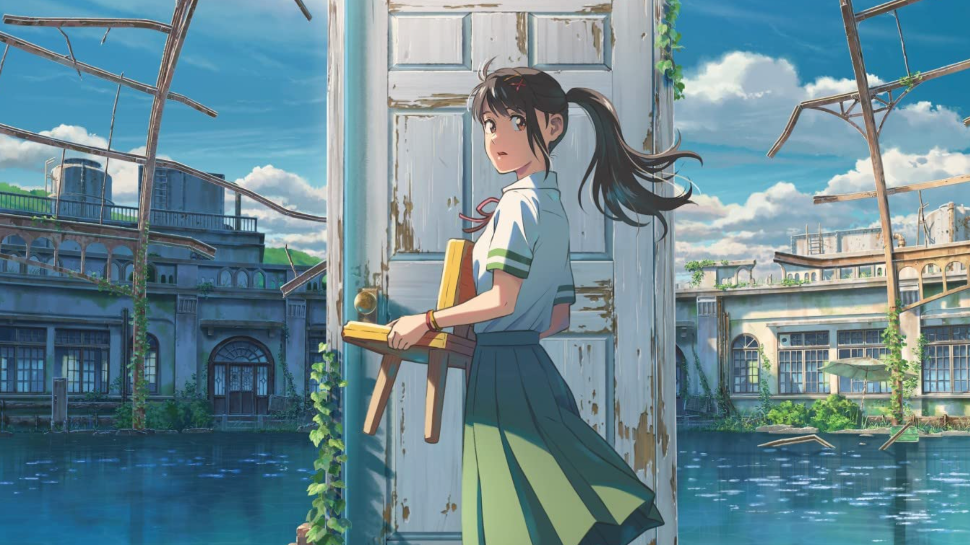
Makoto Shinkai sees a world beyond what we see, weaving tales about Japan in a way only he can. The master storyteller behind Your Name (Kimi No Na Wa) and Weathering With You (Tenki No Ko) is back with another tale of natural disasters, grand mythology, personal sacrifice, and young love with Suzume, his longest and most epic story yet. Running at 122 minutes, Suzume is a long road trip across Japan, a love letter to abandoned places and an unexpected ode to single mothers and working women.
Suzume follows the titular character (Nanoka Hara), a junior in high school living with her aunt in the small coastal town of Miyazaki, where she encounters the mysterious and beautiful Souta (Hokuto Matsumura) who asks her about some ruins in the area. Inspired by the increasing number of abandoned places in Japan, Shinkai introduces the concept of closing doors as a way to honor places that have been left behind and forgotten. Souta is a ‘Closer’, tasked with sealing mystical doorways to the Ever-After, the final resting place of souls and home to a great and powerful worm that constantly tries to enter our world through these doors and cause tremendous destruction in the form of earthquakes.
Also read: Manila as an Anime Setting Looks Like Somewhere We'd Like to Live In
In Japanese mythology, earthquakes are caused by the thrashing of a giant catfish called Namazu or Onamazu who lives beneath the islands of Japan. It is in an eternal struggle with the god Takemikazuchi, who keeps it pinned down with a kaname-ishi or spirit rock. Shinkai puts his own spin on the myth with a more menacing worm and a pair of keystones instead of the catfish and a stone-wielding thunder god. Seventeen-year-old Iwato Suzume unwittingly releases one of the keystones, which turns into a troublemaking cat named Daijin who turns Souta into a chair, kicking off a cross-country adventure filled with epic action sequences, emotional moments, and stretches of quiet that border dangerously close to dragging.
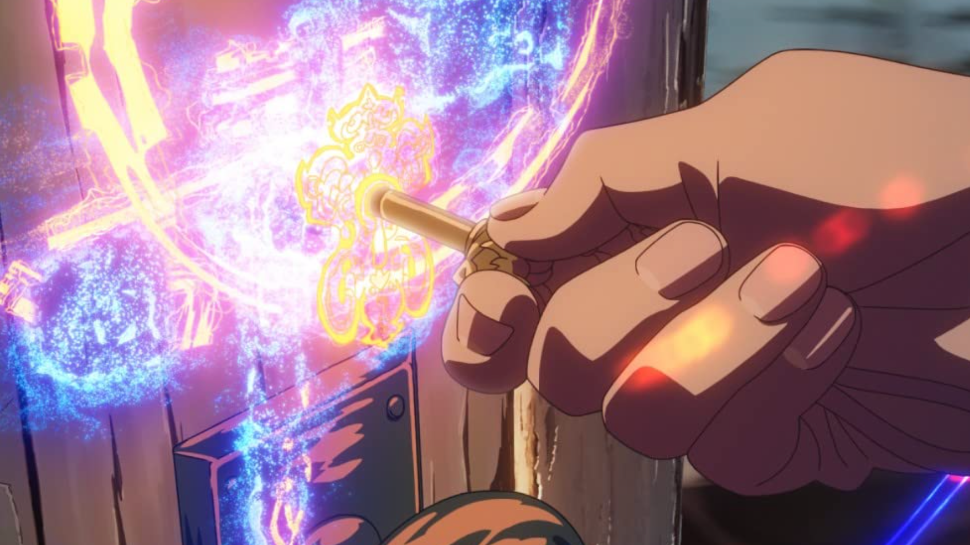
Suzume feels like Shinkai’s answer to a Marvel movie, as close as he’ll ever get to a superhero blockbuster, where a menacing worm that threatens to destroy Japan and only a junior high school girl and a sentient chair stand in its way. There is some action uncommon for a Shinkai film, from battling the forces of destruction to chairs chasing cats down a busy freeway. But it’s the quiet moments that make a Shinkai film, and there’s an abundance of it. It’s the moments between grand set pieces that make Shinkai’s stories shine, observations about Japan and its culture woven seamlessly into the narrative.
There’s a tenderness in the act of closing, and Shinkai demonstrates a reverence for heritage with the Closer’s prayer, which demands recalling the lives of all who had lived in a certain place. The film is all about closure, as Suzume herself unknowingly struggles with unresolved grief that drives a wedge between her and her aunt and legal guardian, Tamaki (Eri Fukatsu). We never properly say goodbye to the places we leave behind, and Shinkai masterfully interweaves the themes of forgotten places with the grieving process.
Turning the tale into a road trip allowed Shinkai to showcase different parts of Japan and feature the different sorts of people you meet along the way. As Suzume follows Daijin, she meets a variety of working class folks, notably women, who help her on her journey. Shinkai pays homage to single mothers in a recurring theme, showing resilience and sacrifice in a modern Japan that doesn’t make it easy for women to find time for themselves.
Tamaki, unexpectedly burdened with the task of caring for an orphaned little girl, realizes she’s spent her prime years raising a daughter she never asked for. As Suzume travels across the country chasing down a mischievous magical cat with her crush-turned-chair, she grapples with her guilt over burdening her aunt as well as reopens old wounds by revisiting a past she never fully closed the door on.
Suzume is peak Shinkai, beautiful to a fault, with the transportive realism and detail that has been a hallmark of his stories. He tells the story in a very familiar, very modern setting, with all the daily contrivances of Japanese life, from social media to digital banking and train passes on mobile phones. The juxtaposition of modernity against places long forgotten serves to turn up the melancholy, a subtle chastisement of a Japan that sometimes rushes forward with little regard for what it leaves behind.
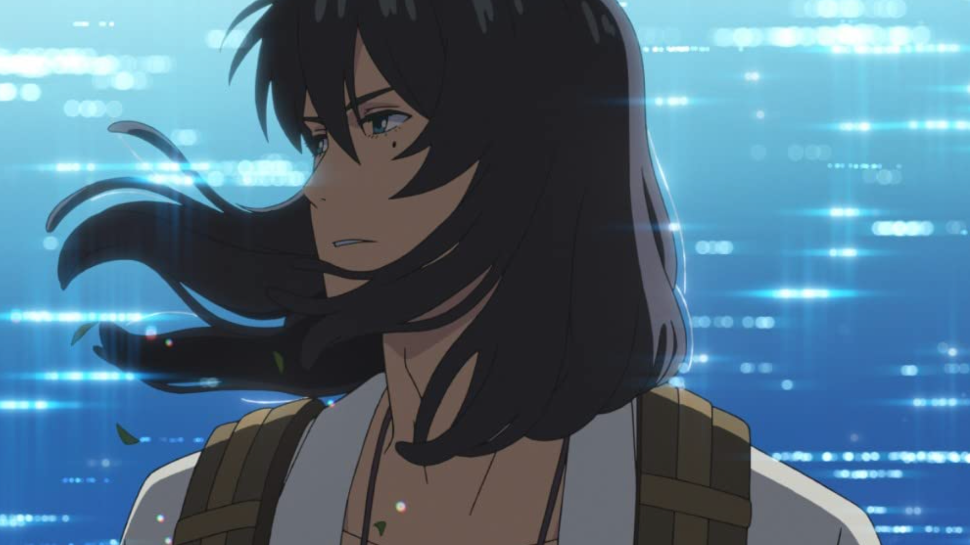
The Japanese readily embrace the new and replace the old, they leave manga in trains after they’ve read them and offload still-functional television sets on sidewalks when a new model is out. It’s the same attitude towards places that no longer serve their purpose, with a shrinking population that has resulted in a growing number of ghost towns. Suzume is Shinkai grieving for these places, and he wants us to remember that people lived in these towns or amusement parks. Beautiful memories were made there, and it’s only proper to say thank you and goodbye.
And of course, there’s love. This is Makoto Shinkai, after all. In what might be Suzume’s weakest point, our heroine harbors an affection for a talking chair that blossoms into love. It feels a little rushed and unearned, but it isn’t too bothersome because we all knew it was coming. Just like we already know to expect a tough choice between the fate of thousands, millions against one’s true love. We already know the answer, and it’s what Shinkai wants us to choose every time.
But predictability isn’t a great failing when the storytelling is sublime, and it doesn’t get more sublime than Makoto Shinkai. Suzume is a beautiful and satisfying adventure that delivers adrenaline and closure in equal doses, opening the door to a world of magical star-dotted ombré skies and compelling mythology. It’s Shinkai’s most ambitious, most exciting tale yet and we should be grateful for the ride.
Suzume is now showing in cinemas nationwide.
