
Who Were the Sakdalistas, and Why Aren’t They in Quezon?

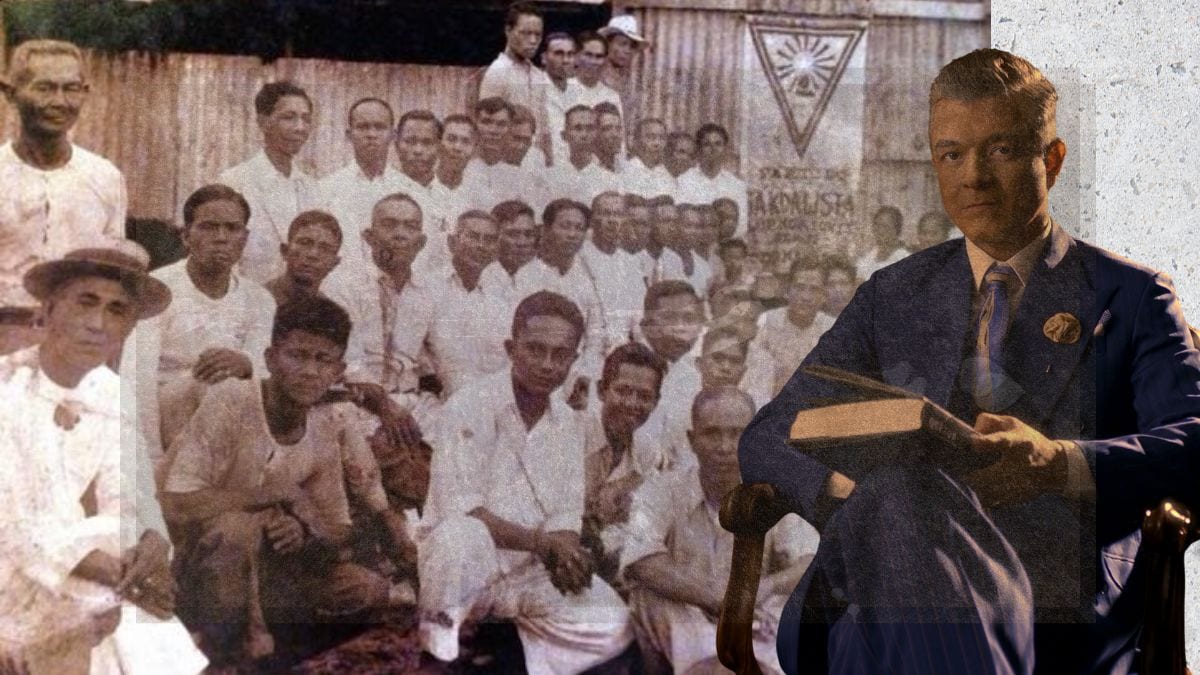
First and foremost, I would like to preface my observation about Quezon by saying outright that it is a pretty decent film. Jericho Rosales’ portrayal of Manuel Quezon as the jester-in-chief, chameleon, womanizer, and opportunist is something I’ve expected. Borrowing implicitly or explicitly from the motif of Shakespeare’s Richard III, Tarog paints Quezon as a tragic figure: part victim, part gambler of circumstance, who continually hedges the nation’s journey to independence against his own self-advancement. The appointment scene best illustrates this, as Quezon deftly plays off everyone’s impulses to secure what he needs for his cause and master plan as the principal spokesperson of Filipino self-determination. And for those who took umbrage at this specific choice and framing, Tarog has barely scratched the surface.
At most, Tarog’s Bayaniverse, since its inception in 2015, can be seen as a grittier set of counter-narratives to the sanitized hagiographies we get from mainstream portrayals and school textbooks. When Heneral Luna first premiered, Jerrold Tarog was able to galvanize public acclaim through a combination of social media campaigning and positive word of mouth, especially since, outside of Marilou Diaz-Abaya’s Jose Rizal (1998), few films had captured the public’s appetite to take history with any degree of seriousness.
If we are to use Friedrich Nietzsche’s rubric on the purpose of history—though he is not the only thinker to articulate this—Tarog succeeds in making the past vivid and ambiguous, while avoiding the trap of sermonizing or hectoring the audience to adhere into a conclusion. Emilio Aguinaldo’s character throughout the Bayaniverse embodies this tension well. We see how he evolves from an indecisive chief executive during the war against America, to a man cornered at Tirad Pass, and finally to a fading relic by the turn of the century. In this regard, Aguinaldo is less of a villain or a scumbag. Instead, like Quezon, we can see that he is pulled by the winds, rather than the other way around.
I frankly couldn't care less about absolute accuracy, though it must be said that a basic fidelity to what has been etched or imbibed in the sources should still be observed. Otherwise, your movie risks turning into Abraham Lincoln: Vampire Hunter. Tarog has done his research, selected what to include and what to leave out, and made his case.
In this regard, however, I would like to note that Tarog, for all his narrative flair and visual mastery, has committed a major blunder that deprives Quezon of its necessary reckoning. The explicit and intentional excision of the Lapiang Sakdal from Quezon’s arc functions both as a wall of silence and as an admission of the Bayaniverse’s subtle but recurring motif.
As a refresher, the Lapiang Sakdal, or Sakdalista Movement, was a political party and organization that emerged in the 1930s, often described as populist and even socialist in its own eclectic way. Led by Benigno Ramos, it grew out of his daily Sakdal, and was able to captivate an entire generation—hundreds of thousands of what we might otherwise dismiss as common folk—under his banner. Unlike Quezon and his ilk, Ramos’ aims were concrete and tangible, not limited merely to immediate independence, though that was a prerequisite.
ALSO READ
Quezon Is a Triumphant Blend of Fact, Fiction, and a Whole Lot of Exposition
The Dark Side of Manuel Quezon
They championed land reform, the expansion and modernization of the armed forces, a crackdown on graft and corruption, non-intervention abroad, safe working conditions, decent wages, and a government that embodied what they referred to as the spirit of Andres Bonifacio’s 1896 Revolution. They rejected Nazism, Fascism, and Bolshevism, arguing that the Philippines’ problems could not be solved by any imported formula from overseas. Long story short, before their 1935 uprising—and before Ramos’ eventual drift toward apologism for Imperial Japan—they had established themselves as the genuine opposition to the Nacionalistas after the 1933 elections, successfully winning seats in Congress and local offices.
From this standpoint alone, the absence of Ramos is puzzling. Ramos, after all, was not just some random rabble-rouser; he was part of Quezon’s inner circle before their falling-out in 1930. By not including the Sakdalistas, Tarog removed a potentially captivating subplot that highlights the internal contradictions within the independence camp—and Quezon’s closest match in shrewdness and intellect. Instead, what we get is Leonard Wood’s monologue, which could have been more powerfully articulated by Ramos.
As for Tarog’s commitments, while he is often circumspect about his personal views—a sign of maturity—one can still deduce a pattern in where he stands. Tarog’s films are consistently comfortable orbiting around the movers and shakers of the past, to the point that there are hardly any echoes of the hoi polloi in his tapestry, with the exception of the Guardia de Honor, who serve as a haunting specter in Goyo. This orientation, if you look closely, explains why his settings often feel hollow or bereft of life, with little to no viscera.
To compensate for this lack, Tarog often turns to the perspective of an insider, with Joven serving as the perfect foil. But across the three films, Joven is not a strong enough character to serve as the story’s ethical anchor or ballast. At the same time, he embodies the contradictory and impotent moral indignation so resonant in those with buyer’s remorse. The catch, however, is that Joven still belongs to this milieu, and his revolt against it will always be underwhelming, for he is but a lamb surrounded by wolves and foxes.
Aside from my earlier ruminations, Tarog has every right to depict the past with little to no need for validation regarding its emotional texture or fallout. So long as there are no out-of-place instruments, artifacts, costumes, or tools in his period pieces, I can hardly care if his protagonists are flawed or haunted by their own demons.
What makes any decent art, literature, music, and so forth so impactful and appealing is its ability to engage with its audience from a dialectical rather than a didactic premise. The difference between the two is always stark: to partake in dialectics is to accept that contradictions lie at the heart of all thought and action, with its materialist offshoot even suggesting that the world moves through the unity of its oppositions. Didacticism, meanwhile, is the impulse to hector, to scold, and to force a work of art to conform exactly to one’s own subjective preferences or personal pathology.
From this dynamic alone, we can easily discern which art endures the test of time and which remains frozen in amber. While this is not the be-all and end-all of metrics, it can help us evaluate whether Tarog belongs to the former or the latter. And I can say with sincere and utmost confidence that Tarog’s Bayaniverse has a good chance of enduring—for whether we like it or not, a paradigm shift has been underway since it first premiered in 2015.
For all the controversies and loopholes that have dotted the Bayaniverse saga since the beginning, Tarog still manages to reach an insight we often take for granted—or have outright banished from our senses: that the reason history is often regarded as boring has more to do with our confusion than with its practicality. In that regard, Tarog illuminates the possibility that history can be treated not as pure lamentation or a cautionary tale—as has been done a thousand times before—but as rocket fuel and an invitation to see through the fog. It’s not that we don’t care about the past; we simply want to ask whether it remains relevant to our own fate and direction, both collective and individual.
Since the Bayaniverse has concluded, we can either discard it entirely and start again from stage one, or build something new and refreshing from it, regardless of the trilogy’s own limitations and achievements. So long as time continues to unravel, there will never be a shortage of ways to interpret history as something still alive and kicking. And that provocation remains Tarog’s greatest contribution, and challenge, to the conversation.
