

Religious Trauma and All-Consuming Grief: The Unbearable Sadness of The Whale

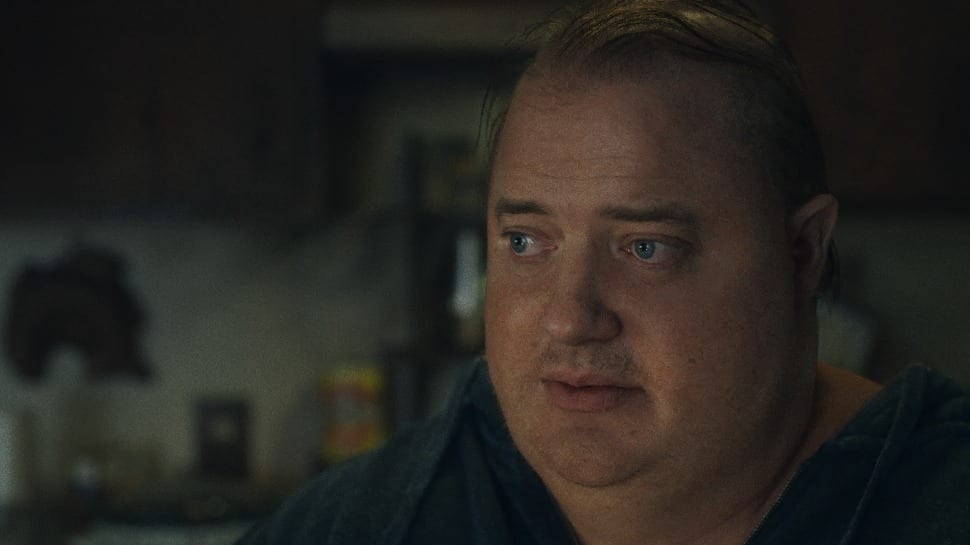
It’s easy to file away Darren Aronofsky’s The Whale as a cinematic triumph. We can talk about how Brendan Fraser gave the performance of a lifetime as Charlie, a morbidly obese homosexual man with an eating disorder; or how Hong Chau and Sadie Sink were stellar in their roles as Charlie’s best friend and daughter, respectively. We can even mention how Fil-Am Matthew Libatique’s sublime cinematography was more understated, but no less stunning, than all his other collaborations with Aronofsky. All of this is true. The Whale is a wonderful, terribly moving film.
Also read: 'End the Bias Against Those Who Live with Obesity,' Says The Whale Star Brendan Fraser
But we really need to talk about playwright Samuel D. Hunter’s scathing attack on religion and the how it destroys people’s lives. Based on Hunter’s eponymous play, The Whale is a heartbreaking exploration of the failure of religion, in particular conservative Christianity, to understand and embrace love. Ty Simpkins plays a door-to-door evangelist cleverly named Thomas who chances upon Charlie in the middle of a medical emergency. Thomas is convinced that he was sent by God to save the whale of a man and starts to visit him regularly, armed with the good news of the Lord.
Ty Simpkins as Thomas

But for any homosexual raised in a religious environment, the Lord’s news is anything but good. Religious trauma is so terrifying and real that its scars last a lifetime, and in the case of gay, lesbian, and bisexual folks, that lifetime tends to be shorter than it deserves to be. Suicide risk among LGBTQ youth and adults is astronomically high compared to straight people, and religion shapes a lot of that conversation. A quick, but ill-advised trip to the comments section of any social media post about the LGBTQ will often reveal deep-seated and long-standing homophobia and bigotry brought about by and justified with religion.
Charlie’s eating disorder is the result of his grief from losing his lover Alan, who wasted away from the guilt and self-loathing that Christianity instills in homosexuals. Internalized homophobia is common among gay Christians and some, like Charlie’s partner, never manage to break free. Thomas’ frequent visits become more and more obtrusive, from merely hanging around to borderline proselytizing until it becomes apparent that his need to ‘save’ Charlie is really about saving himself. In the end, Thomas mistakenly focuses on a Bible passage that he believes is the root cause of Charlie’s pain. It’s a cherry-picked verse that conflates fleshly desires and homosexuality with eternal damnation.
But Charlie’s response is surprising and deceptively Christ-like. He tells Thomas about the love of his life and describes their first kiss, how they make love, and how beautiful they found each other. It’s a response filled with love. But Thomas’ revulsion to Charlie’s words are greater than his aversion to his grotesque, inhumanly massive frame. Earlier in the film, Charlie asks Thomas if he finds him disgusting, and Thomas blankly says no. But as he reels from Charlie’s story, we witness the kind of disgust brought about by religious brainwashing, where a story about two men falling in love elicits a stronger reaction than the sight of a 600-pound man.
There’s a deep, ineffable sadness and claustrophobia that infuses every frame of The Whale, the entirety of the film transpiring almost exclusively within the confines of Charlie’s dark, cluttered house. When the film opens with a zoom session of Charlie’s writing class, his camera is expectedly turned off, ostensibly broken. It’s uncomfortably familiar in a post-covid world and an important reminder that there are real lives in front of the cameras, whether they’re turned on or not. And some lives are sadder than others. As one student writes, “I think I need to accept that my life isn’t going to be very exciting.”
Hong Chau as Liz

Charlie’s life isn’t particularly exciting, and neither are any of the lives of those around him. Alan’s sister and his only friend Liz (Chau) is a health worker who visits him regularly and takes care of him. It’s a lonely routine, but it’s essentially Liz’s life. When Charlie reconnects with his daughter Ellie (Sink), she comes around with baggage she’s been lugging for eight years, abandoned by a father who fell in love with his night-school student and came out as gay. It’s a lot, and it’s interesting, but it isn’t very exciting. But like all our lives, there are moments of beauty and there are moments with love. And Charlie is filled with so much of both.
This is what pulls us through the unbearable sadness of The Whale. Charlie is deeply flawed, but has a heart far bigger than his body. He constantly apologizes to Liz for being such a burden, disappointed in himself for being an inconvenience. When Ellie lashes out and exhibits behavior that her own mother calls ‘evil’, Charlie still considers her amazing and believes in her goodness. He’s so in love with his daughter that he finds wonder in everything she does, even when she scribbles how she ‘hates everybody’. Even as Thomas forces him to listen to Bible verses, Charlie is filled with so much faith and goodness that you realize that he really doesn’t need saving.
Sadie Sink as Ellie

The Whale is one of the most honest and critical looks at the damage caused by religious trauma. Charlie demands honesty from his students, ultimately discarding the set curriculum in favor of something raw and honest. In the process of connecting with Ellie, he understands that we are all just trying to distract others from seeing the sadness and mundanity of our own lives. Religion, in Hunter’s estimation, is an excuse to focus on other people’s problems rather than ours, or making what aren’t problems problems so they can be saved.
When Alan died, Charlie turned to food as a means of coping with the crippling, all-consuming grief of losing the love of his life. Weight gain also became a means of distancing himself from wasting away the way Alan did, creating an inescapable cycle of grief and self-loathing. But Charlie has survived, plowing through a life spent indoors, holding on to the memories of beautiful things and moments in life, filled with a hope that defies belief and expectation. Aronofsky ends the film differently from the play, which ends in darkness. It’s a cinematic conceit that gives one of the year’s saddest and difficult to watch films an unexpected, but much-needed lightness and catharsis.
The Whale is now showing in cinemas nationwide.
