

There's a Small Busking Community in the Philippines, and Martin Riggs Wants to Make it Bigger

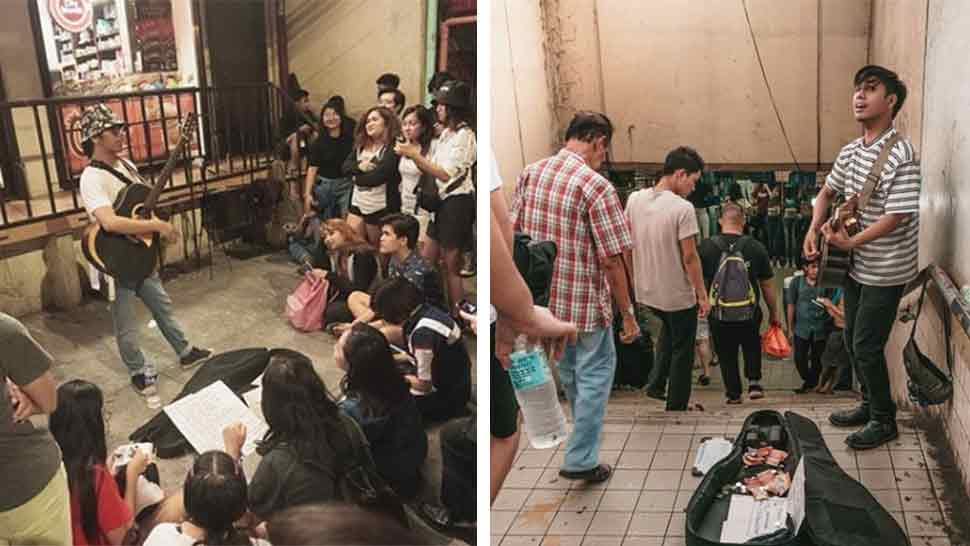
Busking is a grand tradition and rite of passage for many a musician in cities and cultures around the world, including the Philippines. Singers and musicians have shown off their talents in street corners and busy intersections in many parts of the country for years, either out of economic necessity, or just to have an automatic audience there to voice out their appreciation, and, hopefully, have people toss in a few coins or bills.
In recent years, busking culture has gradually moved from seedy alleyways and highway overpasses to gleaming new malls and commercial developments. The profile of typical buskers has also changed—today you’ll just as likely to see young, able-bodied men and women playing guitars or violins on open public areas as more mature and differently abled singers and musicians.
“Busking in the Philippines is starting to be an expression of freedom and also an avenue to promote (musicians’) craft,” says Martin Riggs, an acknowledged early champion of the resurgence of busking culture in Metro Manila. “Things can improve if we get enough help from those who can, in terms of security and permits and exposure to inform Filipino masses that busking is normal and we just want to share music in the streets of the Philippines.”
How Martin Riggs started busking
Riggs was in grade school when his uncle first taught him how to play the guitar. His foray into busking was an accident—he was strapped for cash one day and couldn’t get a ride home, so he took his guitar out and played right there on the street. Eventually a nearby bar allowed him to play on its stage just before the actual band went up. That was his first taste of busking, and he hasn’t looked back since.
“In the beginning people kept asking me what church I go to, and para saan daw yung ginagawa ko,” he says. “Some people smile at me and cheer me on. I smile back at the kind ones and ignore the rude ones.”
View this post on InstagramEvery Friday • @jamesonph • The Meeting Point • Poblacion, Makati • #StreetGigsniMartinRiggs #NormalizeBusking #TheBuskingCommunity ?Ang saya. Thank you so much for coming everyone! #StreetGigsniMartinRiggs • Makati ? ? ???? @cdpmanuel>pA post shared by Martin Riggs Nuñez (@_martinriggs) on >p
>p>p>pYears later, after racking up hundreds, possibly thousands of hours busking in many different street corners of the city, he jokingly says that he’s still not sure if he can actually sing. >pIn February 2019, Riggs joined Callalily’s Kean Cipriano’s new venture O/C Records, first as one of its artists, then, as executive assistant. Now he’s the official A&R (artist and repertoire) guy of the fledgling label and talent management company. >p“I think (Kean) saw my potential, network and drive to get things done, even new things, when all I have was pure pulse and gut feel and knowing the right people to talk to, Riggs says. “(Being A&R) was my dream job because I am really passionate when it comes to looking for good artists with the ‘Odd Creature’ quality.”>pRiggs says it was him who introduced artists like Earl Generao, Frizzle Anne and Drive of Day Dreams to Cipriano. All of them are now signed under O/C Records.>pA busking community>h2During the 2019 edition of Fete dela Musique, the annual music showcase chiefly organized by the French Embassy in the Philippines featuring different “stages” spread out across different venues across the city, Riggs found himself in charge of an all-new Busking Stage and the O/C Records Stage, both held at the Ruins in Poblacion, Makati. For the first time, buskers from across Metro Manila gathered in a one-of-a-kind musical performance that showed the breadth and depth of talent literally found on the streets. >p“They first watched a documentary of me on TV that was uploaded on YouTube,” he says to explain how he connected with other “professional” buskers in the city. “Then they reached out online. Some went to the O/C Records Open Mic and asked if they could be a part of my street gig. I welcomed them with open arms.”>pLate last year, Riggs and his colleagues at O/C Records premiered an online show called Objective Criticism where they invite aspiring singers and songwriters to perform their original songs in front of a panel of judges composed of local professionals in the music industry. Riggs says the first artists he signed to the label through the show were the best five buskers who joined the open mic: Pappel, Eugene Layug, Stephan Clive, Migs Dato and Alyssa.>p“I think this was a sign that I’m on the right track as a musician,” he says. “I’m the street performer who was hired to look for good talents and found (them) in the streets and signed them to a record label. It’s coming full circle that I will always be grateful for.” >pRiggs also helped organized Busking Community PH, which is composed of actual buskers, in the hopes of normalizing busking as a legitimate artform throughout the country.>p“We’re over 40 buskers who perform in the mean and real streets of Manila,” he says. “Over 25 buskers volunteered for our recent event, UP FAIR Hiwaga and pretty much those are the active ones.”>p
As for Riggs himself, he says he still harbors dreams of becoming a lawyer someday, but his ties to the music business and the opportunities coming his way just seem too good to pass up. Outside of his duties with O/C Records, he still enjoys performing and says one of his most memorable “gigs” happened along P. Noval Street in Manila.
“That moment when I made one person stop, and a hundred other people stopped to look and listen,” he reminisces. “They lit their flashlights during my original songs. Someone hugged me and cried. I always dreamed of that happening but never thought it was possible.”
ADVERTISEMENT - CONTINUE READING BELOW
