

911 Technology Empowers LGUs for Efficient Emergency Response


When a disaster, health crisis, or accident strikes, every second counts. Hence the importance of technology that allows hospitals, ambulances, firefighters, and police to respond immediately in these critical and life-threatening situations.
Many of us are familiar with the hotline number 911, which is the primary emergency number used in the United States and other countries like Canada, Mexico, Colombia, Costa Rica, Ecuador, and Paraguay. The Philippines has also recently adopted 911 as an emergency number, which is a practical move, as opposed to having citizens memorize multiple numbers.
But on top of being just a number to call, there's actually a cutting-edge 911 technology available in the country now. Next Generation Advanced (NGA), also known as Next Generation 911 (NG911), implements cloud-based solutions for more efficient and reliable emergency call handling. It includes features like more precise call routing, integration of multimedia data (e.g., text, video), and improved location tracking.
NGA founder and CEO Don Ferguson

Through its partnership with industry leaders like Amazon Web Services, Google Emergency Location Services, and SpaceX's Starlink, NGA is able to transform traditional emergency response systems to be more adaptable, efficient, and capable of handling diverse types of emergency communications.
"When you dial 911 using our technology, the call is immediately routed to the local government unit (LGU). The location of the caller automatically appears on the system. This allows the LGU to dispatch the nearest responder to the incident location," explains Don Ferguson, founder and CEO of NGA.
Ferguson has over 30 years of experience deploying large-scale, mission-critical
systems and holds patents in emergency call routing and services. He was also part of President Barack Obama's technology and innovation team focused on public safety communications.
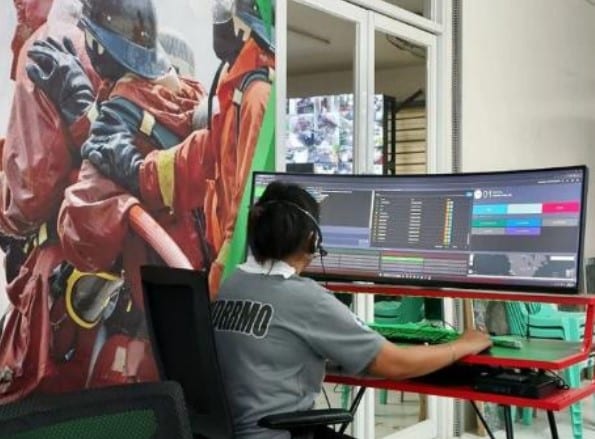
NG911 office in Morong, Rizal
ALSO READ
A Guide to the 9 Major Dams of the Philippines
From concerned dad to safety innovator
Ferguson says the concept for the technology was inspired by his experiences as a father. "At that time, my son was nine years old and starting to gain his independence. As protective parents, his mother and I were trying to figure out how to give him independence while still being able to protect him," he shares.
At the time, cell phones were becoming more advanced with GPS and internet connections. So, he built an app for the Blackberry and early iPhone. "My idea was that pressing a button on the cell phone would automatically start a conference call with everyone who cares about my son and share his location—like a panic button," he says.
"As use cases became clearer, I realized we needed to connect the panic button to the police, especially if I was out of town for business. We extended the safety network from family and friends to include the police. That's how the concept started."
It was a lightbulb moment for Ferguson. "The 911 system in the US, while very good, is also very old. It doesn't allow for video, and location was an issue. It also didn't allow for dynamic information from the caller," he recalls.
In the mid-2010s, Ferguson recognized a demand for this technology in states like California and secured a contract to enhance its 911 system. Their Filipino chief finance officer, Ishka Villa, who had joined the team, strongly suggested bringing the technology to the Philippines. In 2019, they began introducing it to the Philippines, marking Ferguson's first trip to the country.
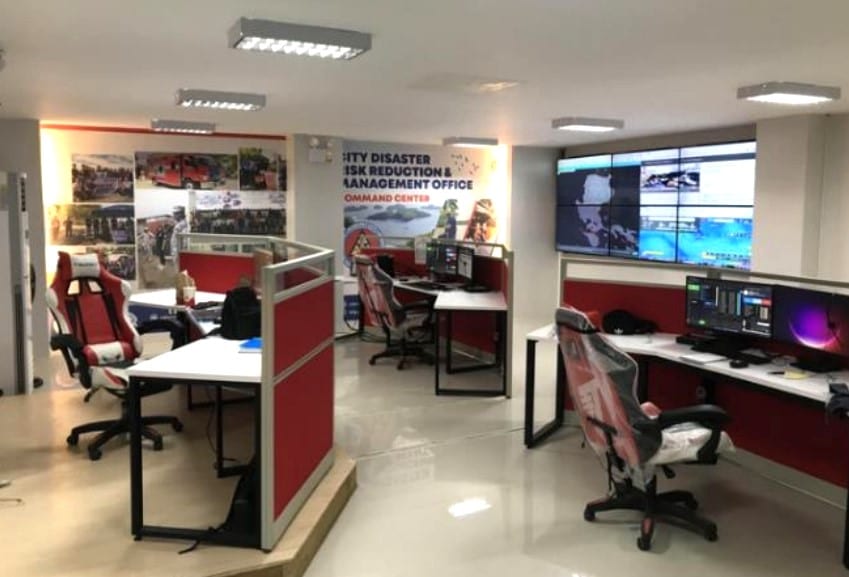
NG911 facility in Alaminos, Pangasinan
Bridging the gap
According to the IT chief, NG911 was received by LGUs in the Philippines with great interest but also with a lot of skepticism, especially in its initial year. "They loved the concept of having the most modern 911 system on the planet to serve their LGU. But it was hard to get them to believe that it could happen because there's such a gap. It was hard to imagine how it could be done," observes Ferguson.
He and his team needed to understand the nuances of the local telecommunications networks, such as PLDT and Globe, to address the technology's integration. Leveraging their expertise in 911 systems, they collaborated with the carriers to overcome these challenges.
While it was a difficult process five years ago, the investment in time, energy, and money is clearly paying off. "Now it is very easy for an LGU to adopt this. And the citizen doesn't have to do anything except dial 911," he says.
"The system that we're deploying on behalf of Morong and Alaminos is one where, when you dial 911, it uses advanced call routing rules to deliver it to the nearest responder. When the responder receives the call, they know you are calling them, see your number, and see your location. If you have called multiple times, they have a history of incidents that you have reported and, because they know your location, can provide an immediate response to your situation," Ferguson adds.
For now, if a caller wants to share a video or photo, the 911 call taker will send an SMS with a link. The caller can then use this link to share the photo or video, which will be sent to the 911 call taker. This feature is crucial for situations such as accidents or administering CPR. NGA is working on further integrating the photo and video features into the 911 system.
Ferguson is also looking forward to August 8th, when they will inaugurate the NG911 system for the Philippine National Police (PNP). He expects the system to be integrated into the PNP National Capital Region (NCR) within 60 days and adopted by the LGUs in the region within three to six months.
While there are ongoing challenges, significant strides have been made in improving the emergency response framework in the Philippines. NGA's initiative aims to ensure that every Filipino has complete trust in the efficiency and reliability of the 911 emergency response system.
"We envision that every Filipino, young or old, will understand that when they dial 911, they trust that they're going to get the response that is needed. It's that simple," says the NGA chief.
