
Here We Go Again

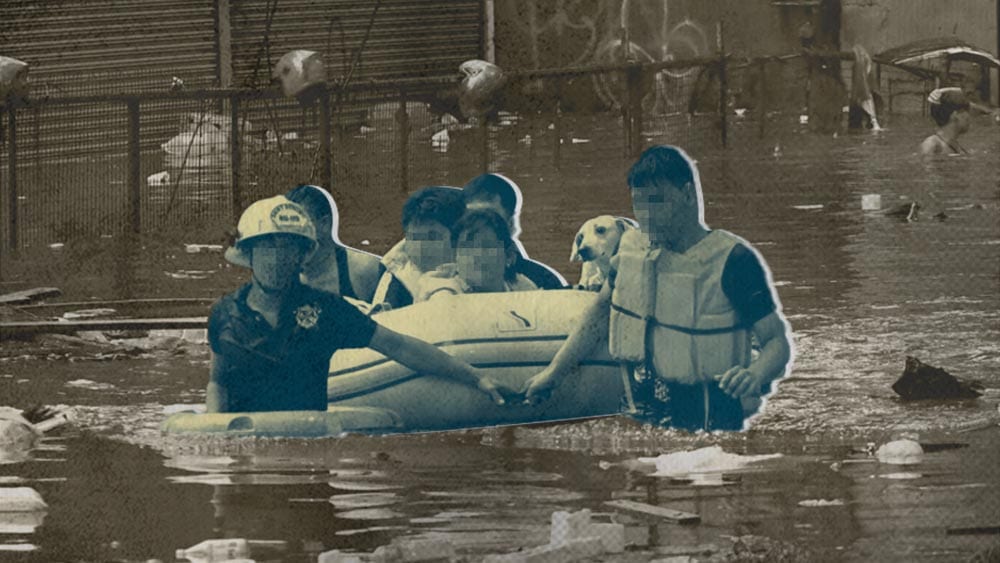
I woke up Wednesday morning to see my car half-submerged under floodwaters just outside my bedroom window. Well that’s new, I thought, as I half-ran out of my room in my boxers and ratty old T-shirt to try and save the poor car from being totally engulfed. I managed to get it to start and was actually able to drive it a few meters before it finally conked out and died.
I literally had to push the car up in thigh-deep waters so I could get it to a slightly elevated part of the street. A couple of kind strangers and my nephew helped me out.
ALSO READ
Typhoon Carina: List of Donation Drives for Affected Communities
NOAH Website From 2012 Still Maps Out Flood Hazard Level
While I was doing that, the floodwaters were starting to pour into the inside of my apartment. Floating debris and god knows what else swirled all around me as I made my way back under a heavy downpour so my niece, nephew, and I could start taking valuable things up to the second floor. It was stressful, to say the least.
When I finally had time to stop and take a shower (to get the leptospirosis-tinged floodwaters off my skin), I checked social media and realized we actually got lucky. There were disturbing videos and images, as is the usual case when natural disasters hit the country—stranded commuters waiting for rescue on top of big city buses on national highways; residents forced to evacuate to their roofs as their houses down below became inundated; a rampaging Marikina river overflowing and consuming everything in its path. There were eerie images of familiar city landscapes submerged in floodwaters, stalled cars with their roofs sticking out, videos of torrential rains and winds pummeling hapless commuters, and heart-wrenching photos of stray animals abandoned by their owners.
No, this isn’t the first time we’re struck by these visuals. Nearly every year, the Philippines is hit with numerous storms, typhoons, tropical cyclones, the habagat; and every year we’re forced to see the effects of these natural disasters play out on social media. And that’s if we’re lucky. Many of us actually live through them. Whether we’re stranded on our way to school or work or watch as the only home we’ve ever known gets swallowed up by floodwaters, or even, tragically, lose a loved one to accidents or disease directly as a result of these calamities, the experience of living through them is universal for us Filipinos.
And it’s not just anecdotal evidence, or something that gets emphasized by our social media feeds. It’s backed up by science. According to Statista, which quoted a 2023 study, the Philippines is the country with the highest natural disaster risk in the world, with a disaster risk index of 46.86. Our neighbor Indonesia isn’t far behind at second place with 43.5.
And for those keeping track, we actually climbed up in the rankings of countries most at-risk of disaster, hitting number one from number three back in 2018. The report from that year states that, since 1990, the Philippines has been hit by 565 disaster events. That’s an average of about 20.2 disasters every year. And the total monetary cost of these disasters? A whopping $23 billion. And this was back in 2018. We’ve had many more disasters hit us in the six years since.
And in case you feel like these natural disasters seem to be getting more and more common, that, too, isn’t just your imagination. “Since the century began, natural disasters have become more frequent,” Statista says. “Every single year since 2013 has recorded more than 400 events. In 2022, 421 disasters were reported worldwide, a 23-percent increase compared to 2000. Considering that climate-related events are more common than geophysical ones (earthquakes, volcanic eruptions), accounting for almost 80 percent of all natural disasters in 2022, the general upward trend can be mostly associated with climate change and its impact in weather patterns and phenomena.”
So given all this, and the fact that these things keep happening to us over and over and over again, the question is, have we not learned anything? Why is it that, every time we get hit by a typhoon, super or not, we just sit here all passive and take it like we can’t do anything about it? But Nick, I can hear you whining, the government is doing something about it. Government agencies like the National Disaster Risk Reduction and Management Council (NDRRMC) under the Office of Civil Defense and the Department of National Defense, is tasked to look after the welfare of the people during natural disasters or emergencies. Various local government agencies have their own disaster response mechanisms in place precisely because we experience these things so very often.
And, to be fair, there have been some strides. That UN report from 20i8 said that there have been explicit provisions for environmental protection mandated by the NDRRMC, the Department of Interior and Local Government, and the Department of Environment and Natural Resources.
But in many ways, these are reactive measures, meant to support and assist during and immediately after a disaster. What about efforts to actually prepare us for when disasters inevitably strike. What about efforts to mitigate the effects of these calamities? To paraphrase the United States’ Federal Emergency Management Agency (FEMA), what actions are the government taking to reduce the cause and impact of these disasters?
FEMA has an excellent but by no means exhaustive list of suggestions in this area, such as using permeable pavement when re-surfacing roads and driveways; protections of wetlands so they continue to serve as natural flood water absorption; and creating floodable parks so they can become water retention areas in the event of a flood. There's a whole bunch of architectural and engineering solutions that we can explore and adopt if they apply to us and our peculiar situation.
If there are efforts, they certainly don’t seem to be working; otherwise we’d see fewer images of stranded commuters and flooded homes and streets. Either that, or the effects of climate change have become so severe that we’re just not able to keep up. Which one do you think is more likely?
In the end, the reality is that we may have no choice but to just live with these semi-regular skirmishes with all-out natural disasters. Due to our unfortunate geographical location that’s just conducive for these types of natural disasters, coupled with leaders choosing to overlook the importance of mitigation in favor of response and recovery, we may not be able to live to see the day when we don’t have to feel scared or anxious every time a bit of rain falls.
But hey, aren't we getting a Taylor Swift-ready concert venue soon? We’re getting ready for that, at least.
