

How Thousands of Animals Behaved Before the Massive Earthquake in Turkey and Syria

“When animals go crazy, run away from the sea and go to the highlands” an ancient Indonesian folk song warns children.
For a long time, humans have known that there are just some things that animals can sense that humans cannot. For example, when snakes and other wildlife descend from their dwellings in the mountain, it is said to be a sign of an impending volcanic eruption.
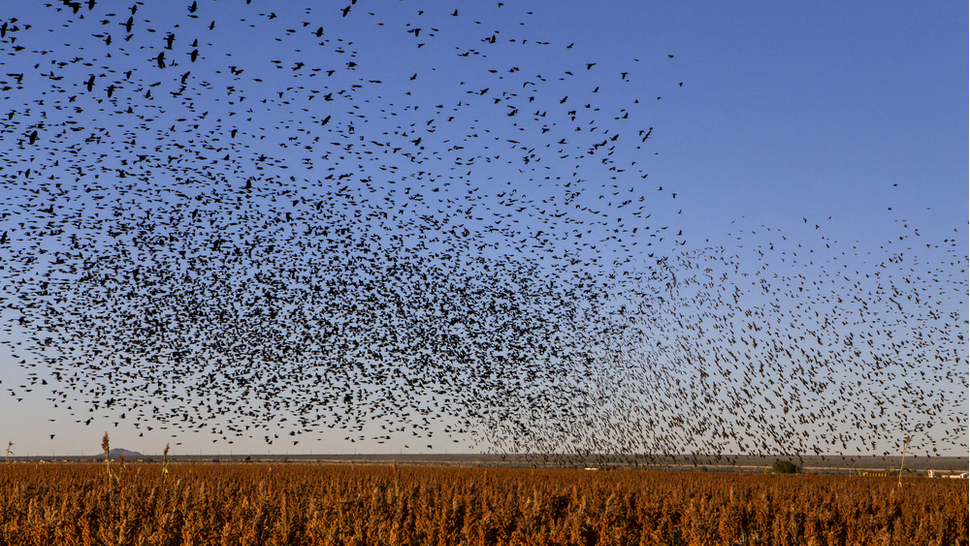
Just before a powerful 7.8-magnitude earthquake struck Turkey and Syria on February 6, 2023, people witnessed the strange behavior of animals: birds were reportedly seen flying erratically, dogs became restless and howled incessantly, and cows continuously moved around their enclosures minutes before the earthquake happened.
Such animal behaviors before earthquakes are not isolated incidents and have been documented since ancient times. In fact, in 387 B.C., Roman writer Aelian detailed how mice, snakes, centipedes, and beetles Helike City hours before a deadly earthquake struck it.
A similar incident was caught on radar in 2016 when thousands of birds took to the skies and flew erratically minutes before an earthquake occurred, reports the Washington Post:
At 6:47 a.m. on Saturday, thousands of birds took flight across the state of Oklahoma. Weather radars lit up with blue and green, signifying that a large number of birds suddenly became airborne at nearly the same time. Then at 7:02 a.m., a 5.6-magnitude earthquake struck the state, originating in Pawnee County.
According to the United States Geological Survey (USGS), an earthquake forecast was made in China in the 20th century or "several decades ago" based on animal behavior. People slept outside their homes anticipating a powerful earthquake, and when it finally arrived, they were spared with the ground started shaking and leveling their homes.
In 1975, snakes fled their underground dwelling places in the city of Haicheng, China. Seeing it as a sign of an impending earthquake, the town leaders promptly evacuated the city before a 7.4-magnitude earthquake struck the densely populated hub. Although tens of thousands were able to escape the earthquake, the city counted 1,000 casualties in the earthquake. If the population had not been forewarned by the snakes, the death toll could have been higher.
In a study published in the Bulletin of the Seismological Society of America, over 700 reports of strange animal behavior were documented and reviewed against the occurrence of earthquakes.
"The probability density of foreshocks and the occurrence of animal precursors are strikingly similar, suggesting that at least parts of the reported animal precursors are in fact related to foreshocks. Another major difficulty for a systematic and statistical analysis is the high diversity of data."
And then, in 2011, animals at the Smithsonian's National Zoological Park behaved frantically: Chimpanzees and gorillas, who typically spend most of the day on the ground, started to make noise and climbed trees, minutes before the ground shook.
Scientists could not explain why animals seem to be able to predict earthquakes, but a promising theory about earthquake waves could explain why.
According to the USGS, animals might be able to detect P Waves or Primary Waves, the first type of seismic waves emitted during an earthquake. These P Waves travel faster than S Waves or Secondary Waves that are felt by humans.
"Many animals with more keen senses are able to feel the P wave seconds before the S wave arrives,” says the USGS.
But scientists are still at a loss to explain how animals are able to sense earthquakes minutes or even hours before they happen since S Waves occur seconds or a minute after P Waves.
To this day, scientists are still not sure how animals are able to detect earthquakes and tsunamis minutes before they become apparent. In 2004, elephants fled the coasts of Sumatra and Aceh in Indonesia and sought refuge on higher ground or someplace away from the sea.
