

Palawan and the Phenomenon of the Sail

“At sea, I learned how little a person needs, not how much.”
- Robin Lee Graham
Friday, February 3: A Ticket to Elsewhere
On the waterfront.

We all find our way back home eventually. It doesn’t matter how long it takes. You’re meant to return to the place where you were born when you’re ready. This, I knew when I left my mother and father’s house when I was 20. That, I am reminded of the farther along I go on this path to elsewhere.
Elsewhere has now taken me to the east coast of Busuanga, Palawan, Coron’s little brother, as the locals say. It’s a Friday afternoon at the Marina del Sol Resort & Yacht Club, and I’m here to cover my first regatta, the BPI Busuanga Cup, to watch a sport more commonly associated with the ultra rich and the ultra richer. For this trip, I’m a spectator trying to understand the spectacle of the sail. As an outsider, I’m too caught up in the turquoise waters and the glittery waves the sun makes on this fine late afternoon. A guy could get used to this.
Snap out of it. Shelve the nostalgia for Sunday. As a writer on an assignment, I have all afternoon today to prepare. On the waterfront, I see the boats about to set sail tomorrow morning. A lot of these yachts and boats come from elsewhere, too. They arrived from Punta Fuego Yacht Club in Nasugbu about two or three hours ago. These boats were said to have been built in Western Europe and the Nordic region, and have since made their way to Philippine waters. The sailors themselves are sons and daughters from elsewhere, as well. We have competitors who hail from Barcelona, Marseille, and Holland. Some are kababayans from Manila, Subic, and Batangas, albeit four or five social classes above me.
I chance upon a man named Renie Ticzon, who would take me to his boat later on. His Papaya 2 yacht is racing in the cruising division tomorrow. “If computers have Apple, then boats have the Papaya!” he says. As a hobbyist, he’s been at this for about 10 years now. He started out surfing before commanding hobie cats then boats. “As you get older, the boat gets bigger.”
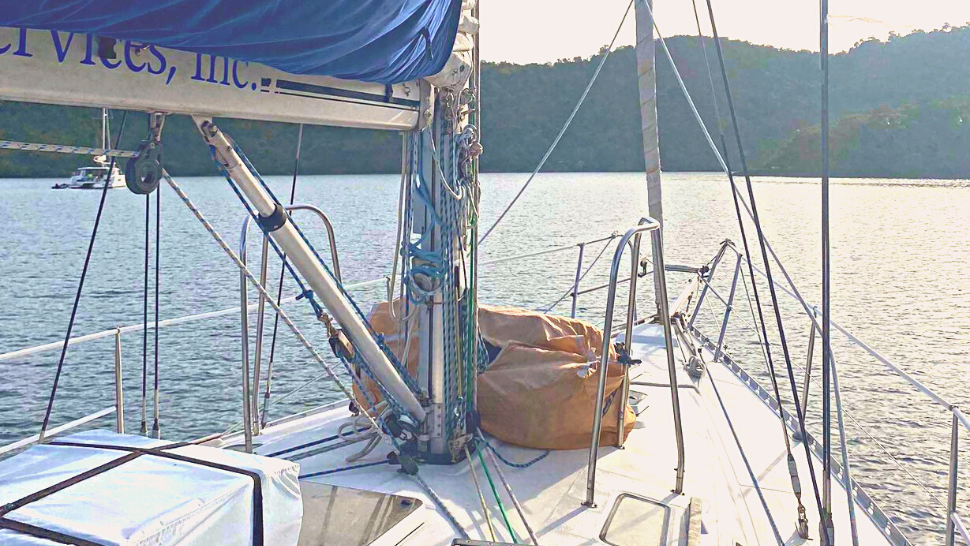
Nobody can really claim they’re an expert in sailing, not even him. Speed is a function of the wind and the wind can oftentimes be unpredictable a hundred nautical miles away. He tells me that the period between November and April is the best time to sail (November is the start of the season, and the Papaya has joined several regattas in Puerto Galera, Subic, and more, as well). He would know, as someone who also happens to own Papaya Yacht Charters & Services, Inc., a boat repair shop based in Barangay Papaya in Batangas. The name of his boat is an ode to the community. “The Papaya has become quite the personality.”
It has quite the name recall, I'll give him that.

And so have Ticzon and his girlfriend, Remie (Renie and Remie, go figure), who’s part of a five-to-six-man team under the Papaya. “Pinanalo niya kami sa mga race.” He says that he’s going to need some more of that magic again tomorrow. Both of them have seen some big changes in local sailing over the past decade. Ticzon rejoices in the emergence of Filipino boat owners as of late. “Dati, ang sailing para sa puti lang. Tapos ang mga Pilipino, mga crew. Boat owners were usually foreigners. Pero more and more, Filipinos are getting into it. Kami, ‘yung Papaya, to contribute to the popularity of sailing, mayroon kaming bahay ni Renie sa Anilao, Batangas. Doon, we offer sunset cruises on a sailboat. The playground of the rich and famous."
The playground of the rich and famous. Interestingly, Ticzon, too sees (one of) the irony of this sport. "We are a country of 7,000 islands and ang gaganda ng beaches natin pero ‘yung sailing natin napakababa ng penetration. Hindi tayo first world, oo, pero kapag pumunta ka sa Malaysia, may sailing culture. Sa atin, dapat mayroon din...
“But it’s changing. Kanya-kanyang tulong. Write about it. Tell people about it. Writer ka e.”
I’ll see what I can do.
Saturday, February 4: Race Day
The cup expends roughly 126 nautical miles.

Christ, how foreign these yachts are to me.
We arrive at the 75-foot long, 18-foot wide monster of a ship called Lost in Asia boat at around 9:00 a.m, manned by Captain Peter Baird. It's a first-class yacht that has four bedrooms, an office, and its own wine cellar. A guy could get used to this. I was told by one of the crew members aboard the ship that it costs P500,000 for a full tank. It takes an extra P30,000 for the electricity costs and thousands more for the docking fees monthly. That's how much it takes to play in the playground of the rich and famous.
The fleet should be ready in about an hour. We head to the racing site in the north east side of the island, around Lusong, neighboring Santa Monica. We pass the famous pearl farms of the bay while in transit. Over to our left is said to be where the Olympia Maru shipwreck is. The 450-foot cargo ship was sunk by a U.S. aircraft back in September 1944, and has since become a hotspot for divers. Sinking, drowning, and pirates are the worst anxieties of any seafarer. That much I know.
There's a legitimate fear of pirates if you stay too long in one place, they tell me.

We arrive at the site, and so do the 11 boats competing in the tourney. Today is the day of the Doni Altura Memorial Cup. Claudio “Doni” Altura is a pillar of Philippine sailing, and so the inshore racing memorial is cup named after him. The award-winning yachtsman is the former commodore of the Manila Yacht Club and former president of the Philippine Sailing Association. Albert, his son, is the owner of the beautiful 40-foot behemoth, Hurricane Hunter, under the IRC. There are three classes to the BPI Busuanga Cup: the IRC Racing, the Ocean Multihull, and the Cruiser. I see Ticzon’s Papaya 2 in the distance. It gets to compete against Hurricane Hunter, which is about double its size and speed.
How is that fair? Well, thanks to the handicap system, every owner gets to race on an equitable basis. See, handicapping allows all boats across various classes to compete with one another. It levels the playing field by basing the race off on performance and equipment, instead of just the time. The race outcome data is adjusted by a numerical multiplier. For the cup, it’s 30 minutes, which is rewarded to the handicap, who in this, case, are the Papaya, Lady May, Neptunus III, Columbus, and Captain Napoleon from the cruising division. The IRC class, on the other hand, is comprised of Hurricane Hunter, Jun Villanueva's 52-foot beauty Belatrix (the favorite heading into the cup), Selmar Star, and Emoceon One. The Ocean Multihull class has Carino and Poco Loco. There are no such thing as underdogs here. What a life these people must have.
The boats reach the starting point and bang goes the gun.
ALSO READ:
You Can Rent This Entire Island in Palawan for P5,000 a Night
In This Small Stream in Palawan, a New Goby Species Was Discovered
Buult in the '80s, Lost in Asia was once named "Neptune's Chariot," originally coming from San Diego.

As we wait for everything to settle, I talk to one of the skippers on board, and ask how the boats are doing for the first leg. He has binoculars on so chances are he sees better than me. Belatrix, unsurprisingly, was leading the fleet, followed by Emocean One and Hurricane Hunter. An hour eclipses and it's much of the same. Belatrix was practically cruising toward the finish line, ending up with a corrected time of 1:27:03 hours. Emocean One came in second at 1:39:18. The second leg of the tournament produced the same results: Belatrix placed first with a corrected time of 2:04:31 while Emocean One arrived at 2:27:24.
That's that for the race. And that's that for my coverage. We shoot some stuff for our video content, and we're settled.
At 2:00 in the afternoon, things slow down and the boats go their separate ways. After a short stint at Santa Monica, an islet owned by one of the competitors, we head back to the island, too. Later this evening, these sailors are to do sailor things: get drunk, smoke, and talk travel.
It's time for calm. Atop the deck and beneath the wind that fills the sails, I can't help but feel the smallness of my being. The waters are all-consuming and everything feels insignificant in the most glorious of ways. These waves are a remedy to the madness of the modern world. A guy could get used to this. I am consumed by longing and thoughts of home. This inexplicable feeling, I've come to understand, is what they call "the Sublime." Mother of god, what a beautiful thing. I submit to the acquiescence...
Sunday, February 5: Busuanga and the Sublime
I'm on the waterfront waiting for the boat that would take us to Pass Island, one of Coron Bay's hidden gems. It takes about 15 minutes on a speedboat to get there.
We arrive, and all these boats have me thinking about my father. In a poverty-stricken youth, he and his older brother, Oni, would fish in a nearby Ozamiz river. One day, he tells me that he fell from the boat and would subsequently drown the next minute. That was the one time he says that his body forgot how to swim. He was inches away from meeting his demise, if not for Oni, who would come to save my father's life. Oni passed away a few years ago at 60, from a stroke on Fiesta Day. In all my years I've known my dad, I've only seem him cry once, and that was at Oni's funeral. Last December, my father turned 60, as well. I think I owe him that fishing trip we've been planning for a while now.
View this post on Instagram>pIt's funny how inflection points work. These are the moments when it all changed. For my father, one of those inflection points came during that near-death experience when he was nine. Another was his kuya's demise. On his own 60th birthday, the same age Oni was when he died, another inflection point emerged. "Traydor ang buto-buto," he'd quip. On Pass Island, I meet an inflection point of my own.>pSome of these points are more pronounced than others, I realize. They can appear in as simple an event as a drunken conversation with friends. Sometimes, it appears during a fine day for a swim, like this one.>pOn Pass Island, I snorkel through the coral reef. I've never been a good swimmer (I have a fear of the waters because of my father's story). But for some reason, my body just knew how as soon as I jumped into the water. For another reason, too, all I could think about was my father drowning. Traydor nga ang buto-buto. But not this time. At least not yet.>pThe white sands are marvelous and the waters, just sublime. The same kind of sublime Immanuel Kant or Edmund Burke or poets like William Wordsworth, Victor Hugo, and Samuel Taylor Coleridge, among others, allude to in their work. In aesthetics, the Sublime can be defined as the "quality of greatness, whether physical, moral, intellectual, metaphysical, aesthetic, spiritual, or artistic." It is that unquantifiable and ineffable feeling outside all possibility. The Sublime is something you cannot hope to contain. It's some magical power that pervades the mind. >pUnder water, I wrestle with the sublime. Thoughts of home become as clear as these turquoise seas. I now realize this to be an inflection point. It's all going to change. In the moments heading into or out of these said inflection points, the dimensions for nostalgia expand. Remembering is a chamber, and man is forever its prisoner. On the beach, there's that nostalgia again. All my life, I've gotten this far without looking back too much. I resent it. All my life, I go farther and father away from home. I miss my folks. I miss who I was when I left. God knows I could’ve been more careful. God help me, I wasn’t.>pThe ancient philosophical critic Longinus, in literature, calls the Sublime the "echo of greatness of spirit.">p
 Photo by COURTESY.
The earlier you leave home, the earlier the unraveling starts. It was always about undoing the old self with each decision and never looking back. It was always about doing what felt proper and good and crazy in the world in that precise moment. The regard for the hurt that can’t hurt you as much as it once did evaporates as soon as a new event or vision is seen. It was always about trying to figure out this indescribable thing that eats at us when we’re left to our own devices, alone and trying to figure it all out. I was to only remember what was needed, when I needed to, and I got what I bargained for. I never bothered asking who or what I was. My larger concern was always who or what I was going to become.>pBut here I am looking back. Here I am thinking of my father. Here I am wondering how I came to cover the ultra rich and ultra richer. Here I am earning a new inflection point. What's become of me here, in Palawan, then? Sitting on these sands, devoured by the distance between me and home, I see to it to take in as much of this moment while I'm at it. Therere some things you can never write about. You call it a moment and appreciate it for what it is. A moment—to be lost again to time. I hope to find this again when I need it the most.>pWe're called to the boat that's about to leave in 10 minutes. The sun is going down on my last day here, and look what I found. My god, what a sight. A guy could get used to this. Such a shame it has to end. The place where I was born is hundreds of nautical miles away. We all find our way back home eventually. It just so happens that eventually hasn't come for me just yet.>p
>p
