
Today I Learned: How a Volcano Destroyed a City to Save Roman Culture

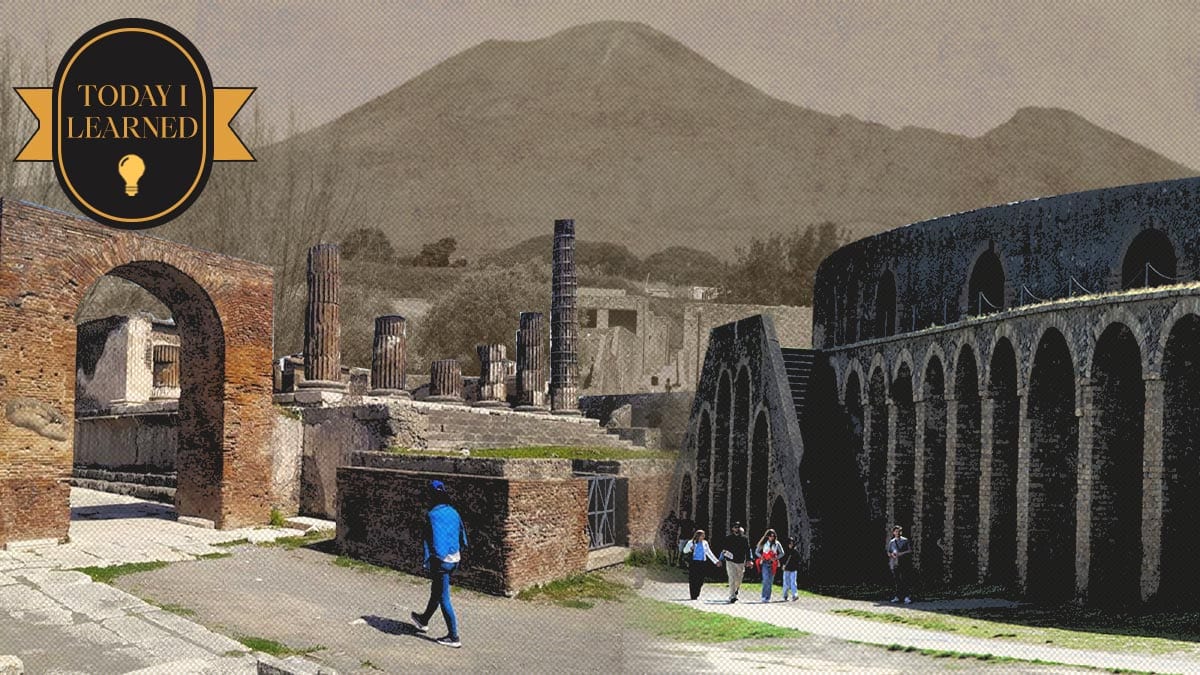
ILLUSTRATION: Igi Talao
So this is my first time to visit a brothel (no, really).
“Welcome to Pompeii’s Lupanare Grande, this ancient city’s biggest brothel,” says our Italian guide. “Here, Pompeiians partook of the world’s oldest profession. This has 10 rooms and as you can see, customers could even choose the ‘service’ they wanted.”
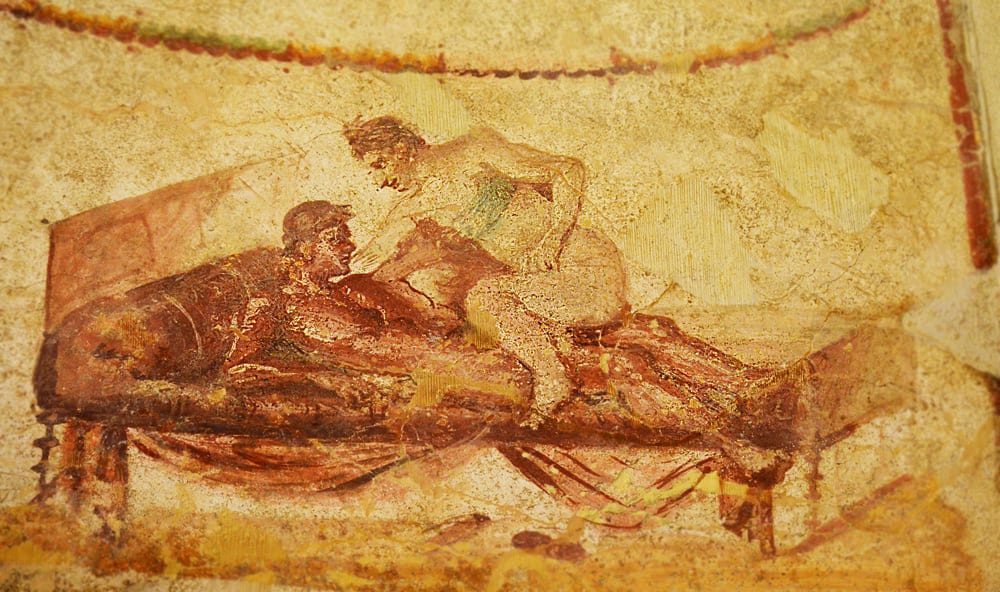
No kidding: above the small rooms are frescoes or small paintings of various sexual services, erotic art that’s nearly 2000 years old. There’s even graffiti etched onto the walls, ranging from "Sollemnis, you’re really good in bed" to "What’s up, Proclus, this is Sabinus"—a Roman Bromance etched in eternity.
The Lupanare Grande is one of the most popular attractions inside the legendary Roman city of Pompeii. Buried by a surprise volcanic eruption, its unusually quick demise would be both a bane and a blessing in preserving Roman culture.
One of the frescoes depicting the services once offered at the Lupanare Grande, Pompeii’s biggest brothel, where customers came’ . . . and then went. It’s one of the ancient city’s most popular tourist destinations.
ALSO READ:
A Tourist Returned Artifacts She Took From Pompeii's Ruins After Getting Cursed
What to Do in Verona, Italy, Hometown of Romeo and Juliet
It Was the Summer of 79
The summer of 79 AD was in full swing: though still recovering from a massive earthquake that flattened parts of the city 17 years ago, life and business in the seaside Roman city of Pompeii flowed on.
Strategically situated by the Bay of Naples, Pompeii was a prosperous ‘tourist destination’ free from war—brimming with lavish villas and resorts for the ancient world’s elite.
The city had a thriving wine and fishing industry, and its 15,000 or so residents spent their time and money catering to tourists while enjoying local performances, from theatrical plays and chariot races to the crowd favorite—gladiator fights to the death.
Once a prosperous Roman city of 15,000 people, Pompeii was buried in the two-day eruption of Mount Vesuvius, which still looms over the city today.
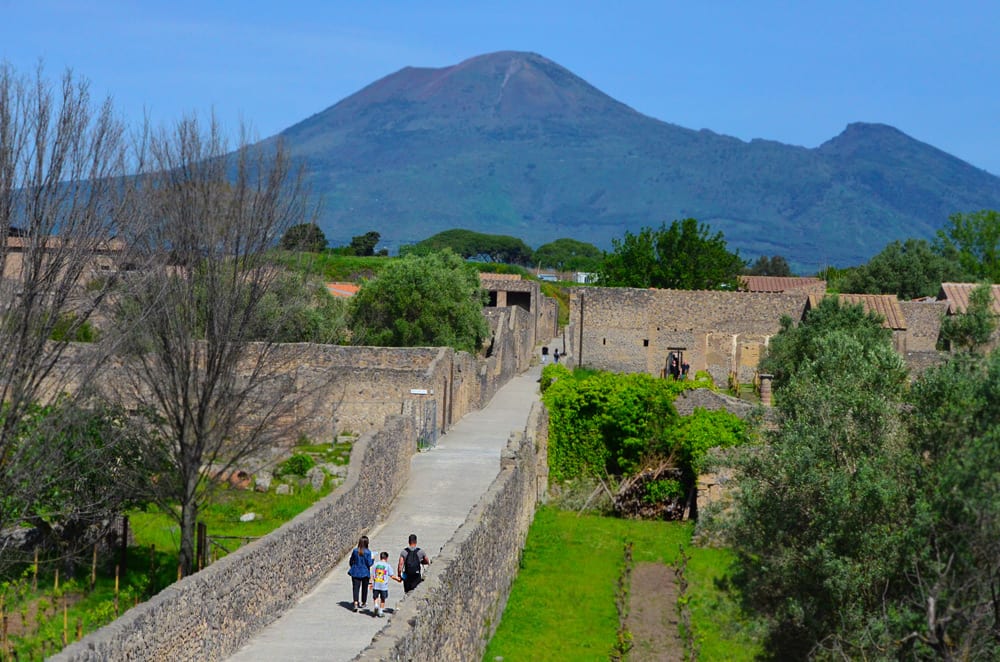
On a sunny Tuesday, August 24, 79 AD, Pompeii’s residents looked up at the rumbling summit of Mount Vesuvius, just eight kilometers away. An unusual plume of smoke was wafting up. A fire, perhaps? Certainly not a volcanic eruption, since the mountain had never been active, at least not in the 800-odd years since Rome became one of the ancient world’s superpowers. Few residents even suspected that the mountain was really a dormant volcano.
Suddenly, Mount Vesuvius unleashed hell.
With an explosion that would make the Old Gods shudder, a gargantuan cloud of smoke and ash surged a full 33 kilometers above the volcano, so immense it could be seen from the capital city of Rome, 220 kilometers away.
For two full days, Vesuvius unloaded her fiery bowels—completely burying the cities of Herculaneum, Oplontis, Stabiae, and, of course, Pompeii in up to 20 feet of ash. Thousands of people died instantly. The landscape was so utterly transformed that no trace of the old cities could be found. Even the sea was pushed a kilometer away.
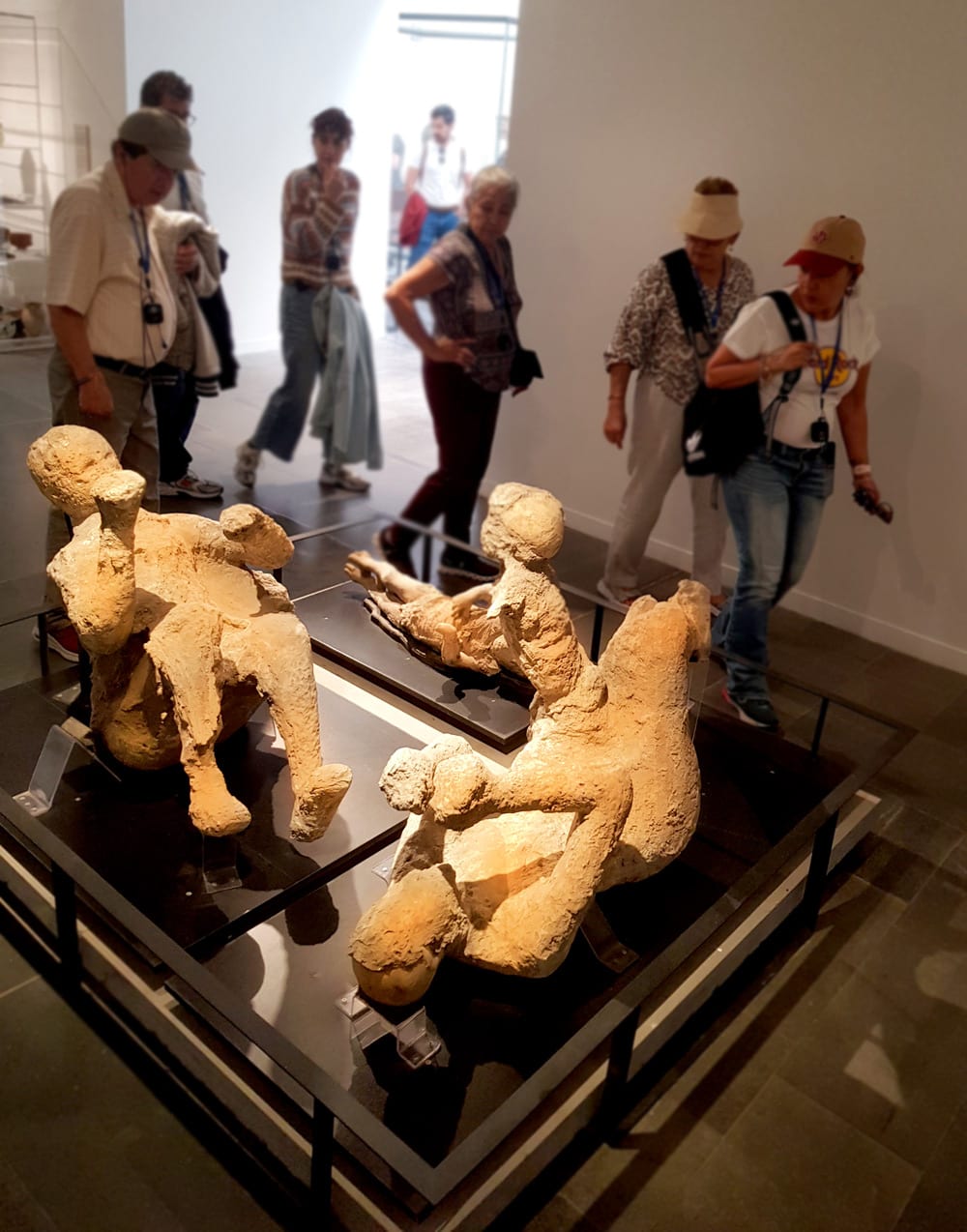
Around 2000 Pompeiians and 15,000 people from neighboring cities were buried by Vesuvius’ two-day eruption. These aren’t fossilized bodies, but concrete casts made by pouring plaster into the long-hollow cavities where people died. Dozens of these ancient characters are on display in Pompeii.
And so Pompeii slept, preserved from the ravages of time and people—until explorers started unearthing the city’s ruins in 1748, a labor that continues to this day.
Nearly 2000 years after its ‘demise’, Pompeii has become the greatest time capsule ever found, allowing modern people a glimpse into the lives of ancient people. And you know what? We’re not all that different.
Here are some similarities I discovered while exploring the ruins of Pompeii, a city that connects the past with the present.
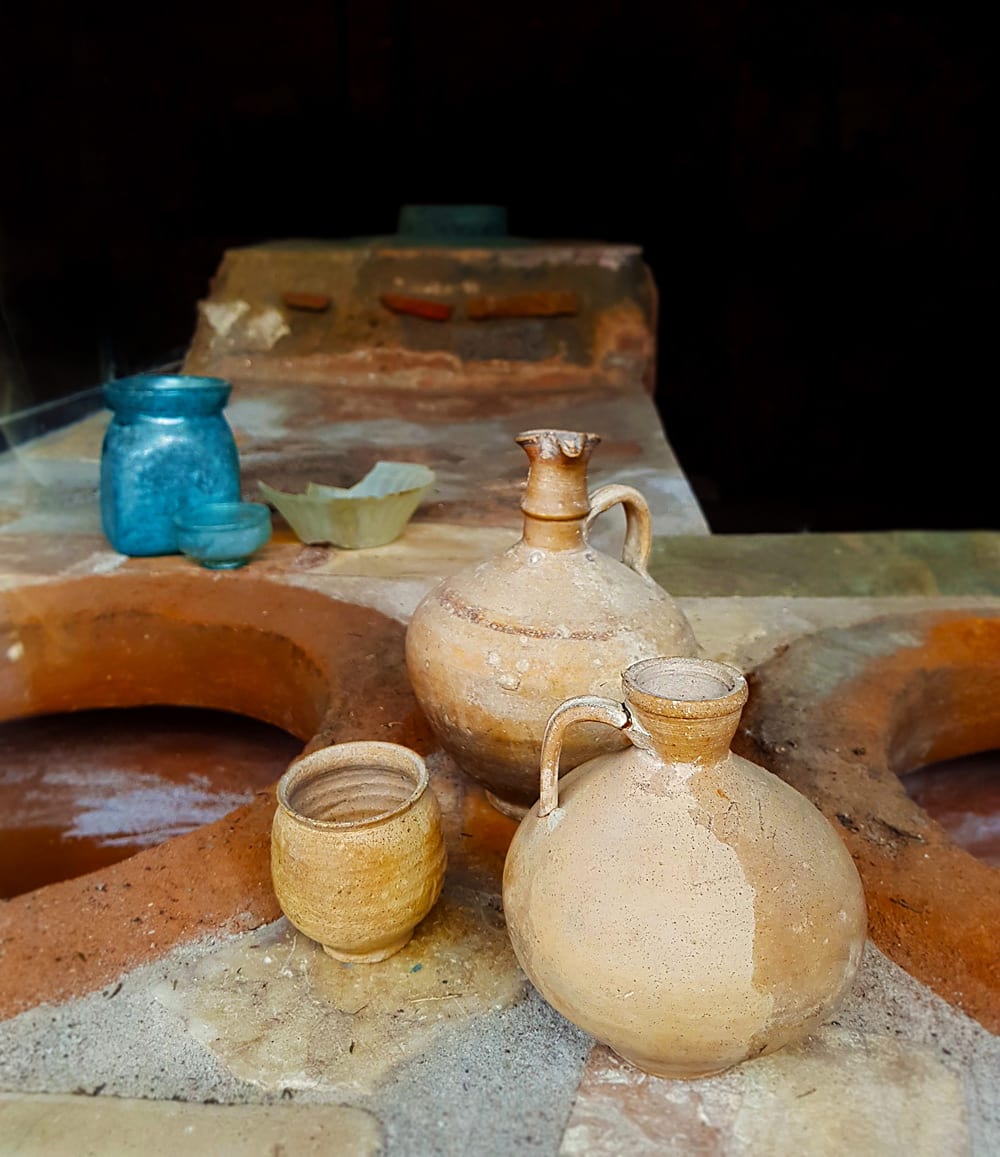
Most ancient Romans lived in crowded apartments called insulae. Like modern-day dormitories, there wasn’t much space to cook, so most people ate and grabbed take-out at fast-food shops called Thermopolia. I took this photo of dolia or earthen jars perfectly preserved atop a beautifully-decorated marble countertop, as impressive today as it was 2000 years ago.
Ancient Fast-Food Restos: Thermopolia
“This is a Thermopolium, an ancient fast-food store where customers would line up to choose their food,” says another guide. “Food is placed inside dolia (singular: dolium) or heated earthen jars, which are set on decorated counters. After choosing what you like, you’d pay with Roman coins and either grab a seat to eat, or have take-out.”
I look around the 2000-year-old eatery that has hosted more visitors after it was buried than when it was still operating. It’s in remarkably good shape: the walls are painted with frescoes of the different types of food you could order (sheep and fish stew were always popular, but small mice swimming in olive oil were a delicacy).
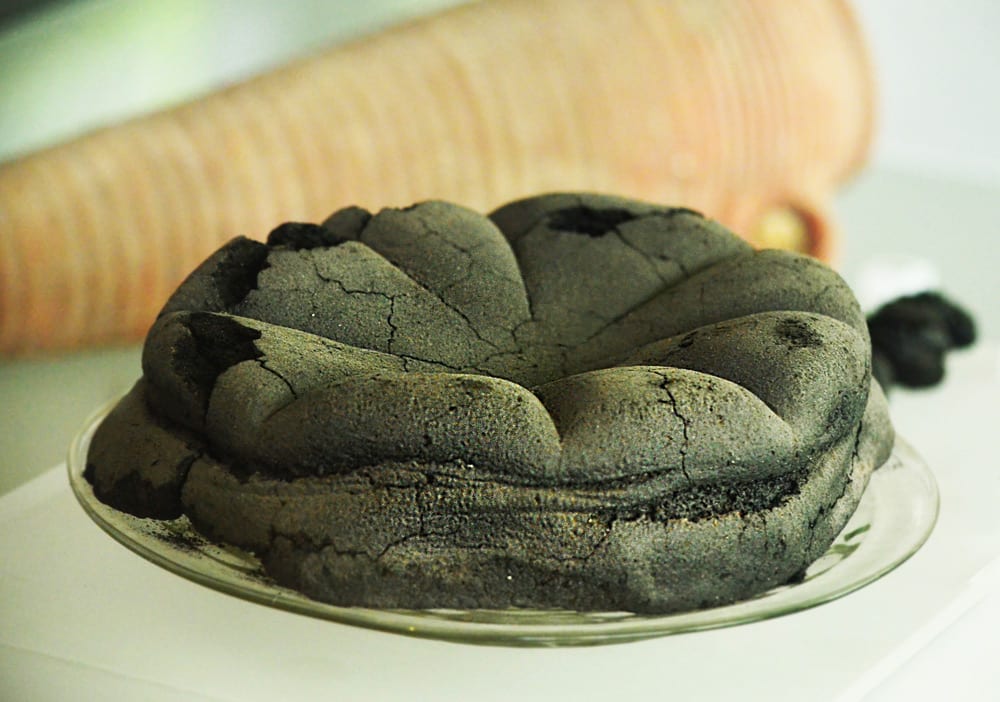
A loaf of bread, divided into eight slices, lies preserved in Pompeii, where it was found inside an earthen oven. Wheat bread was the lifeblood of the masses. Like many modern-day politicians, ancient Roman candidates tried to ‘buy’ votes by giving free loaves of bread to prospective voters. Old tricks never die.
The countertop is stylishly decorated with polished marble (the owner had great taste and a deep budget, as the colorful marble slabs were imported from all over the empire). Even the shop owner’s name—Lucius Vetutius Placidus—can still be seen painted on the walls.
What really blew my mind was how loaves of bread (baked once by man and again by Vesuvius) have been perfectly preserved, now encased not in ash, but in glass. The carinderias of yesteryear, Thermopolia fed people like us—the working masses—while wealthier, hoity-toity Romans would try to avoid being seen eating in one (so jologs naman, those Thermopolia).
Ancient MMA Rings: Gladiator Amphitheaters
Though Pompeii features sprawling markets, vineyards, and apartment buildings, no Roman adventure would be complete without paying homage to the Schola Armaturarum, the city’s gladiator academy, plus the amphitheater where they fought and died for coin and glory.
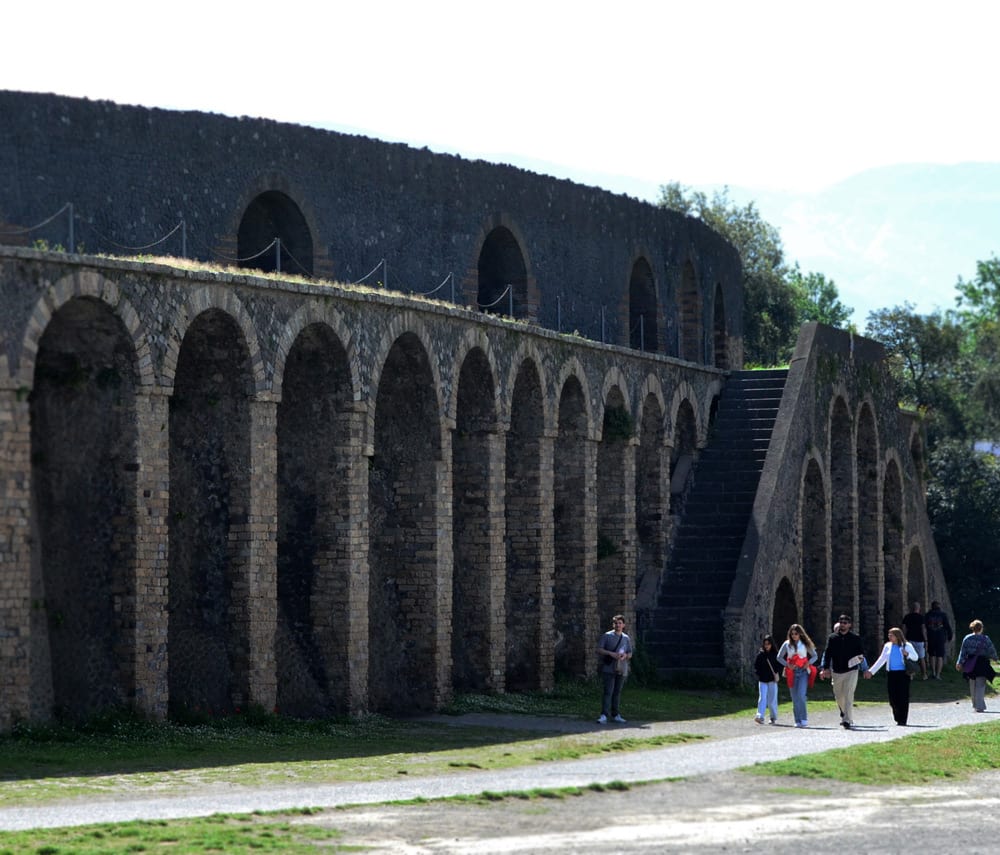
“This amphitheater can accommodate up to 20,000 people—more than the entire population of Pompeii itself,” gestures another guide. At 135 meters long and 104 meters wide, it is larger than 30 NBA basketball courts combined. An immense cloth awning called a velarium once shaded both spectators and gladiators—the best of which hoped to rise to the big leagues, someday fighting in the famous, supersized Colosseum of Rome itself.
Pompeii hosts the oldest known Roman amphitheater, built almost a century before the giant Colosseum in Rome itself. It has a seating capacity of 20,000 – meaning that even 2000 years ago, it could host more people than Araneta Coliseum. Today, performers stage concerts in it – with 15 scheduled in 2025 alone.
While most gladiators lived short and brutal lives, the best could win a wooden sword called a rudis, which signified their freedom. Top fighters (such as Pompeii’s local homeboy champ, Celadus the Thracian, whom local girls had a giant crush on) won fame, women, and fortune—even selling tiny ‘action figures’ of themselves to swooning fans, as modern boxers, wrestlers, and MMA fighters still do today.
Ancient Graffiti: Bawal Umihi Dito
Exploring not just Pompeii, but other cities like Napoli and even Rome itself, I was surprised at how much graffiti was painted onto the walls. Though now taking the form of spray-painted punk art, street graffiti was practically invented by the Romans, the word itself meaning ‘to scratch words onto walls.’
Painted or etched, ancient Roman graffiti ranged from sweet messages to election propaganda. Here are some standouts:
For those who don’t believe in Venus (Goddess of Love), just look at my girlfriend (smooth, Bro).
All of us apple sellers support Marcus Holconius Priscus for Mayor. He is truly a man of justice (ancient political party list hogwash).
“Anyone who wants to piss or take a shit here should move on. If you ignore this warning, you shall pay a fine. Children shall be fined in silver coins, while slaves will be smacked hard on their butts.” (an ancient Bawal Umihi Dito sign).
* * *
No longer just confined to history books or television, the culture of ancient Rome can be seen and touched in Pompeii, a living window to the past.
Seeing what life was like 2000 years ago gave me a stunning revelation: that people have always been people.
Just as today, we still work our butts off, eat quick meals at a carinderia or an affordable fast-food joint, temporarily forget the drudgery of our lives by watching sports or drama, roll our eyes at election propaganda, try to avoid war, tag our friends on walls (now we have social media walls) and live, love, shit, and die as humans have done for thousands of years.
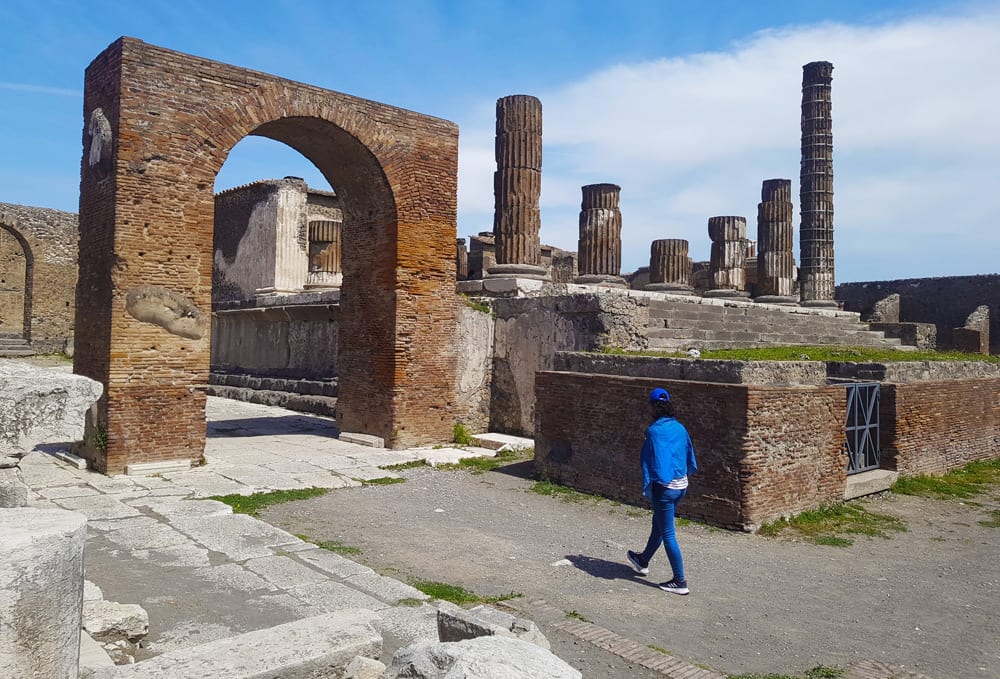
The heart of the old city, the Forum was a huge open space surrounded by markets, temples, and other important buildings. This arch is still standing, 2000 years after it was built.
Visiting Pompeii not only gave me a glimpse of the past but also allowed me to situate our era amidst a much longer and comprehensive human timeline. This is the way it has always been, and this is how it will be for millennia to come. Let us not feel so special—for we too, shall pass on.
This life-changing revelation unlocked, I take a final look at Mount Vesuvius—a volcano that at first obliterated, but eventually saved the culture of ancient Rome to show us how little we’ve changed all along.
Vale Gratias, Mons Vesuvius. Farewell and thank you, Old Vesuvius.
