
2025 Midterm Elections: Vote-Rich Provinces and Cities in the Philippines

Every three years, registered voters in the Philippines get the chance to elect people to office, with the hopes that this could make our nation better. The president, vice president, and senators are elected for a six-year term, while members of the House of Representatives, governors, vice governors, provincial board members, mayors, vice mayors, city/municipal councilors, barangay officials, and youth councilors are elected for a three-year term.
On May 12, 2025, the Philippines will have its midterm elections, where elected leaders are midway through the administration of President Bongbong Marcos. This is happening in the wake of Duterte's recent detention at the International Criminal Court, continued territorial dispute in the West Philippine Sea, POGO ban, probe into confidential funds, and several other socio-economic issues that elected lawmakers will soon face and, ideally, resolve.
ALSO READ:
Why Filipino Voters End Up Choosing the Wrong Leaders
Why Voters Stick to Their Choice—Even If They're Wrong
On May 12, 2025, up to 68,431,965 voters will have a hand in the future of the Philippines. Here are some statistics that may shape the upcoming elections.
Vote-Rich Regions in the Philippines
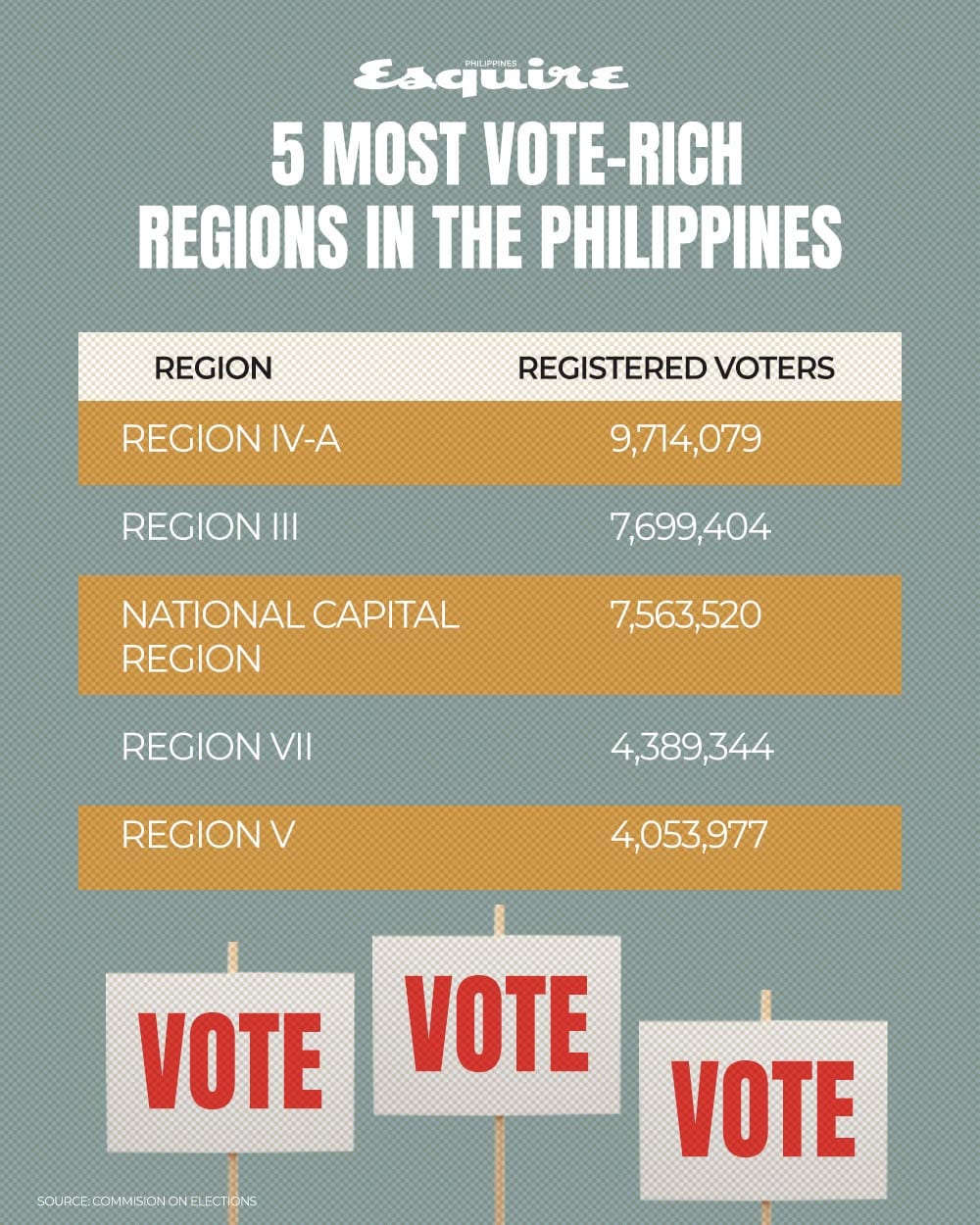
According to the Commission on Elections (COMELEC), Region IV-A (or CALABARZON) has the largest number of registered voters (9,714,079) among the 17 administrative regions in the Philippines. It is also the most populous region in the country, comprising five provinces: Cavite, Laguna, Batangas, Rizal, and Quezon; and one highly urbanized city, Lucena. This is followed by Region III (Central Luzon), with 7,699,404 voters; the National Capital Region (Metro Manila), with 7,563,520 voters; Region VII (Central Visayas), with 4,389,344; and Region V (Bicol), with 4,053,977.
Vote-Rich Provinces in the Philippines
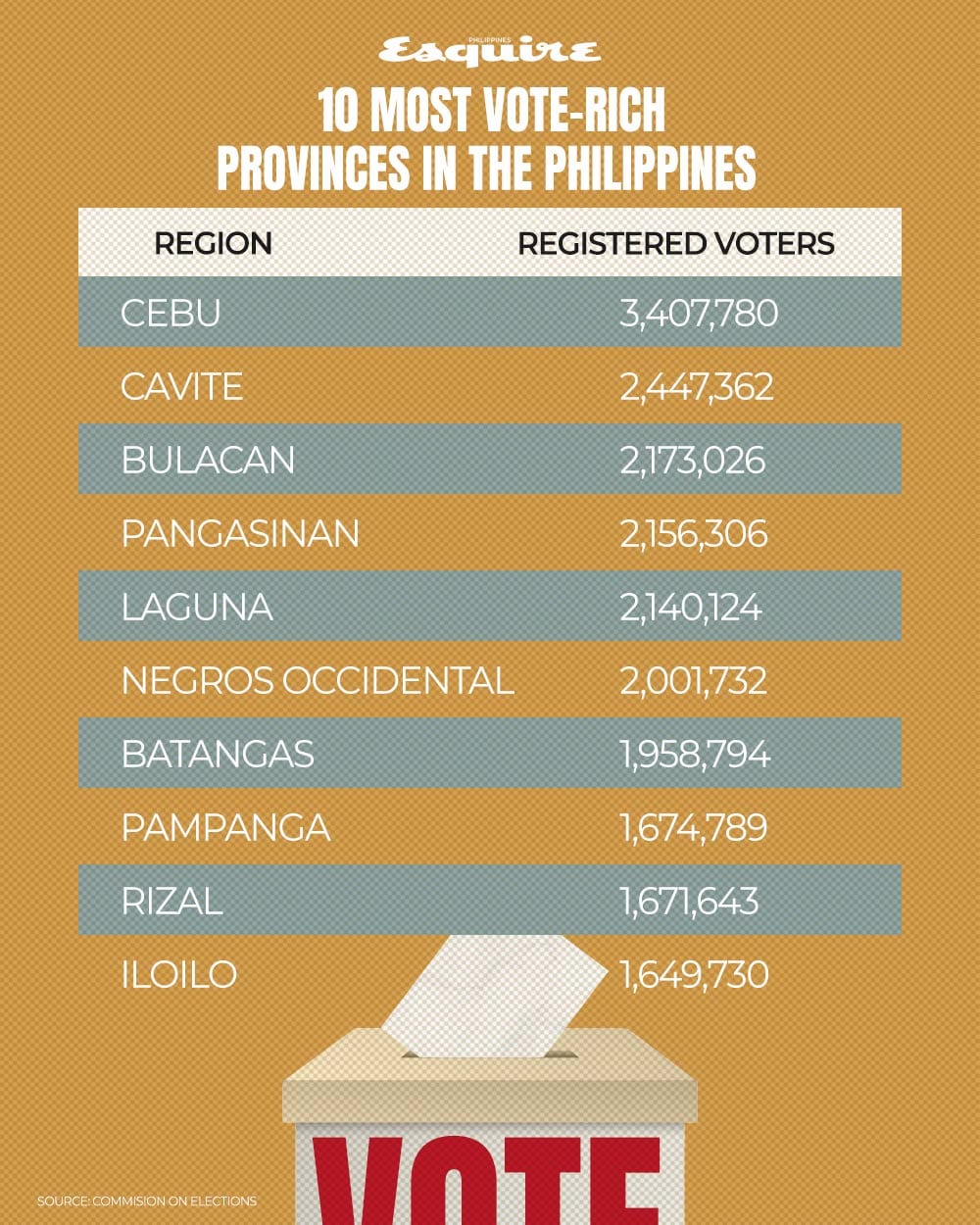
Among the provinces, 18 have more than one million registered voters, with Cebu Province in Central Visayas having the most number of voters at 3,407,780. Cebu also has the most combined cities and municipalities of any province in the Philippines, with 53 in total. Cebu City, its capital, is the sixth-most populated city in the Philippines, according to the 2020 census.
Cebu Province is followed by Cavite (2,447,362) in Calabarzon, Bulacan (2,173,026) in Central Luzon, Pangasinan (2,156,306) in the Ilocos Region, Laguna (2,140,124) also in Calabarzon, and Negros Occidental (2,001,732). Negros Occidental (capital: Bacolod) is the most populated province in Negros Island Region, and the second most-populous province in the Visayas after Cebu. It also has the largest number of chartered cities among all the provinces in the Philippines.
Other Philippine provinces with more than one million registered voters are Batangas, Pampanga, Rizal, Iloilo, Nueva Ecija, Quezon, Davao del Sur, Leyte, Camarines Sur, Zamboanga del Sur, Isabela, and Misamis Oriental.
Vote-Rich Cities in the National Capital Region
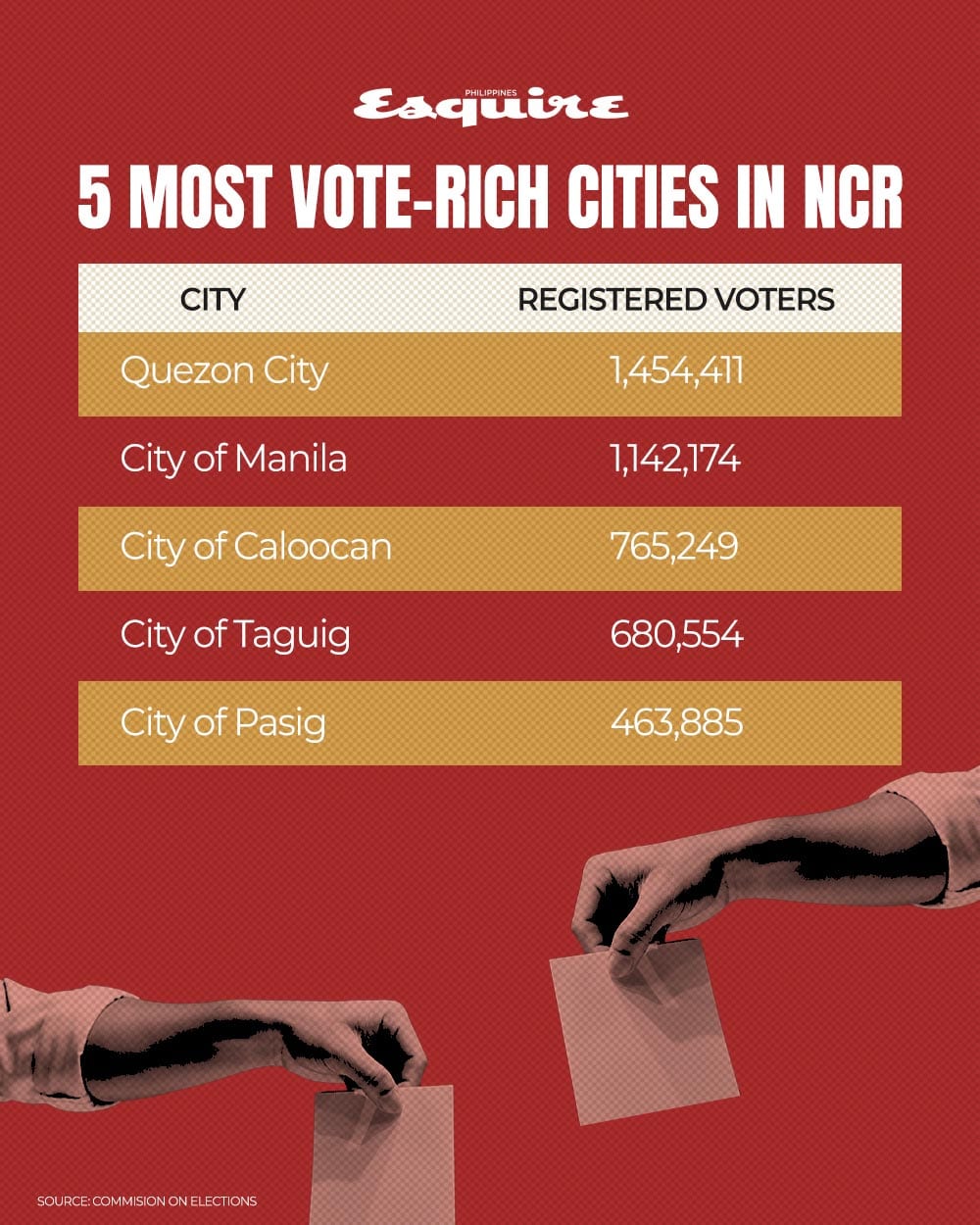
Quezon City has the most registered voters in Metro Manila, with 1,454,411. Trailing behind is the City of Manila, which has likewise exceeded the one-million mark with 1,142,174 voters. Quezon City and Manila are also the most populous cities in the Philippines.
Pateros, the lone municipality of Metro Manila, has the least number of voters in the region, with 37,830.
Other Data on the Number of Registered Voters in the Philippines
A 2023 research titled "Factors Influencing Voting Decision: A Comprehensive Literature Review," published in Social Sciences, identified the various factors that affect the voting decisions of a population. At an individual level, factors include income, education, gender, age, political ideology, personality traits, emotional intelligence, climate change concerns, and healthcare experiences. Socio-cultural factors also play a crucial role in shaping an individual's voting decisions: social identity, ethnicity and race, religion, media influence, and social networks. Political factors are also critical: party identification, candidate characteristics, policy positions, campaign strategies, and economic conditions.
Among these factors, data on gender and age are readily available from the Commission on Elections.
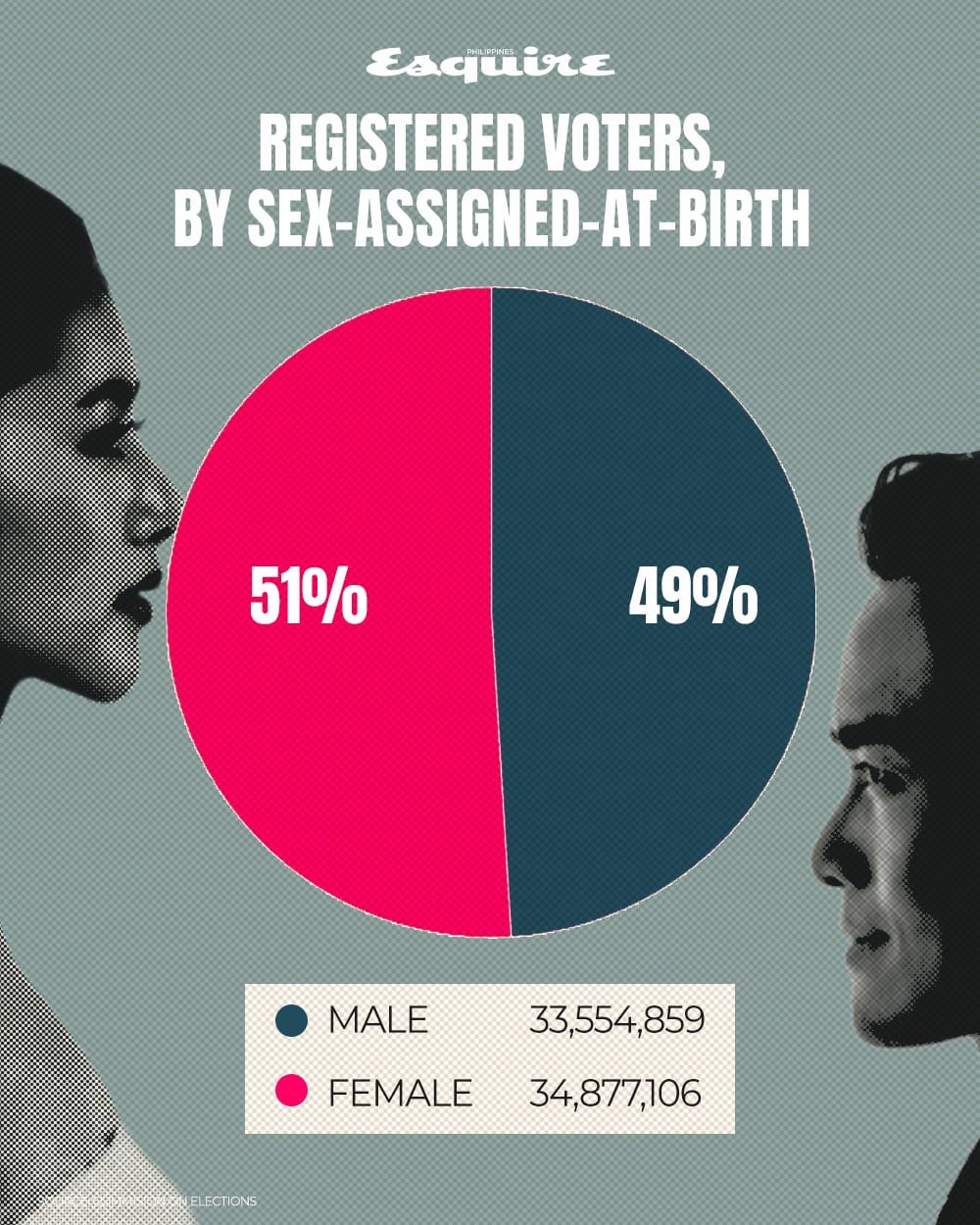
Of the 68,431,965 voters in the Philippines, 34,877,106 are assigned-female-at-birth, while 33,554,859 are assigned-male-at-birth, putting the percentage at 51% and 49% respectively.
The mentioned research by Kuwachai et al said that related literature found that women tend to be more likely to support left-leaning parties or candidates compared to men, and this can be attributed to the fact that women often prioritize issues such as healthcare, education, social welfare, and gender equality, which are commonly associated with progressive policies. Men, according to the study, are more likely to support conservative or right-leaning parties, which often prioritize national security, economic growth, and traditional values.
Research has also consistently shown a relationship between age and political preferences. Previous studies claim that younger voters, from 18 to early 30s, tend to support more progressive or left-leaning parties and candidates. This is because issues of concern among younger voters are climate change and social justice, which often align with progressive policies and platforms. The age group is also more open to social change.
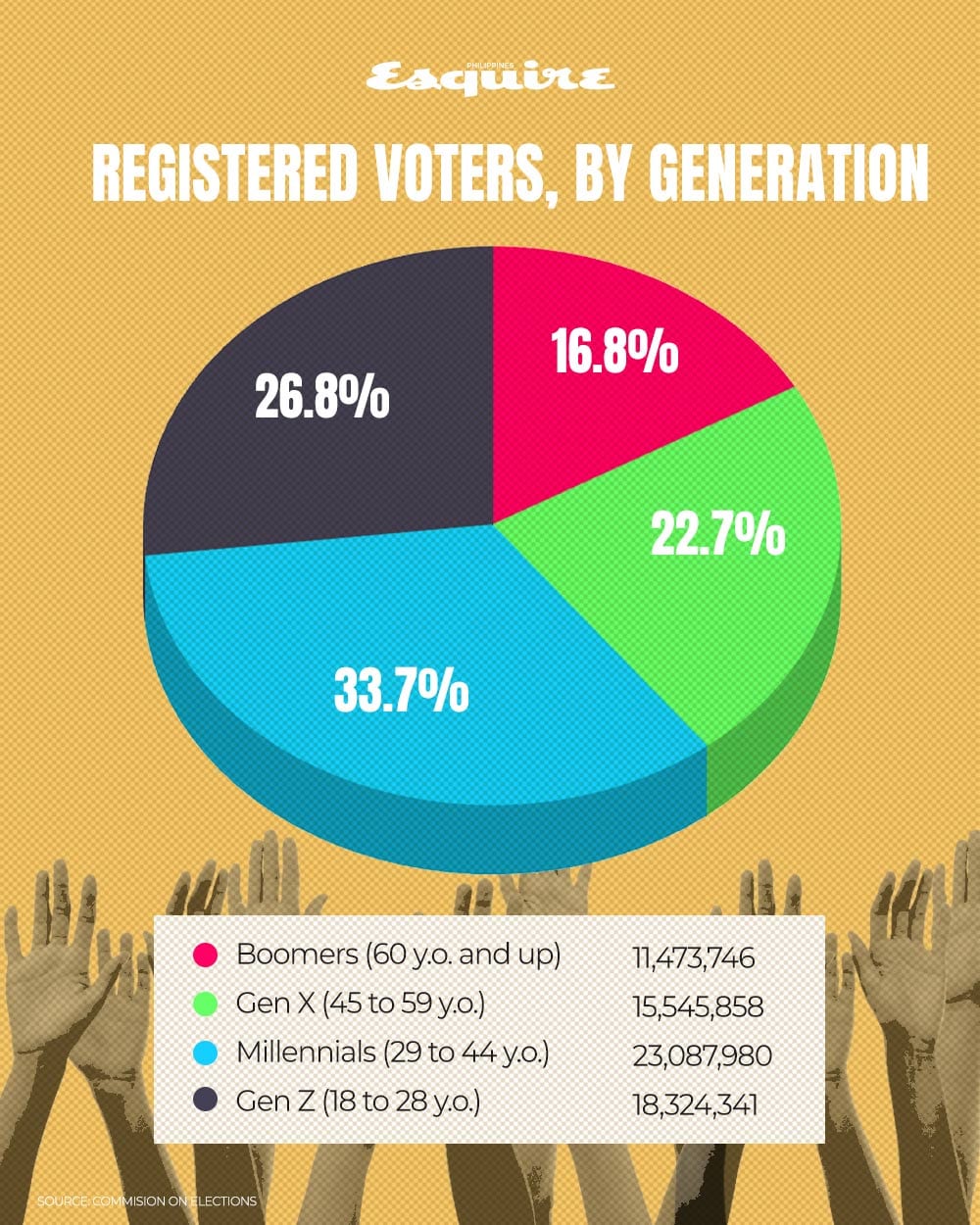
In the Philippines, the voting demographics, based on age, are as follows:
- 18 years old: 1,201,634
- 19 years old: 1,466,826
- 20 years old: 1,585,615
- 21 years old: 1,770,629
- 22 years old: 1,796,634
- 23 years old: 1,755,892
- 24 years old: 1,845,022
- 25 years old: 1,822,504
- 26 years old: 1,672,802
- 27 years old: 1,736,584
- 28 years old: 1,670,239
- 29 years old: 1,653,541
- 30 years old: 1,671,748
- 31 years old: 1,671,397
- 32 years old: 1,630,968
- 33 years old: 1,587,408
- 34 years old: 1,568,588
- 35 years old: 1,489,108
- 36 years old: 1,437,666
- 37 years old: 1,428,253
- 38 years old: 1,355,948
- 39 years old: 1,285,575
- 40 years old: 1,285,754
- 41 years old: 1,269,236
- 42 years old: 1,277,387
- 43 years old: 1,237,720
- 44 years old: 1,237,683
- 45 years old: 1,256,375
- 46 years old: 1,204,259
- 47 years old: 1,149,647
- 48 years old: 1,113,403
- 49 years old: 1,086,282
- 50 years old: 1,047,641
- 51 years old: 1,018,399
- 52 years old: 1,046,040
- 53 years old: 993,969
- 54 years old: 996,799
- 55 years old: 1,033,892
- 56 years old: 975,208
- 57 years old: 906,862
- 58 years old: 869,337
- 59 years old: 847,745
- 60 years old and above: 11,473,746
Voting in the 2025 Midterm Elections
The midterm elections in the Philippines on May 12, 2025, Monday, is a special non-working holiday. Polling places are open from 7 a.m. to 7 p.m. To find out where you're supposed to vote, the COMELEC has created an online platform called Precinct Finder. All you have to do is enter your first name, middle name, last name, and place of registration.
On the day of the elections, approach the Electoral Board at your polling place and give them your details. Make sure that they give you a blank ballot, a secrecy folder, and a marking pen.
Voters are supposed to choose candidates for the following positions (with the governor and mayor positions dependent on whether you're in the jurisdiction of any province or in highly urbanized and independent component cities):
- 12 senators
- 1 party-list group
- 1 congressman or congresswoman
- 1 provincial governor
- 1 provincial vice governor
- Sangguniang Panlalawigan
- 1 mayor
- 1 vice mayor
- Sangguniang Panlungsod o Bayan
Fully shade the circles next to the candidate you're voting for. Avoid overvoting. Undervoting or abstaining, however, is fine.
After you've completed your ballot, feed the paper into the ACM. Make sure to double-check the names on the printed receipt before dropping it into the box.
Return the folder and marker, then an election inspector will mark your fingernail with an indelible ink.
Data from the Commission on Elections
